




















































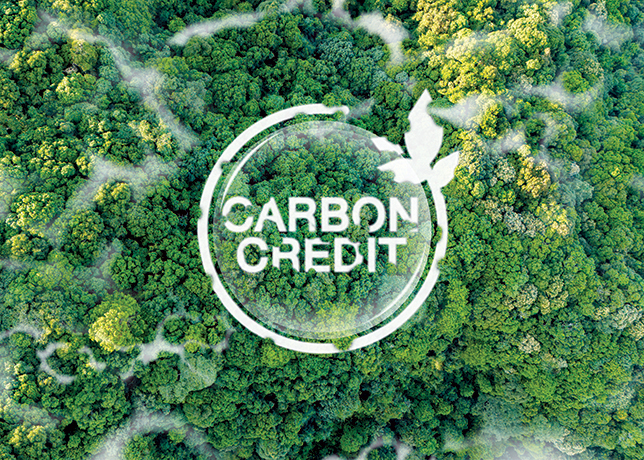
A comprehensive analysis reveals less than 16 per cent of credits deliver genuine emission reductions, as the $2.1-billion voluntary carbon market plummeted by 60 per cent between 2022-2024
A quarter-century of carbon offsetting has failed to deliver meaningful reductions in global greenhouse gas emissions, according to a comprehensive review of scientific evidence to date.
The systematic analysis, published in the Annual Review of Environment and Resources in 2025, examined over 970 million tonnes of carbon credits.
Representing nearly 20 per cent of all credits issued globally, it concluded that fundamental structural flaws render most offset programmes ineffective at scale.
According to the study co-authors, Joseph Romm of the University of Pennsylvania, Stephen Lezak of the University of Oxford, and Amna Alshamsi of the University of Sussex: 'A growing number of studies have found that the most widely used offset programs continue to greatly overestimate their probable climate impact often by a factor of five to ten or more.'
The research synthesises two decades of peer-reviewed literature and found that approximately 812 million of the 972 million tonnes analysed are unlikely to represent genuine emissions reductions.
MARKET COLLAPSE & QUALITY CRISIS
The voluntary carbon market, which reached $2.1 billion in transactions in 2021, contracted to $723 million by 2023, a decline exceeding 60 per cent.
Major corporate buyers including United Airlines, Delta Air Lines, Nestlé, Gucci, and EasyJet have reduced or eliminated offset purchases following mounting evidence of quality failures.
Over 5.2 gigatonnes (Gt) of credits have been issued since carbon offsetting began in 1989, with the Clean Development Mechanism and Joint Implementation programme accounting for 3.3 Gt, equal to 63 per cent of total issuance.
The Verified Carbon Standard, Climate Action Reserve, Gold Standard, and American Carbon Registry issued the remaining 1.9 Gt.
Despite this substantial market volume, atmospheric carbon dioxide concentrations reached 424 parts per million in 2024, according to the World Meteorological Organisation—a record high that underscores the limited climate impact of offsetting to date.
Research published in Nature Communications in 2024 found that fewer than one in six credits studied represented actual emissions reductions.
Analysis by The Guardian and carbon market researchers indicates that market failures stem from four intractable problems: ‘non-additionality’, impermanence, leakage, and double-counting.
Non-additionality occurs when credits are issued for projects that would have proceeded without offset financing.
The review found that 85 per cent of Clean Development Mechanism projects had 'a low likelihood of ensuring environmental integrity', whilst only 2 per cent demonstrated high likelihood of additionality.
FORESTRY & NATURE-BASED SOLUTIONS UNDER SCRUTINY
Forest-based credits account for approximately 40 per cent of the voluntary carbon market but face severe permanence and leakage challenges.
REDD+ projects, which represent a quarter of voluntary market credits and aim to prevent deforestation, demonstrate over-crediting ratios of 1:13. This means every genuine credit accompanies 12 without real climate benefit.
Leakage estimates for forest conservation projects typically exceed 70 per cent and can surpass 100 per cent, yet project methodologies often assume rates of only 6 per cent or claim no leakage whatsoever.
Cookstove projects, representing over 15 per cent of voluntary market projects, exhibit ninefold over-crediting according to 2024 research.
A 2021 review of 174 tree-planting organisations found only 18 per cent mentioned post-planting monitoring, with merely eight organisations discussing survival rates.
COMPLIANCE MARKETS & INTERNATIONAL FRAMEWORKS
COP29 in November 2024 advanced Article 6 of the Paris Agreement, creating pathways for international carbon credit trading through bilateral arrangements and a successor mechanism to the Clean Development Mechanism.
However, the agreement failed to address fundamental quality problems, retaining problematic features including minimal enforcement mechanisms and allowing hundreds of millions of questionable CDM credits to transfer into the new system.
The Paris framework introduces 'corresponding adjustments' to prevent double-counting, requiring seller nations to add back emissions reductions to their national inventories when credits are internationally transferred.
This mechanism theoretically prevents both buyer and seller from claiming the same reduction, though implementation complexities remain.
The World Bank analysis suggests corresponding adjustments could price authorised offsets between $31 and $155 per tonne CO2e, substantially higher than current voluntary market rates of $7-22 per tonne.
INDUSTRY RESPONSE & REFORM EFFORTS
The Integrity Council for the Voluntary Carbon Market (VCM) launched Core Carbon Principles in 2024, establishing minimum standards for quality, transparency, and permanence.
Major registries including Verra and Gold Standard have updated methodologies, with Verra requiring verified real-time monitoring data and climate risk accounting, and Gold Standard emphasising direct emissions reductions overcompensation.
Technology-based carbon dioxide removal methods, including direct air capture (DAC) and biochar, offer greater permanence and quantification certainty but currently cost up to $600 per tonne.
BloombergNEF analysts project a reformed voluntary market could reach $30-35 billion annually by 2030-2035, driven by verified carbon removals and compliance-linked credits.
The research recommends urgently phasing out non-removal offsets by 2035, focusing exclusively on high-integrity durable carbon dioxide removal and storage.
BY Abdulaziz Khattak