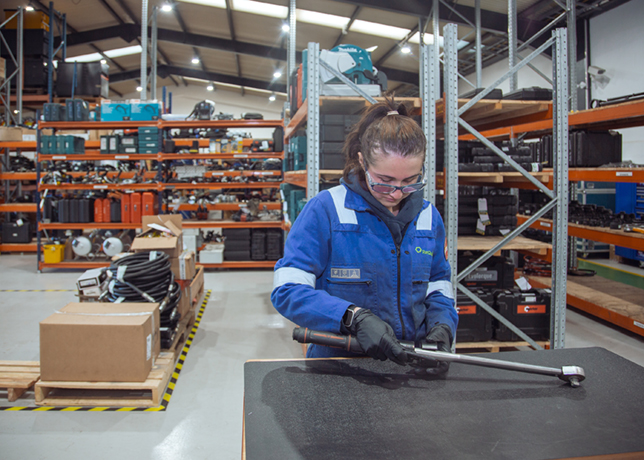




































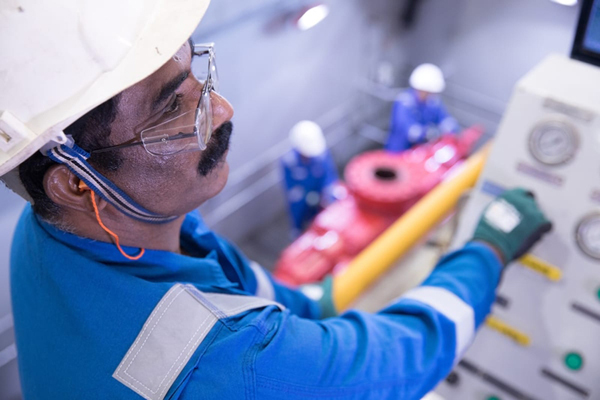
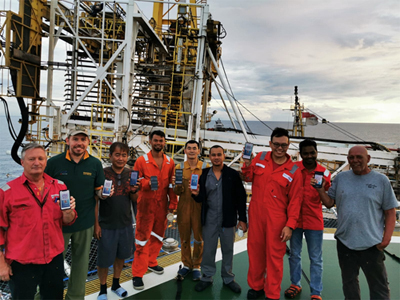





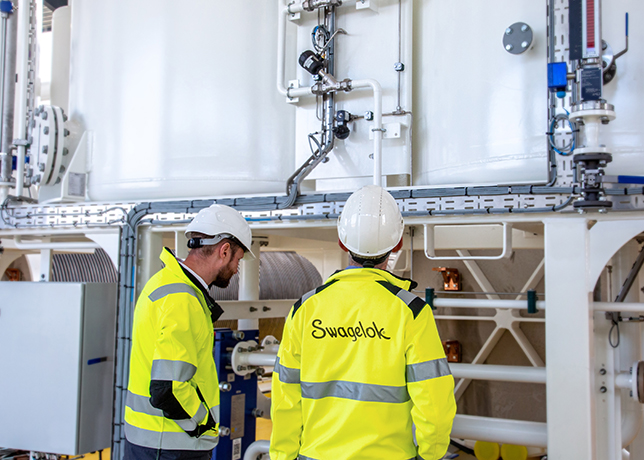
 Swagelok engineers at Clean Energy customer site
With a complete suite of products and services for hydrogen applications, Swagelok helps build solutions more quickly, easily, and reliably Hydrogen is one of the world’s most promising sources of clean and sustainable energy and power. From transportation and material handling to stationary, portable, and emergency backup power, it’s useful in a range of applications, and industries everywhere are taking notice.
But for hydrogen to truly meet its full potential, the critical fluid systems that handle, transport, store, and dispense the gas must be as safe and reliable as possible.
And importantly, traditional industry knowledge and design acumen, typically stemming from the oil and gas industry, don’t always directly translate for hydrogen applications.
Why? Hydrogen is simply much different than typical oil and gas media, and as such, requires different design strategies for reliable infrastructure.
 |
Hydrogen systems must be designed with specific use challenges in mind |
With this in mind, here are Swagelok’s top five system design considerations for hydrogen infrastructure applications:
• Consider the end user: Aside from the gas pump, most industrial oil and gas systems exist out of sight for the everyday consumer. And they’re typically handled by professionals.
But the potential for hydrogen as a clean energy source brings hydrogen systems directly into the hands of everyday people.
Consider transportation; a hydrogen fuel cell vehicle will be refuelled at a hydrogen station where the user will transport a high-pressure gas into their vehicle through a convenient dispenser.
To mitigate safety concerns, hydrogen infrastructure must be designed with specific use challenges in mind.
• Minimise potential leak points: One of those challenges is the potential for leaks, and it’s why it’s important to minimise the number of potential leak points throughout your system.
Hydrogen molecules are extremely small and can escape through even the tiniest crevice in a fluid system.
Comparatively, it’s very hard for a large molecule—crude oil, for example—to move through those same gaps.
This means that traditional oil and gas system design generally isn’t up to the task of leak-tight hydrogen containment.
Seals, materials, and the typical ways in which pipes and tubing are connected in the oil and gas space aren’t capable of safe hydrogen containment.
Reducing leak points in hydrogen infrastructure means minimising the number of individual connections throughout the system and utilising proper tube-bending techniques in strategic locations rather than incorporating another fitting. Your supplier may be able to assist you with design training opportunities.
• Utilise high-quality stainless steel: Because hydrogen molecules are so small, they can also contribute to a unique form of corrosion known as hydrogen embrittlement, a phenomenon that reduces a metal’s ductility and resistance to fracture and fatigue.
These issues can lead to system failure, resulting in safety risks, increased downtime, and financial loss.
But selecting the right material can prevent hydrogen embrittlement. Generally, a well-designed hydrogen system should be made from high-quality 316 stainless steel tubing materials, which have demonstrated good performance over lengthy service life.
Selecting the right material can prevent hydrogen embrittlement. Specifically, stainless steels containing elevated levels of nickel can deliver optimal performance in hydrogen systems.
The American Society for Testing and Materials (ASTM) requires a minimum of 10 per cent nickel in 316 stainless steel formulations, but 316 stainless steel with a minimum of 12 per cent nickel is better for the unique challenges posed by hydrogen.
Nickel content helps stabilise the microstructure of stainless steel, enabling it to be more resistant to hydrogen embrittlement.
• Optimise tube fittings: Components that have been well established in oil and gas applications may not be the best option for hydrogen applications.
For example, traditional cone and thread fittings have been widely used in oil and gas systems. But they can be more prone to leaking in a system meant for hydrogen containment.
In fact, the cone and thread design dates back to the late 1800s. And there are far more modern, higher-performing options available today.
Cone and thread fittings can be more prone to leaking in a system meant for hydrogen containment.
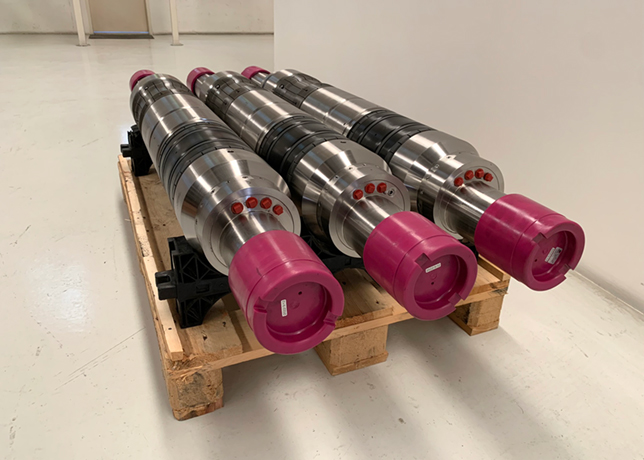
For example, Swagelok’s FK series fittings are engineered specifically for use in hydrogen applications.
They maintain ideal pressure ratings of up to 1,050 bar, have been used in a wide variety of industries and applications since their introduction, and remain an optimal choice for hydrogen vehicles, hydrogen infrastructure, and more.
Available in high-quality stainless steel material options, they are an ideal design choice.
• Consult with the experts: Hydrogen is a new frontier for clean energy. Infrastructure developers, vehicle OEMs, and others are working together in real time to deliver reliable solutions that will propel the industry forward.
The answers don’t always come easy. When in doubt, it can be helpful to work with a supplier that can offer hydrogen-specific knowledge, design expertise, and product recommendations based on the needs of the application.
And this is why Swagelok has dedicated itself to the clean energy space. The company not only provides critical fluid system components, such as fittings designed specifically for hydrogen containment, but also materials science expertise and expert engineering assistance.
With a complete suite of products and services for hydrogen applications, Swagelok can help customers build solutions more quickly, easily, and reliably.