































Saudi Arabia, the UAE and regional neighbours explore low-temperature geothermal potential for cooling, desalination and baseload power, as clean energy transition accelerates
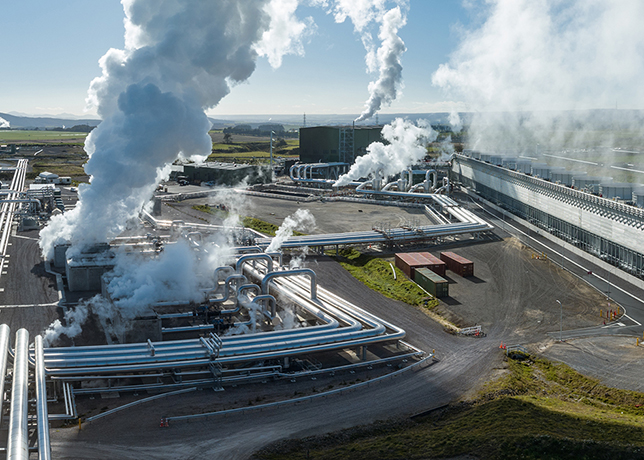
The Gulf Cooperation Council nations stand atop a largely unexplored energy resource that could fundamentally reshape their approach to electricity generation, water desalination and cooling, and that is geothermal heat stored deep beneath the desert sands.
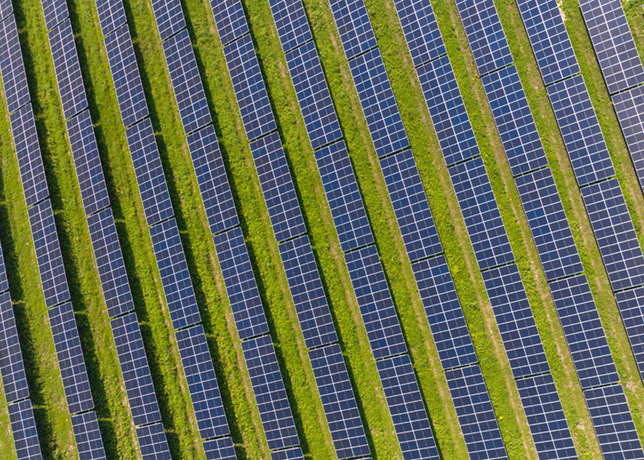
While the region has invested heavily in solar photovoltaic installations, recent geological surveys and pilot projects reveal that underground thermal resources may provide the consistent, dispatchable power that intermittent renewables cannot deliver alone.
A 2024 King Abdullah Petroleum Studies and Research Center (KAPSARC) discussion paper suggested that the western region of Saudi Arabia exhibits prominent geological characteristics suggesting substantial geothermal resources.
These resources are characterised predominantly by low-to-medium temperature gradients, except for Jizan and Wadi Al-Lith, where temperature gradients appear appreciably higher.
The Harrat volcanic field comprises over 2,500 dormant volcanoes and craters and a few hot springs. The surface water temperatures recorded in some of these hot springs, on average, are below 80 deg C, with seasonally varying flow rates.
Reservoir temperatures ranging from 100 deg C to 150 deg C may also be found in deep sedimentary basins near the coasts of the Arabian Gulf and the Red Sea.
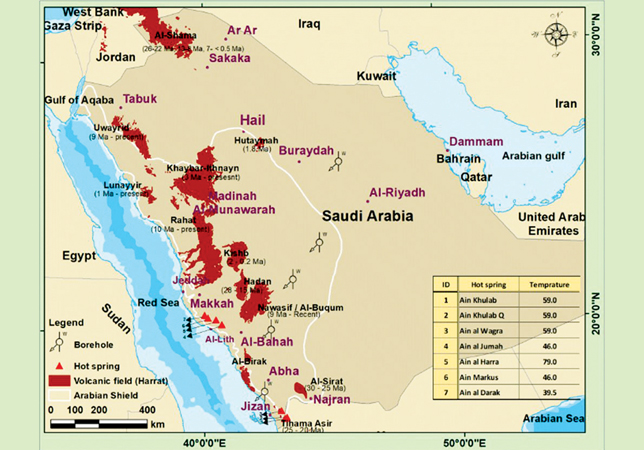 |
Major geothermal spots in Saudi Arabia (Source: Lashin et al, 2020) |
These basins present significant potential for exploiting geothermal energy for large-scale water desalination plants.
According to Project InnerSpace’s GeoMap Middle East tool, the initial findings identify urban cooling applications with Gulf States cooling accounting for about 70 per cent of peak electricity demand.
GeoMap shows a potential of approximately 14,000 gigawatts (GW) of cooling with Iran, Egypt, Iraq, and Turkey indicating major opportunities, and Saudi Arabia, UAE, and Qatar following.
The Red Sea Rift (western Saudi Arabia/northern Yemen) holds potential for gigawatt-scale power production and desalination; eastern Turkey and northern Iran also have strong power potential.
Oman presents another promising frontier. The potential for low-enthalpy geothermal energy in Oman appears to be significant, according to research presented by RG Thermal Energy Solutions.
TEMPERATURE CLASSIFICATIONS & APPLICATIONS
Geothermal resources divide into distinct categories based on reservoir temperatures. Medium/high-enthalpy resources feature reservoir temperatures of 150-300 deg C, are ideal for conversion to power, and are typically only found in volcanic regions.
Low-enthalpy resources have reservoir temperatures of 90-150 deg C, are far more common, and are ideal for direct applications, i.e. heating, cooling, desalination and steam generation.
The Middle East represents a unique geothermal market: Resources are plentiful but of lower temperatures, unsuitable for power generation, while direct thermal energy applications are plentiful, especially desalination and cooling.
Geothermal energy offers a versatile value chain across a range of temperatures. In low-reservoir temperature applications (below 100 deg C), this energy powers building heating and cooling, aquaculture, and food processing.
As temperatures rise, this energy enables industrial uses like concrete drying, fabric manufacturing, and mineral extraction in the 100-200 deg C range.
Beyond 150 deg C, geothermal energy supports hydrogen production and repurposes wells for waste heat recovery.
ECONOMIC COMPETITIVENESS & ENERGY SECURITY
The weighted average levelised cost of electricity is $81.5 per megawatt hour (MWh) , which is higher than that of solar photovoltaic and onshore wind energy but comparable to that of renewables that integrate storage and still lower than that of conventional energy sources.
Low-enthalpy geothermal heat is cheap, making it very interesting for various direct use applications. Comparisons with fuel oil demonstrate substantial cost advantages.
Geothermal energy offers continuous baseload power with capacity factors of, at least, 70 per cent, exceeding solar and wind energy but being slightly lower than nuclear power.
With effective reservoir management, geothermal power plant capacity factors may even exceed 80 per cent.
Geothermal electricity is insulated from electricity price volatility because the sales of electricity are linked to either feed-in-tariffs or long-term power purchase agreements, typically spanning the plant’s 30- to 50-year useful lifespan.
Iceland provides empirical evidence of this stability. Electricity in that country is derived mainly from hydro- and geothermal sources, household electricity prices have remained stable for eight years.
• Cooling applications in high-temperature climates: Studies show that cooling consumes 101 terawatt hours (TWh) of electricity in residences and 70 terawatt hours TWh in commercial establishments, accounting for 50-70 per cent of total yearly electricity usage.
There are significant savings in energy consumption when using geothermal for cooling, and the infrastructure requirements also prove surprisingly modest.
Based on baseline scenarios, each geothermal well in a cooling application replaces approximately 1 MW of power plant capacity.
At 100 kg per second per well, 100 deg C, with a temperature differential of 30 deg C versus conventional district cooling, each well produces approximately 10 MW thermal.
Abu Dhabi in the UAE has already demonstrated the concept’s viability, where the first low-enthalpy geothermal project in the Middle East was drilled at Masdar City in 2010.
The project consists of a closed loop of 2 geothermal wells, with a flow rate of 100 kg per second, and an average temperature of 95 deg C.
• Desalination potential: In Saudi Arabia, over 30 water desalination plants positioned on both coasts consume enormous quantities of energy.
Multi-effect distillation systems require inlet temperatures of 100-70 deg C, process temperatures of 50-70 deg C, and energy consumption of 1.5 KWh electric per cu m plus 60-80 KWh thermal per cubic metre.
Geothermal desalination offers transformative fuel savings of over 85 per cent.
Greece has already validated the technology combination. The first of its kind pilot plant, located in Vounalia, on the Greek island of Milos, is due to generate 2,000 cu m per day of drinking water and a name-plate power capacity of 500 KW electric. Estimated water production costs are $1.95 per cu m.
• Oil and gas industry synergies: With decades of experience in oil and gas exploration and development, Saudi Arabia is in a favourable position to exploit geothermal energy.
The country already has the infrastructure, supply chains, and workforce required to advance and deploy geothermal technologies at the rapid rate required to meet its national energy and decarbonisation targets.
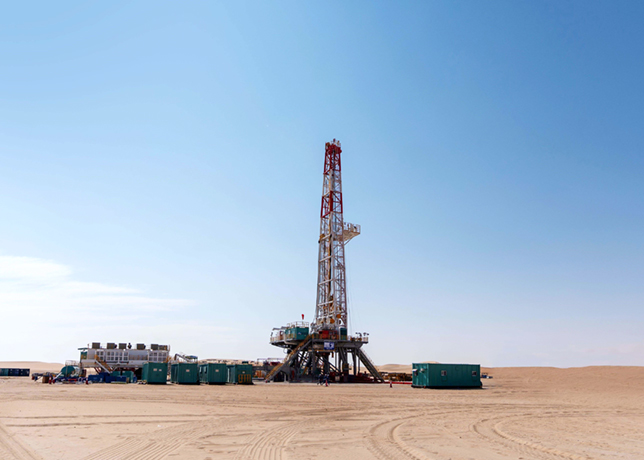
Many technologies essential in geothermal, such as directional drilling and well stimulation, are already deployed in Saudi Arabia’s oil and gas sector.
Abandoned oil and gas infrastructure presents immediate opportunities, and many of these idle wells have the requisite temperatures for geothermal exploitation.
The benefits from converting these assets to geothermal wells include cost savings, risk mitigation, and environmental protection.
Research indicates that a repurposed geothermal well can remain active for 30 years or more, representing a considerable opportunity to prolong the life span of these stranded assets.
• Environmental footprint and carbon intensity: Geothermal energy stands out for its efficiency in land use, requiring just 7.5 sq km per TWh hour per year, which is far less than that of other renewables.
A geothermal power plant that produces one MWh of electricity requires only 1 sq km of land, whereas a solar farm needs 8.4 sq km for the same amount of electricity.
Geothermal energy also has one of the lowest life cycle greenhouse gas emission levels, emitting 97 per cent less acid-rain-causing sulphur compounds and approximately 99 per cent less carbon dioxide than fossil fuel plants of similar size.
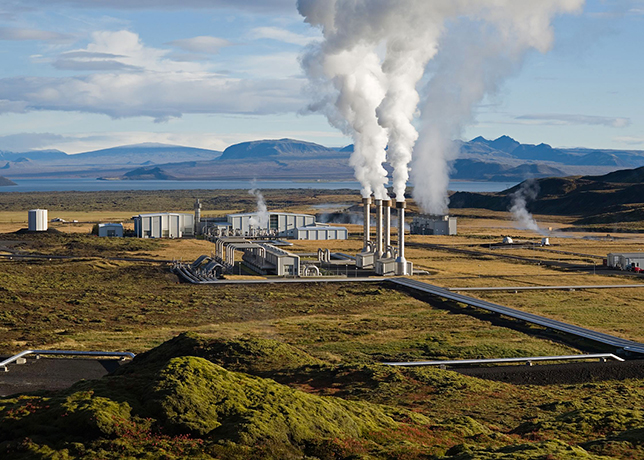
Most of the emissions released from a geothermal power plant are water vapour, which is a small portion of the steam that is captured and recycled back into the reservoir.
• Current development status and future trajectory: In 2020, the Kingdom of Saudi Arabia established a goal to displace 1 million barrels per day (mbpd) of liquid fuels in the power sector and to generate 50 per cent of its power from renewables, with the remainder being supplied by natural gas, by 2030.
The initial geological and geophysical exploration for the northern part of Harrat Rahat and surrounding areas of Medina, conducted by the Saudi Geological Survey, has hinted at potential 'sweet spots' for geothermal energy production.
The most visible example would likely be the exploratory work being done at the King Abdullah University of Science and Technology (KAUST), which broke ground in early 2024. This project aims to assess the potential of lithium extraction and carbon dioxide or flue gas sequestration.
Overall, the geothermal market in the Middle East is likely to increase significantly within the coming years and may go up to approximately $473 million by the year 2033.
At present, Saudi Arabia has no laws defining geothermal energy, distinguishing it as an energy source, or governing its extraction and usage.
The absence of such legislation and regulations poses risks to the geothermal sector, including inefficiency, lack of quality control, and potential environmental impacts.
Establishing national geothermal targets for cooling and power generation can help the country overcome development challenges and capitalise on opportunities.
These targets guide policy formulation, customised technology development, in-house capacity building, planning, and investments.
The convergence of geological potential, technical expertise, extreme cooling demands, and political commitment positions the Gulf states to transform geothermal energy from an overlooked resource into a cornerstone of their clean energy transition.
BY Abdulaziz Khattak