



























Hybrid fleets combine autonomous survey capability with manual intervention, optimising both cost and flexibility as offshore infrastructure development continues across the region, Chris Buckle tells OGN
The offshore energy industry has long depended on remotely operated vehicles (ROVs) to carry out critical subsea tasks, but their role has expanded beyond inspection.
Today’s advanced work-class ROVs support every stage of subsea pipeline construction, from pre-lay surveys and route verification through to post-lay inspection and commissioning.
With vastly improved control systems, increased power and dedicated tooling, ROVs now operate at greater depths and precision than ever before.
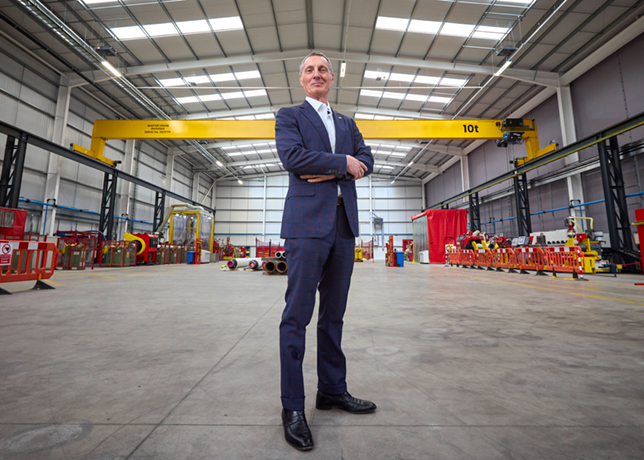
"The shift towards remote piloting marks a new chapter in subsea operations defined by efficiency, safety and high-quality data," Chris Buckle, Commercial Manager at Forum Energy Technologies, tells OGN energy magazine.
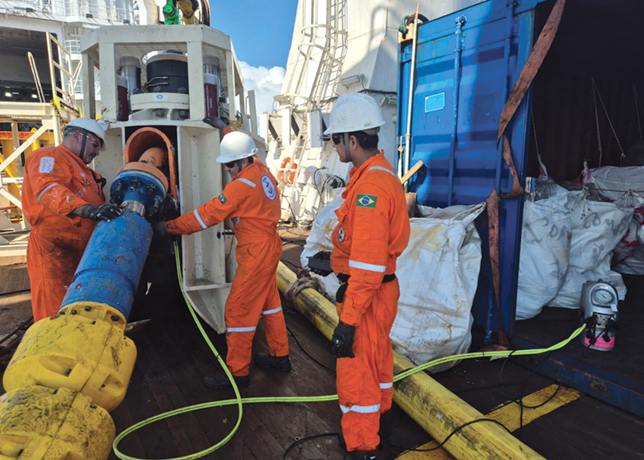
In many subsea operations, the ROV effectively serves as a "taxi for the tools"; its primary purpose is to transport specialised equipment to the worksite.
But to fulfil this role, the ROV must operate with absolute reliability and speed, ensuring tools arrive exactly where and when they’re needed.
They also have to be highly configurable, capable of adapting to a wide range of missions, payloads and environmental challenges.
Above all, this performance must be backed by 100 per cent support from the manufacturer, ensuring that operators can depend on rapid assistance, spare parts and technical expertise whenever required.
DEEPWATER & SHALLOW-WATER OPERATIONS
Operating conditions dictate how ROVs are deployed. Deepwater campaigns demand power and endurance, while shallow-water environments introduce risks such as tether entanglement and visibility loss.
In depths of less than 50 m, operators often rely on inspection-class vehicles or limited intervention from the tether management system (TMS) to reduce hazard exposure.
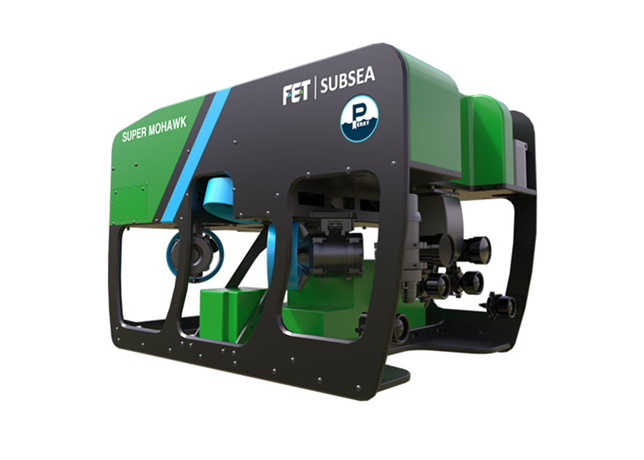 |
One of FET’s latest Inspection Class ROVs, the Super Mohawk |
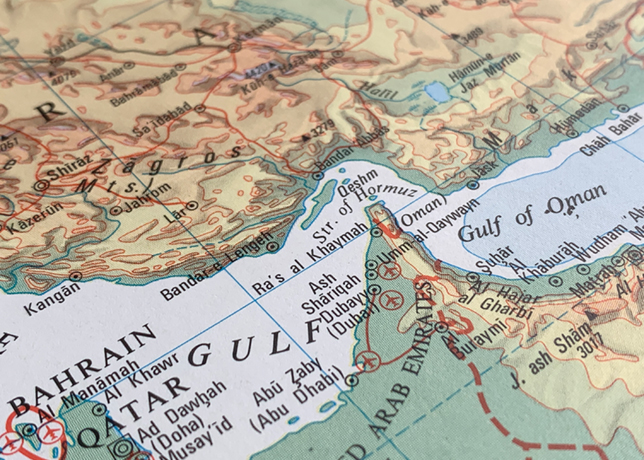
Environmental factors such as sediment and current also affect performance. In areas like the Arabian Gulf, where fine seabed material can easily be stirred into dense clouds, success depends on pilot skill and careful vehicle tuning.
Careful low-thrust manoeuvres help maintain positioning accuracy, even when visibility drops to zero.
Forum Energy Technologies’ (FET) ROV’s which are rated to 200 hp, are widely used for deepwater projects up to 4,000 m and beyond.
The latest Perry XLX Evo III model features large (420 mm diameter) that improve stability and control for precision tasks such as pipeline touchdown monitoring and intervention in harsh environments.
FET’s subsea technologies are supporting offshore activity in the Middle East. In 2025, UAE-based offshore construction company CCC (Underwater Engineering) selected two Perry XLX-C work-class ROV systems for deployment on its DP3 dive support and construction vessel Wadad Aletheia.
The 3,000-m rated vehicles support subsea construction, inspection, drill support and pipeline operations across regional offshore projects.
SUPPORTING THE PIPELINE LIFECYCLE
Precision is critical in pipeline installation. Throughout the project lifecycle, ROVs act as the operator’s eyes, hands and data collectors.
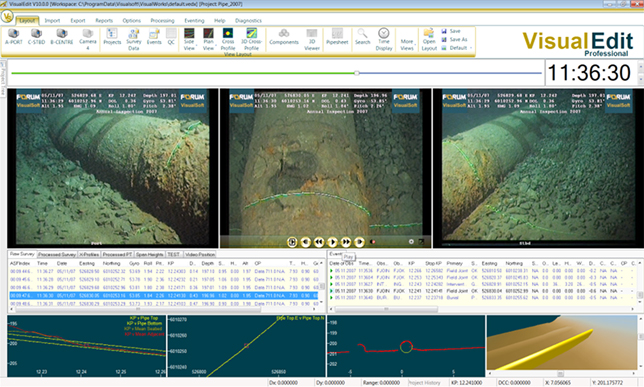 |
FET’s VisualSoft delivers streamlined workflows and enhanced operational control, both offshore and remotely |
Pre-lay surveys map the seabed using multibeam and side-scan sonar alongside HD video. These datasets identify hazards such as rock outcrops or debris and help model optimal routing, reducing costly rework later in the campaign.
During laydown and touchdown, ROVs coordinate with vessel crews to control the rate and angle of pipe descent.
Using dual vehicles, one for positioning and one for side-on monitoring, helps ensure accurate alignment and prevents free spans.
If trenching is required, ROVs can deploy jetting or dredging tools, or guide larger trenching vehicles to achieve consistent burial depth while minimising seabed disturbance.
Once installed, post-lay inspection and commissioning confirm pipeline integrity. ROVs conduct visual checks, logging anomalies such as coating damage or anode wear while taking cathodic protection readings with integrated probes.
These measurements create a baseline dataset for ongoing condition monitoring. Smaller inspection-class vehicles, such as FET’s Mohican or Super Mohawk, often handle manifold inspections and general visual surveys.
DATA & DIGITAL DELIVERABLES
Modern subsea operations are increasingly data driven. Sensors and cameras mounted on ROVs generate large volumes of video and positional data that are processed into inspection records.
FET’s VisualSoft suite provides synchronised video and sensor capture, enabling correlation between imagery and positional data.
Editing tools clean and validate multibeam and ROV navigation data, ensuring high-quality deliverables for operators and helping avoid repeat surveys.
TRAINING & COMPETENCE
The most advanced ROVs are only as capable as the teams operating them.
Developing pilot competence is a major focus across the sector and FET has a dedicated training department to ensure operators receive the required knowledge.
Mastering vehicle control takes time and practice, as does troubleshooting under pressure offshore. Offshore operations also demand collaboration and resilience, qualities that underpin successful subsea teams.
SMARTER CONTROLS & FUTURE HORIZONS
While modern ROVs feature automated systems such as auto-heading and auto-altitude, piloting still relies on human skill and situational awareness.
One major advancement is mid-water station keeping, allowing ROVs to hold position without a seabed reference by linking to the vessel’s dynamic positioning system, a capability particularly valuable in busy offshore regions such as the Arabian Gulf.
Looking ahead, the next phase of ROV evolution is already underway. Remote piloting from onshore control centres will reduce offshore footprints, while electrification promises to eliminate hydraulic risks and improve efficiency.
Hybrid ROV/AUV fleets will combine autonomous survey capability with manual intervention, optimising both cost and flexibility as offshore infrastructure development continues across the Middle East.