
























Capital inflows, automation and geopolitical pressures are reshaping mining economics, as technology-driven innovation redefines resilience across an increasingly complex global minerals landscape
The global mining industry is entering a decisive phase defined by technological convergence, capital mobilisation and geopolitical urgency, as critical minerals move to the centre of industrial policy and supply chain strategy.
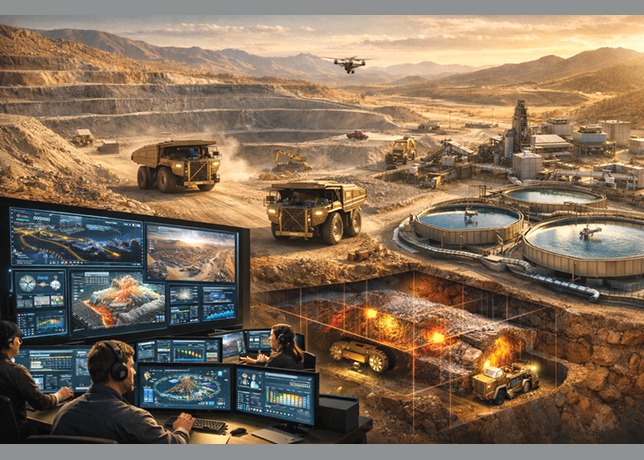
A distinct mining and metals technology layer is emerging within the approximately $200 billion mining equipment, technology and services ecosystem, driven by the integration of artificial intelligence, robotics, advanced sensors and digital platforms.
This shift is unfolding alongside a broader critical minerals super cycle, with innovation increasingly determining the economic viability, scalability and environmental performance of mining projects.
According to Beacon Events’ Ten major mining tech trends in 2026 report, the sector is experiencing an unprecedented alignment between capital markets, mining operators and technology providers.
Around $15 billion was deployed into mining technology financing and mergers and acquisitions between 2021 and 2025, including a record $4.8 billion in 2025, signalling both the strategic importance of minerals in geopolitical competition and the growing role of technology in enabling efficient and sustainable extraction.
GLOBAL MINING LANDSCAPE & PROJECT DYNAMICS
Mining systems are becoming more complex, capital intensive and technologically dependent as ore grades decline and operations move deeper underground.
Large-scale underground projects are now exceeding 30 million tonnes per annum, with capital costs reaching $10 billion or more.
These dynamics are reshaping project design, requiring advanced modelling, simulation and real-time decision support to manage geological uncertainty and operational risk.
At the same time, the industry is under increasing scrutiny over environmental performance, water usage and operational resilience.
This is driving adoption of digital tools, automation and resource efficiency technologies, while also influencing regulatory frameworks and investment decisions.
Mining projects are no longer evaluated solely on resource size and grade, but on their ability to integrate technology, manage environmental constraints and align with evolving supply chain requirements.
STRATEGIC & ECONOMIC DECISION DRIVERS
Investment decisions across the mining sector are increasingly shaped by a combination of technological capability, environmental constraints and geopolitical positioning.
The integration of data platforms, predictive analytics and automation is enhancing operational efficiency and reducing costs, while innovations in processing and recycling are expanding the range of economically recoverable resources.
Water scarcity, energy intensity and emissions are becoming critical constraints, influencing both project feasibility and long-term valuation.
At the same time, governments are intervening more actively to secure access to critical minerals, supporting domestic capabilities and encouraging the development of resilient supply chains.
This convergence of factors is transforming mining into a technology-led industry where competitive advantage is defined by innovation, integration and adaptability.
TEN DEFINING MINING TECHNOLOGY THEMES SHAPING THE INDUSTRY
• Surging tech financing and M&A: Mining and metals technology has attracted approximately $15 billion in financing and deal activity between 2021 and 2025, with 2025 alone reaching $4.8 billion.
Software and sensor-focused acquisitions accounted for about 90 per cent of transactions, while nearly $1.2 billion in venture capital flowed into the sector in 2025.
Increasing participation from cleantech investors and mining majors reflects the strategic importance of technology in unlocking resource value and improving sustainability.
• Growth in demand for automation, operational edge control and AI in mining: Automation is transitioning from isolated applications to system-wide deployment driven by AI-enabled edge control.
While only around 3 per cent of mining processes are fully automated today, more than 90 per cent of operations are investing in autonomous fleets and digital optimisation tools.
Emerging technologies are expected to expand automation into more complex environments, enhancing safety and enabling real-time decision-making.
• Increased material recycling and mine tailings reprocessing: The reprocessing of waste materials is becoming a major source of supply, with companies targeting significant volumes of metals from tailings and stockpiles.
Globally, around 100 gigatonnes of mine waste is generated annually, with projections indicating substantial growth.
Advances in recovery technologies are enabling economically viable extraction from previously discarded materials, effectively creating new resource streams.
• Geopolitics and sovereign supply chains: Critical minerals are now central to geopolitical competition, with governments prioritising domestic supply chain resilience.
Public funding initiatives and strategic alliances are supporting technology development and resource extraction, while competition in processing and refining capacity is intensifying.
Technology access is becoming as important as resource ownership in determining national competitiveness.
• Water pressures and scarcity: Water is emerging as a defining constraint, with mining consuming billions of gallons daily and a significant proportion of critical mineral deposits located in water-stressed regions.
The mine water management market is projected to grow from around $8 billion to $12.5 billion by 2033, while poor water management already imposes financial impacts exceeding $20 billion.
Technologies such as dry processing, desalination and digital monitoring are becoming integral to project viability.
• Biotech and AI convergence: Biotechnology is beginning to intersect with AI and data analytics to create new pathways for mineral extraction and processing.
Bio-hydrometallurgical techniques and engineered microbial systems offer the potential for lower-energy, lower-chemical recovery methods, although commercial deployment remains at an early stage.
Investment is increasing as the sector seeks scalable alternatives to conventional processing.
• New public mining and metals tech champions: Mining technology companies are gaining visibility on public markets, with several firms achieving billion-dollar valuations driven by growth in sensors, software and data services.
These companies are reshaping investor perceptions of the sector, demonstrating scalable business models and recurring revenue streams that differ from traditional mining operations.
• A critical need for greater sub-surface visibility and insight: As mining moves deeper underground, the lack of visibility into ore bodies presents significant operational risks.
Technologies such as muon tomography are providing three-dimensional imaging of subsurface structures over time, improving understanding of orebody behaviour and enabling more precise extraction planning.
Enhanced visibility is becoming essential for managing large-scale, high-cost underground projects.
• Coarse ore grinding and flotation breakthroughs: Advances in coarse particle processing are enabling the treatment of lower-grade ores with reduced energy and water consumption.
Technologies capable of processing larger particle sizes can achieve similar recovery rates while cutting energy use by more than 50 per cent and enabling dry tailings management.
These innovations have the potential to unlock significant additional supply, particularly in copper.
• OEMs using tech to grow the aftermarket pie: Equipment manufacturers are leveraging digital platforms, sensors and AI to expand their aftermarket businesses, which already account for the majority of revenues.
Integrated ecosystems that connect machines, energy systems and operational data are enabling predictive maintenance, process optimisation and improved uptime, strengthening customer relationships and creating new revenue streams.
The cumulative impact of these themes is redefining the mining industry’s structure and economics.
As global investment is projected to increase by an additional $150 billion annually between 2025 and 2029, technology is becoming the primary determinant of project success, shaping how resources are discovered, developed and delivered into increasingly complex and strategically vital supply chains.
By Abdulaziz Khattak