




































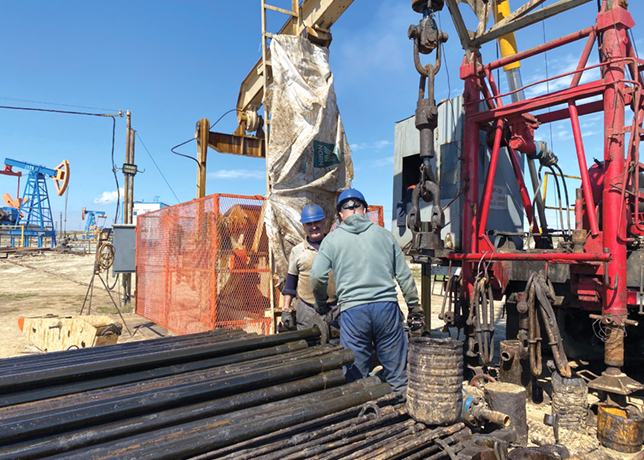









The UAE, which is home to 8.1 per cent of the world’s oil reserve, will make huge investments to boost its oil production capacity.
Apart from oil, the UAE has an estimated gas reserve of six trillion cu m. The UAE’s current oil output stands at 2.7 million barrels per day (bpd), while its gas output is at 65 billion cu m per annum.
Economists also say the UAE is poised to reap a bonanza, thanks to higher revenues from oil exports.
The Abu Dhabi National Oil Company’s (Adnoc) official selling price (OSP) for its main Murban crude is at a record high in line with prevailing global trends.
The economists, however, add that domestic refined product distributors could request an increase in gasoline prices. This would further fuel inflation in the UAE.
Dr Mohammad Amerah, an Abu Dhabi-based economist, said high oil prices will help multiply the oil export revenue of the world’s sixth-largest producer.
The UAE’s oil output is expected to rise to 3.5 million bpd at the beginning of the next decade.
Its oil refinery capacity, which currently stands at 600,000 bpd, is also expected to rise to 1.1 million bpd in the near future, said a report by Wam.
Adnoc has chalked out a plan to increase its crude oil output despite the fluctuation on the world oil market demand for oil continues to rise.
Adnoc’s ongoing programme includes development of production and manufacturing of oil and gas, in addition to other gas-related industries like the petrochemical industry, the report said.
The company expected the programme to yield good dividend within 2-7 years time. It strongly believes its investment in the programme would be profitable.
The UAE has the fourth biggest gas reserve in the world. It is expected that Abu Dhabi’s gas production will increase significantly in the next few years to make it one of the world’s major exporters of gas. It has invested about $7 billion in gas industry projects of Gasco.
It said the projects would be completed soon to allow production to start in 2008-2009.
Japan Bank for International Cooperation said in December it had agreed to provide a $3 billion loan to Adnoc to help it upgrade production facilities.
The agreement was signed in Japan by visiting Adnoc CEO Yousef Omair bin Yousef and JBIC governor Koji Tanami.
The agreement, which aims to cement Japan’s already close energy ties with Abu Dhabi, was signed during Crown Prince Sheikh Mohammed bin Zayed Al Nahyan’s visit to the Japanese capital.
JBIC will provide the loan in collaboration with the Bank of Tokyo-Mitsubishi UFJ, Sumitomo Mitsui Banking Corp, Mizuho Corporate Bank, together with Citibank Japan and BNP Paribas Tokyo Branch, as a form of advance payment in return for converting short-term crude contracts including spot purchases with Japanese refiners such as Cosmo Oil into long-term commitments, a JBIC official said.
Although JBIC has not clarified details of the crude purchase deal, the loan will be made as advance payment for a combined total of 120,000 bpd for a period of more than five years within Japan’s existing crude import from Adnoc, the official said.
“We aim to stabilise Japan’s crude purchases from Adnocthrough converting such short-term contracts such as one-year import contracts or spot purchases to long-term contracts of more than five years,” the official said.
“As a result, we will turn some 10 per cent of Japan’s import from Abu Dhabi into long-term contracts,” he added.
The agreement comes after JBIC and Adnoc signed a memorandum of understanding in late April during former Japanese prime minister Shinzo Abe’s visit to the region, which let JBIC lend Adnoc funds for both upstream and downstream oil and gas projects.
The UAE is Japan’s second-biggest crude oil supplier after Saudi Arabia.
The International Energy Agency’s World Energy Outlook says almost all the crude oil exported by the UAE goes to Asia, with more than half going to Japan.
Lifters said Abu Dhabi will supply full term volumes of crude oil to its Asian customers for January and additional barrels to at least three buyers to meet winter demand.
This is only the second month since November 2006 that Abu Dhabi, the main producer, is supplying additional volumes, but the move may not herald the cartel’s plan to lift output again when it meets next week.
“We received the notice. It is full volume and a small incremental,” one term lifter said.
Abu Dhabi occasionally sells extra crude to its term buyers in Asia, its main export market, although the exact volumes to be supplied this time were not immediately known.
Opec is under pressure to supply more crude to world markets to stop prices from breaching new records and put further strain on the global economy.
While top Gulf Opec officials have expressed deep concern at prices, they reiterated that markets were well supplied and steered clear of saying whether Opec would raise production in 2008.
The incremental Abu Dhabi supplies for December came after a sharp cut-back in November due to offshore oilfield maintenance, and were in line with Opec’s decision to boost daily output by 500,000 barrels from November 1, which failed to stop prices from rocketing.
Two lifters confirmed receiving written notice that they would get full term volumes for a second month in January.
Four lifters said they had not requested extra barrels, while three others had asked for additions, leaving it unclear whether Abu Dhabi will suppply more crude to Asia for January than for December.
But unlike the December barrels, Adnoc did not not actively offer additional volumes for January. It may also not be able to satisfy all requests for additional crude, with one lifter saying it had sought a full additional 500,000-barrel cargo but received less.
“In December, Adnoc offered. I did not ask for some. But in January, we are the ones asking,” a trader with another term lifter said.
The extra crude offered for December lifting may also be due to the volumes made available from maintenance at the 415,000 bpd Ruwais refinery, traders said.
The refinery is expected to be partly shut in December and January, with output to be reduced by about 150,000 bpd during the period.
On the other hand, traders said supply disruptions at the offshore Umm Shaif field, which produces around 200,000 bpd, could prevent Adnoc from supplying larger additional volumes for January. The extent and length of the field’s disruption was unclear.
Other than Saudi Arabia, Abu Dhabi is believed to be another Opec producer with the most spare capacity and could accommodate an increase in the group’s production quotas.
UAE Minister of Energy, and current Opec president, Mohammed bin Dhaen Al Hamli, said recently that Opec has spare capacity of around three million bpd, of which 2.8 million bpd is in Saudi Arabia alone.
Abu Dhabi’s target output from November 1 stands at 2.567 million bpd, according to Reuters calculations.
The UAE has targeted its crude and condensate output capacity at four million bpd in the next few years from around 2.8-to 2.9 million bpd now.
Speaking recently in Singapore, the UAE minister said Asia could rely on oil-producing countries to provide enough oil to fuel the region’s booming economies.
Al Hamli said almost 50 per cent of Opec oil exports are bound for Asia.
“Whenever there have been times of increased oil demand in the Asian region, in every instance, demand has been met with adequate supply, with much of it coming from the Gulf region,” he said in a speech at an energy forum in Singapore.
Touching on the forum’s theme on whether the Gulf region can quench Asia’s thirst for oil, Al Hamli said it can.
“The Gulf countries and other Opec members are not only able, but they are ready, willing and they are quenching the Asian thirst for oil,” he said.
“Opec has maintained a secure stable and steady supply of oil since it was founded in 1960 and will continue to do so in the future.”
As a growing sign of the UAE’s energy sector, it was annouced recently that Takreer of Abu Dhabi, Finland’s Neste Oil and Austria’s OMV would build a plant in Abu Dhabi to make base oil, the main element in lubricants.
The joint venture, which aims to build the plant with an annual capacity of 500,000 tonnes and to capitalise on growing demand for high-performance base oils, would be 60 per cent owned by Takreer, 20 per cent by Neste Oil and 20 per cent by OMV, Neste Oil said in a statement.
Abu Dhabi Oil Refining Company (Takreer) is a unit of Adnoc. Takreer’s hydrocracker would supply the feedstock for the base oil unit.
Neste’s specialty products head Kimmo Rahkamo said the plant, at Ruwais in western Abu Dhabi, would begin operations in 2012, if all goes as initially planned, but that the value of the investment was unclear as it was still early days.
“The planning starts in the summer and it is about a one-year process. After that we will know how big an investment it would be and if it is worth doing,” Rahkamo said.
“The building is then a 2-3 year project.”
Planning of the project would start in the second quarter of 2008 at the latest, Neste said.
Neste said its earlier project to build base oil production in Bahrain was also progressing and Rahkamo said Neste would aim to make a possible investment decision by the middle of 2008, when the cost estimates are clearer.
“Thereafter, it should be ready in a couple of years,” Rahkamo said.
In December, Adnoc said it was teaming up with Germany’s Linde to establish a joint venture which will produce and supply industrial gases.
Adnoc will hold a controlling stake of 51 per cent, while Linde will own the remaining shares in the JV called Elixier.
A $65 million air separation plant will be built in Ruwais and it is hoped nitrogen will be produced by the end of 2009.
“This joint venture is of major strategic importance to us and is the logical expansion of the previous collaboration of our engineering division with Adnoc in the petrochemical industry,” Linde executive board member Aldo Belloni said.
Adnoc had access to about 90 per cent of Abu Dhabi’s oil and gas reserves, Belloni said.
The new plant will supply nitrogen from the end of 2009 to industrial customers in Ruwais and will also produce liquefied nitrogen and oxygen.


