






































By Abdulaziz Khattak
The traditional boundary between business strategy and sustainability is dissolving as regional energy giants pivot from compliance to core value creation.
This strategic shift is no longer peripheral, with companies increasingly embedding environmental, social, and governance (ESG) metrics into capital allocation and low-carbon investments to ensure long-term competitiveness.
“The companies moving fastest are the ones that no longer separate business strategy and sustainability strategy,” Alena Dique, Founder of ESG Middle East Insights, tells OGN energy magazine in an exclusive interview.
Recognised as one of the Top 100 Women Leaders in the Middle East 2025, Dique advocates for radical transparency to combat greenwashing, and maintains that women leadership must move beyond symbolism.
Below are excerpts from the interview:
From your vantage point, how are regional energy companies in the Middle East redefining ESG from a compliance exercise into a core driver of long-term value creation?
What’s changed most in the past few years is intent. Driven largely by the momentum of the UN SDGs, ESG was often treated as a reporting layer: Important, but peripheral.
Today, I’m seeing a much more deliberate shift, particularly among leading energy companies, to position ESG as a core part of business strategy.
This includes embedding sustainability into capital allocation through investments in low-carbon technologies, diversification into renewables, and optimisation of existing operations.
Today, over 60 per cent of companies in the Middle East have adopted formal ESG strategies in recent years, signaling a clear shift from intent to implementation.
In conversations with executives, there’s a growing recognition that sustainability is directly tied to competitiveness, including access to capital, strategic partnerships, and long-term resilience.
Increasing alignment with national net-zero agendas is also pushing companies to think beyond quarterly reporting cycles.
The companies moving fastest are the ones that no longer separate “business strategy” and “sustainability strategy”.
How critical is narrative in shaping credible ESG positioning, particularly at a time when scrutiny around greenwashing is intensifying?
A strong ESG narrative is not about visibility, it’s about translating complex, technical progress into communication that is transparent, verifiable, and accountable.
Meanwhile, the scrutiny around greenwashing has raised the bar significantly.
Globally, while 78 per cent of major listed companies now report Scope 3 emissions, data quality and consistency remain major concerns.
Stakeholders are no longer impressed by ambition alone. They’re asking: What have you delivered? What’s changed year on year? Where are the gaps?
That level of pressure is necessary, and it’s pushing the industry toward more disciplined and honest communication.
What are the most tangible shifts you are seeing in how oil and gas companies are embedding low-carbon solutions into their business models?
The most tangible shift is that low-carbon solutions are no longer being treated as standalone initiatives, they’re being integrated directly into core operations.
We’re seeing momentum in carbon capture, utilisation and storage (CCUS), hydrogen-particularly blue hydrogen-and renewables, alongside a strong focus on operational efficiency.
The GCC carbon capture market alone is already valued at around $1.4 billion and growing, reflecting strong investment into decarbonisation technologies.
Digital technologies are also playing a key role, helping reduce flaring, optimise energy use, and improve emissions tracking.
As someone operating in a highly technical and traditionally male-dominated sector, what structural barriers have you encountered, and how have they influenced your leadership approach?
Operating in this environment has made me very intentional in how I lead. I’ve learned to prioritise depth over visibility, and to build credibility through consistency and insight rather than overextending to fit expectations.
Through ESG Middle East Insights, I wanted to create a platform that amplifies informed, diverse perspectives within the industry and reflects the level of strategic dialogue and structural challenges in the region.
My early exposure through the UN Trade and Development Youth Network also played a role in shaping that perspective-particularly in understanding how global frameworks translate into regional action.

Diverse leadership teams challenge assumptions and bring broader perspectives to complex problems
In your experience, where does the greatest disconnect lie between corporate ESG ambition and execution, and how can leadership teams close this gap more effectively?
The gap is almost always in integration. ESG strategies are often well-articulated, but not fully embedded into how decisions are made across the business.
I’ve seen organisations with ambitious targets, but limited alignment between teams, unclear ownership, or data that isn’t robust enough to track real progress-that’s where execution starts to stall.
For example, only around 13-18 per cent of companies in the region are currently accessing sustainable finance, highlighting the distance between ambition and actual deployment.
Addressing this requires moving ESG from a centralised function to a shared responsibility.
Strong data infrastructure is also critical.
But ultimately, execution comes down to governance and making ESG fully operational across the business.
How do you see emerging technologies, such as AI and data analytics, enhancing ESG performance, transparency, and accountability in the energy sector?
Advanced analytics can improve emissions monitoring, optimise energy consumption, and identify inefficiencies across complex value chains, while AI supports predictive maintenance, reducing both costs and environmental impact.
This shift is critical-particularly as the energy sector accounts for nearly 75 per cent of global greenhouse gas emissions, underscoring the importance of precise measurement and data-driven reduction strategies.
From a policy and regulatory standpoint, which frameworks or initiatives in the GCC are proving most effective in accelerating gender diversity and broader ESG adoption?
National visions and net-zero commitments have been instrumental in accelerating ESG adoption by providing both direction and accountability.
For example, the UAE alone is targeting a 40 per cent reduction in emissions by 2030, a clear signal that policy is driving execution at scale.
Furthermore, as part of the updated UAE Energy Strategy 2050, the country aims to triple its renewable energy capacity by 2030.
On gender diversity, there has been steady progress through board-level initiatives, leadership programmes, and policy-driven targets.
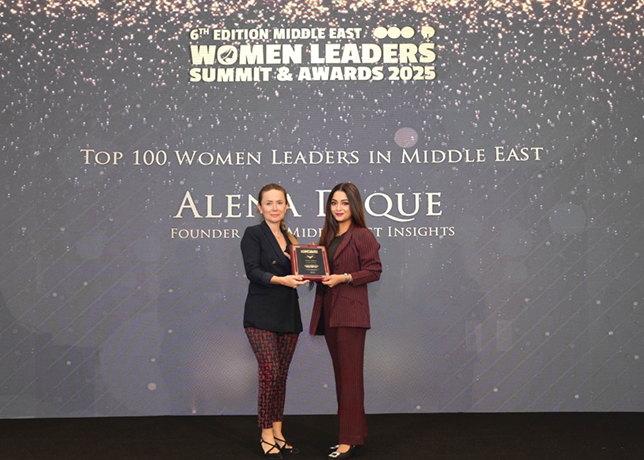
Dique recognised as a top woman leader in the Middle East
How do recognition platforms and visibility initiatives translate into tangible change for women across the energy value chain?
Recognition helps shift perceptions around who is seen as a leader in this space and highlights the presence and impact of women in sectors where representation has historically been limited.
However, recognition alone is not enough. When visibility is combined with access to opportunities, leadership roles, and decision-making platforms, it starts to drive meaningful and sustained progress.
That’s when it moves beyond symbolism.
What new skillsets and leadership qualities will define the next generation of women leaders in energy, particularly as the sector navigates decarbonisation and geopolitical complexity?
The next generation will need to be both technically credible and strategically agile.
The energy sector is becoming increasingly interconnected across sustainability, technology, and geopolitics.
Systems thinking will be critical, and communication is equally important, but above all, adaptability will be key.
Leadership in this space will be defined less by hierarchy and more by influence, credibility, and the ability to deliver integrated outcomes.
If you were to identify one decisive action that energy companies in the region must take over the next five years to align profitability with sustainability, what would it be, and what role should women leaders play in driving that agenda?
The most decisive action is the integration of sustainability into core business strategy, not as a parallel agenda, but as a fundamental lens for investment, operations, and growth.
The opportunity is significant. For example, hydrogen alone could generate up to $200 billion in revenue for the region by 2050, making sustainability not just a responsibility, but a growth driver.
Women leaders have a critical role to play, not simply as representatives of diversity, but as contributors to stronger, more balanced decision-making.
Diverse leadership teams challenge assumptions, improve outcomes, and bring broader perspectives to complex problems.