

































Oil & Gas News (OGN): The Middle East energy sector is undergoing a massive boom. Are the energy firms taking enough measures to protect their management systems from new forms of threats?
It has been clearly shown that defending against external, physical threats is, in relative terms, less expensive that defending against internal threats whether they are physical or cyber. Although a great deal is done to protect business systems from physical or cyber attack there is still a lack discipline at some companies to protect their control systems from internal cyber attacks. Honeywell believes that all aspects of security (internal and external threats both physical and cyber) should be part of a comprehensive layered strategy that has oversight from a single responsible party within the customer’s organisation.
Please highlight the modern-day security challenges faced by the energy sector and the solutions they require to safeguard their energy infrastructure?
Companies need to move their facilities towards a comprehensive strategy that seamlessly integrates the physical, electronic and cyber layers of security with building automation, security and process control systems, enabling the sharing of real-time information. Integration is the most effective and efficient way to achieve faster, better responses, including pre-emptive shutdown/safe-mode and the mustering of personnel in safe areas.
It is widely believed that video surveillance and biometric technologies enhance critical infrastructure security. What are the business benefits?
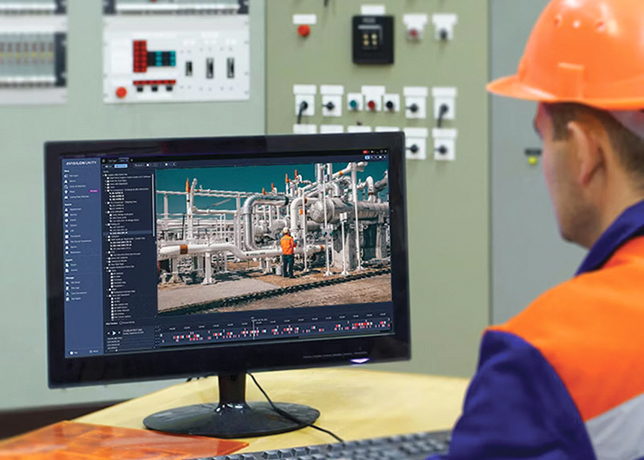
Video Surveillance: Video surveillance offers many benefits to businesses; such as the ability to monitor remote parts of the facility in real time as well as performing forensic analysis of past events in question. Video surveillance enhances not only the security of the facility but also aids in the safety of employees. Criminals are less likely to commit crimes when they are aware that they will be capture on video.
From a business perspective, video surveillance combined with video analytics provides businesses the ability to enhance their rate of detection, whether it be a security incident or a process plant event. By increasing their rate of detection, it allows management and operators to increase their responsiveness to a critical emergency that may have gone unnoticed by human operators. By increasing the responsiveness, facilities may have the opportunity to resolve the plant issue before it accelerates to a critical state that may injure personnel or affect business continuity.
Biometric: Biometrics brings enhanced security to a new level. The ability to clearly define who you are without a doubt benefits business in many ways. It is extremely difficult to duplicate your biometric signature. From a security perspective, increasing security by preventing badge sharing, clearly verifies the card holder is truly who he states he is, and eliminates “buddy” punching of time clocks. From a business perspective, biometric surveillance eliminates password sharing of the IT infrastructure or access to unauthorised applications and files. Overall it can reduce the costs for password maintenance.
We understand that Honeywell is offering a combined face and iris recognition system (CFAIRS) to energy firms. Can you explain its basic features?
Honeywell’s combined face and iris recognition system (CFAIRS) employs breakthrough iris imaging technology to enable surveillance-based multi-biometric (iris and face) recognition of people at ranges up to 5 metres. CFAIRS uses a wide field-of-view video camera to locate all of the people within the range (5 metres) of the sensor. For each person, CFAIRS then automatically acquires and matches both their face and iris biometrics. If the person has not yet been enrolled, CFAIRS can automatically enter the person into a database. One of the key advantages provided by CFAIRS is the ability to rapidly and positively identify people, without having them stop and peer into an iris recognition device. Applications for CFAIRS include: (1) Rapid identification of registered truck drivers at warehouse gates, (2) Non-cooperative watch-list checking of people at facility entrances and (3) Hands-free tracking of employees and guests throughout the plant.
Please provide a brief description for the following terms:
Long-range biometrics: Long-range biometrics are new technologies which operate at distances of 2-10 metres. This compares to existing biometric products which require either contact (e.g. fingerprint reader), or very short range, cooperative operation (e.g. iris reader requiring a person to peer into the camera at a distance of 30cm).
Video analytics: Video analytics are software tools which automatically analyze video surveillance data to identify abnormal events or activities. Examples of video analytics include detecting a parked stopped in a restricted zone, detecting an abandoned package, or detecting a person who has fallen.
CBRNE sensors: Chemical, Biological, Radiological, Nuclear and Explosives (CBRNE) sensors.
Wireless networking and machine learning: Industrial wireless networking provides the ability to securely monitor industrial field instruments and sensors without the need for costly wiring. Machine learning is concerned with the design and development of algorithms and techniques that allow computers to “learn” and take on routine monitoring tasks, thereby off-loading operators to focus on security actions and process optimisation.
How is this market different from other regional markets in terms of sales of these latest biometrics-related security solutions?
We have found this region to be very willing to evaluate and implement new technologies if we are able do clearly demonstrate its value in an integrated security environment. Our customers recognise the potential threat to their businesses and are being quite proactive in upgrading their security solutions.
How do you assess the understanding/awareness of the critical need for these solutions among decision-makers in the regional energy sector?
As Honeywell has been providing process control solutions to a large portion of this customer base for many years we have extensive established contacts throughout the industrial sector. Using these contacts to collect voice of the customer (VOC) data allows us to assess the markets’ needs and trends better than suppliers that are truly new to the industrial marketplace.
What are the expectations for 2008?
We expect the market space to continue to see a healthy double-digit growth trend.


