









































The oil and gas industry has historically approached digital technology through a transactional lens, investing where a clear return could be demonstrated and retreating when it could not.
However, that calculus has changed, and digitalisation is no longer viewed as discretionary innovation, but as operational necessity.
According to Oil and Gas Technology Outlook for 2030 and Beyond, commissioned by Rockwell Automation and researched by GlobalData, more than half of industry leaders now view cybersecurity and cloud computing as technologies actively disrupting operations, while nearly as many identify artificial intelligence as a transformative force.
What is driving that shift is not one breakthrough technology, but six structural pressures reshaping risk, cost and competitiveness across the value chain.
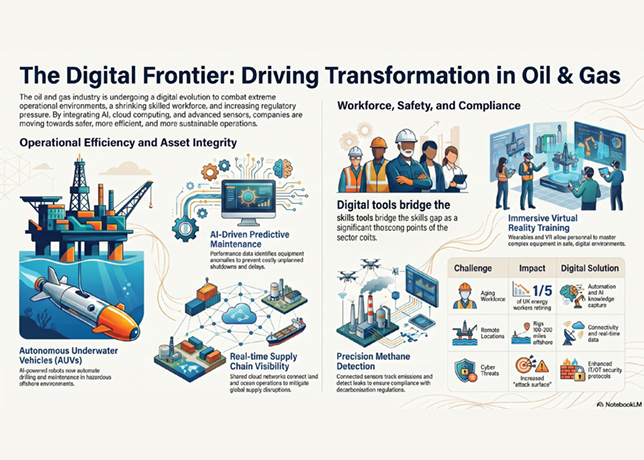
The first is a workforce challenge that has become strategic. With the average age of oil and gas workers now around 56 and a significant share of experienced professionals approaching retirement, operators face a widening knowledge gap.
Recruiting specialist Orion Group has warned that more than half of experienced engineers could retire within the next decade.
At the same time, technical roles remain difficult to fill, and this is elevating digital tools from productivity enhancers to workforce enablers.
AI-assisted training, virtual reality simulations and augmented-reality wearables are being deployed to accelerate knowledge transfer, preserve safety standards and reduce dependence on scarce expertise.
Automation adds another layer of resilience, allowing companies to sustain productivity without proportional increases in headcount, even as it creates demand for new digital skills.
The second force is the growing maintenance burden associated with operating in remote and harsh environments.
Offshore assets face constant corrosion, extreme weather exposure and logistical constraints that make manual inspection costly and inefficient.
In such settings, connected sensors, real-time monitoring and predictive analytics have become critical.
Industrial IoT (IIoT) systems now allow operators to identify anomalies before they develop into failures, reducing downtime and improving asset integrity.
Predictive maintenance, once treated as a digital ambition, is increasingly becoming standard operating practice, particularly for offshore and complex processing facilities.
SUPPLY CHAIN VOLATILITY, REGULATION & CYBER RISK
The third driver is supply chain volatility, and this is obvious because geopolitical disruption, commodity price instability and trade uncertainty have exposed the fragility of globally dispersed supply networks.
From maritime chokepoints to regional conflicts, disruptions increasingly carry operational and commercial consequences.
This is accelerating investment in shared digital platforms that integrate suppliers, contractors and operators through cloud-based systems.
Real-time visibility across procurement, logistics and project execution is becoming essential to resilience.
In a volatile operating environment, disconnected systems are increasingly seen as a source of risk rather than inefficiency alone.
Environmental compliance forms the fourth structural pressure. Methane regulations, emissions reporting requirements and decarbonisation commitments are moving compliance from periodic reporting to continuous monitoring.
Sensor networks that track methane and emissions performance in real time, supported by analytics that can identify trends and flag emerging compliance risks, are becoming part of the sector’s operating infrastructure.
What began as emissions management is evolving into digitally enabled compliance architecture.
The fifth force is cybersecurity, now elevated from IT concern to board-level risk.
The growth of connected assets, cloud systems and operational technology has widened the attack surface significantly.
Ransomware, phishing and attacks targeting industrial control systems have reinforced the vulnerability of critical energy infrastructure.
As a result, cybersecurity spending is rising sharply, reflecting a recognition that digital transformation cannot advance without digital resilience.
In increasingly connected operations, cybersecurity is becoming inseparable from operational continuity.
ECONOMICS OF CONVERGENCE
The sixth and perhaps most transformative force is the rapid maturation of artificial intelligence itself.
AI has moved beyond experimentation into scalable industrial use, from optimisation and predictive analytics to autonomous operations.
Across the sector, companies are deploying AI to improve drilling performance, optimise production, enhance safety monitoring and reduce emissions.
Autonomous underwater vehicles, AI-driven process control and emerging agentic AI systems capable of autonomous reasoning point to a deeper shift in how operations may be managed, and the examples are already emerging.
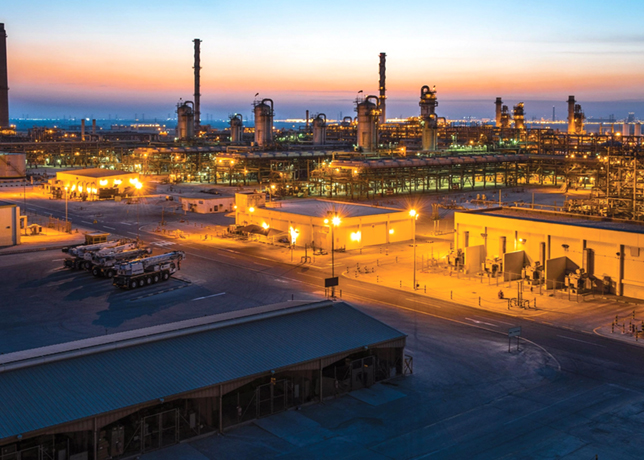
Saudi Aramco, working with Yokogawa, deployed an advanced AI system at the Fadhili Gas Plant to optimise stabilisation processes and lower emissions.
Such projects signal how AI is moving from pilot phase into core operations.
What makes these six forces particularly significant is that they do not act independently; they reinforce one another.
Companies are no longer making isolated digital investments to solve individual problems; they are reconfiguring processes end-to-end.
Global technology expenditure in the energy sector is rising rapidly, with Asia-Pacific and the Middle East among the strongest growth regions.
Patent activity in oil and gas technologies has also surged, underscoring the pace of innovation reshaping the sector.
For an industry often characterised as cautious in adopting change, digital transformation is becoming foundational to resilience, compliance and long-term performance.