










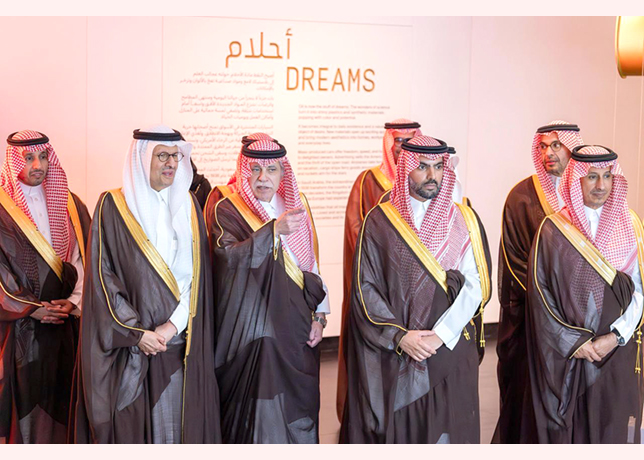
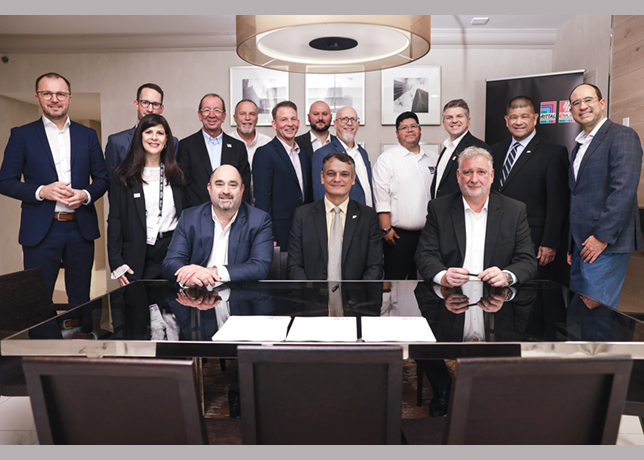






Amir Sheikh Hamad bin Khalifa al-Thani lifted up a light bulb in the shape of an oil drop to inaugurate the train three project, which has seen 2.3 billion dollars of investment in both Qatar and India.
“This is the world’s largest LNG train with a production capacity of 4.7 million tonnes per annum,” said Qatari Energy Minister Abdullah bin Hamad al-Attiyah.
“The Petronet-RasGas deal has been a groundbreaking agreement due to the sheer size of supplies involved ... and the vision that the Qatari and Indian governments share to transfer a safe and reliable and environmentally friendly source of energy from one country with an abundance of supply to another with a huge and growing demand,” he said.
All output of train three, which refers to the series of gas treatment and cooling units, will go towards fulfilling a July 1999 agreement to supply 7.5 million tonnes of LNG per year, over a period of 25 years to the terminal at Dahej in the northwestern Gujarat state.
It will meet energy demand in that state and the southern Kerala state.
But both sides were already looking beyond this deal given India’s enormous gas and energy needs.
B.K. Chaturvedi, India’s deputy energy minister and Petronet chairman, said the LNG receiving capacity at Dahej was being doubled to 10 million tonnes and that new terminals were being built in the southern cities of Cochin and Mangelore to meet the demand of refineries and power plants there.
He said RasGas - 63 per cent owned by Qatar Petroleum, 25 per cent by energy giant ExxonMobil and the remainder by Japanese and South Korean companies - would be a favoured partner for the Cochin project.
“There is a lot of surpressed demand, people do not approach us because there is no availability,” he told AFP after the ceremony.
“Refineries and many other sectors want to improve the economies of their operations because this fuel is cheaper.”
He said India has a daily demand of 120 million cubic meters (4.238 billion cubic feet) of natural gas but that only 70 million of that was being met today.
India’s goal is for natural gas to meet 20 per cent of its energy needs by 2025, up from eight per cent now, said the minister.
He said India was also looking to buy LNG from Malaysia, Oman and Iran.
Qatar pumped 1.3 billion dollars into the project. India spent 600 million dollars to build the Dahej terminal and 200 million on pipelines. The remaining money goes to leasing tankers.
Qatar and its partners are hoping the India deal will open the door to other promising Asian markets like China, Pakistan and Thailand and help them complete projects to supply the US market with Qatari LNG.
“It lays a foundation of confidence to proceed with the next larger size train: 7.8 million tonnes,” said RW Tillerson, ExxonMobile’s president.
Petronet is a joint venture of India’s state-run oil exploration firm, Oil and Natural Gas Corp. (ONGC), state-run Indian Oil Corp and the Gas Authority of India, which imports LNG.
Gaz de France also has a 10 per cent stake in the company.
The project was completed two months ahead of schedule. India has already received the first three cargoes of 138,000 cubic metres each and 34 more are to follow by the end of the year.
Qatar’s giant North Field has recoverable reserves of more than 900 trillion cubic feet (25 trillion cubic metres) of gas, the third largest in the world.
Doha plans to boost annual LNG production to 60 million tonnes by 2010 from the current 18 million.


