













































PETROLEUM Development Oman (PDO) – a government-owned company in which Shell holds a 34 per cent shareholding – has discovered significant new volumes of oil at the Budour Northeast oil field, which was itself discovered only last year.
In addition, the company may also have found a significant volume of oil in a rock formation at the Rabab-Southeast field.
Both fields are located in the south of the country, near the Birba field.
The new discovery at the Budour Northeast field was revealed by Buduor NE-2, a well drilled in 2007 to follow up the field’s original discovery well, Budour NE-1. It consists of a reservoir lying below the one tapped by the Budour NE-1. When tested, Budour NE-2 produced as much as 5,800 barrels of oil per day. Both Budour NE wells – as well as a third drilled in the same area – have been hooked up to PDO’s pipeline infrastructure, thereby contributing to the company’s production.
The oil at Rabab-Southeast was discovered whilst drilling an exploration well. The well is being tested and the results of the well test still need to be evaluated. “The discovery of these reservoirs goes a long way towards realising PDO’s aspiration of replacing produced volumes in any given year with new reserves,” says PDO managing director John Malcolm.
PDO’s exploration director Martin Stäuble adds: “The year 2007 turned out to be an excellent year for PDO in terms of exploration. In fact it was the best year for oil exploration since 1994 and we expect good results from PDO’s exploration activities to continue in 2008. We are obtaining some encouraging preliminary data from our exploration wells in north Oman, but these results still need to be confirmed through well testing.”
To sustain long-term oil production from its contract area in Oman, PDO has turned to diverse methods for enhancing oil recovery from its fields that contain many billions of barrels of oil in place.
Without these investments, PDO expects ultimate oil recoveries from these fields would range between 4 and 20 per cent. But depending on the EOR method employed, ultimate recoveries could increase to as high as 50 per cent.
The company’s first EOR projects will be in fields near Nimr, around Harweel, in Qarn Alam, at Marmul, and at Fahud.
Near Nimr, PDO started injecting steam on September 10, 2007, in a pilot project in Amal West field and will also begin steam pilots in Amal East and Thayfut. Also it is studying the potential of in situ combustion in a shallow reservoir containing 300-700 cp oil in Nimr.
The company also has under way facility construction for injecting miscible sour gas into a cluster of fields near Harweel.
At Qarn Alam, PDO in early 2007 let contracts for constructing facilities for a thermally assisted gas-oil gravity drainage (TAGOGD) project in a heavy-oil fractured carbonate reservoir.
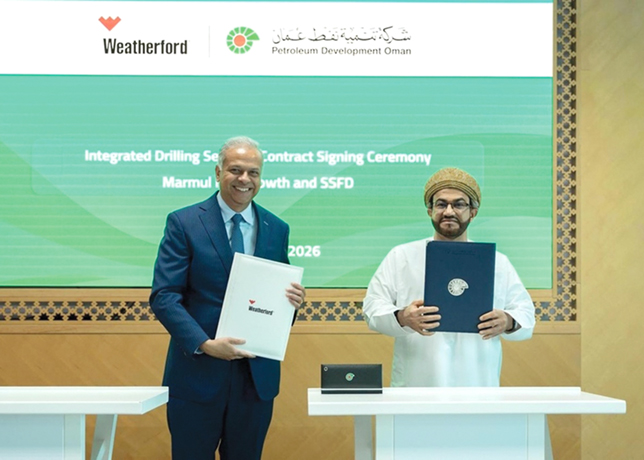
Another contract let in 2007 was for facilities for injecting polymer in a heavy oil reservoir at Marmul.
At Fahud, the EOR process, also TAGOGD, will involve injecting steam to accelerate recovery of light oil from a fractured carbonate. PDO is owned by the Omani government, 60 per cent; Royal Dutch Shell PLC, 34 per cent; Total SA, 4 per cent, and Partex oil and Gas Group, 2 per cent.
PDO is initiating three steam injection pilots in fields in the Nimr area that will assess the process for recovering heavy oil from thick sandstone reservoirs in Amal West, Amal East, and Thayfut fields. Steam injection in a well at Amal West started in September 2007.
PDO designed the pilots to calibrated simulation models for designing the projects, although a pilot in Amal East in the late 1980s and early 1990s provided it with enough information to feel confident that steam injection is feasible in the fields, says Amour Al Suqri, the head of engineering construction for the Nimr projects.
The company plans to complete full field steam-injection facilities in 2010 and later in 2013 add a power plant for providing additional heat for steam generation.
The Amal fields produce heavy oil from beam pumped wells with depths that vary from 500 to 1,000 m.
PDO constructed an 800 cu m per day water treatment plant for the Amal West and Amal East pilots.
Two skid-mounted 200 tonnes per day portable gas-fired steam generators provide the steam.
The Amal West pilot was a fast track 18-month project from initial assessment to steam injection. PDO said it initiated the project in first-quarter 2006, with approval given in third-quarter 2006, and detail design started in first-quarter 2007.
The Amal West pilot has three wells on cyclic injection that will have steam injected in them for one month, followed by one week of soaking, and 3 to 5 months of production. PDO expects the full-sized project in Amal West to involve continuous steam injection with wells on seven-spot, 10-acre patterns.
For the Amal East pilot, PDO plans to move one of the 200 tonnes per day steam generators from Amal West. The pilot also will use three wells.
Al Suqri says the reservoir in Amal East is deeper, so that higher pressures will be needed to inject steam. The reservoir is about 200 m thick.
For the full-scale project, the company expects Amal East to remain on cyclic steam injection until the reservoir heats up sufficiently for continuous steam injection.
PDO also plans to inject steam at Thayfut. Its pilot involves 1 well on continuous steam injection and cyclic steam injection in four other wells.
In the south of Oman, PDO has under construction the facilities for the Harwell Phase 2AB miscible sour-gas injection project. PDO awarded the engineering, procurement, and construction (EPC) contract in December 2005 and expects to finish construction in 2010.
PDO discovered Harweel in 1997 and since has found seven similar fields containing intrasalt carbonate stringers in a large 1,000 sq km area. The company estimates that the cluster of fields contained an initial 1.8 billion barrel in place of light sour oil and retrograde condensate. The fields in the cluster include Shujirat, Sakhiya, Harweel Deep, Sarmad, Ghafeer, Dafiq, Dhahaban South, and Zalzala.
PDO has drilled more than 60 wells in these fields and in Phase 1 has produced oil from four fields and injected gas in the Zalzala field to confirm the viability of miscible sourgas injection.
During Phase 1, PDO produced about 18,000 bpd from the Harweel cluster of fields. But production could increase to more than 100,000 bpd once the Phase 2AB project is finished.
“The crude oil found in the cluster is some of the oldest on earth,” says Harweel project manager Ian R. Hill.
Hill estimates a 10 per cent ultimate oil recovery without miscible sour-gas injection that may increase to more than 30 per cent with injection.
In 2005, PDO signed a $1 billion EPC contract with Petrofac for an oil and gas processing station as well as gas-injection facilities near Harweel for the full-scale EOR project. Petrofac is executing the work from its Sharjah base in conjunction with Galfar Engineering & Contracting, an Omani company.
The central processing facility will include one of the highest-rated, largest-capacity gas-injection compressors in the oil industry.
The Harweel facilities will process very corrosive fluids, so that much of the installed equipment and piping is made from corrosion-resistant alloys.
Zalzala field will be first to go on stream once the full-scale EOR project begins. The Sakhiya and Dafaq fields will be added later, although both will be on primary production before miscible sour-gas injection starts.
PDO discovered Qarn Alam in 1972 and estimates that initial oil in place in the field’s fractured carbonate reservoir was 1 billion barrel. Without the thermal project, PDO estimates only a 4 per cent ultimate oil recovery from the field. But with its thermally assisted gas-oil gravity drainage (TAGOGD) project ultimate recoveries may exceed 32 per cent, according to the company.
Qarn Alam project manager Rik Hofland says a steam pilot during 1998-2003 proved out the injection concept. The TAGOGD process involves injecting steam into the formation’s fractures to heat the low-permeability oil-bearing rock. The heat liberates gas that reduces die oil viscosity, allowing the oil to flow easier.
Hofland says die fractures serve as conduits for both the injected steam and the produced oil, but unlike a conventional steam-injection project, in which the steam serves to drive oil to producing wells, the steam at Qarn Alam provides heat to enhance the existing gravity drainage mechanism. This feature allows the project to have only a few injection wells.
The company’s plan is to inject during the next 30 years 18,000 tonnes per day of steam and have a plateau production during 10 years of about 30,000 bpd.
The project involves drilling 149 new wells that include 69 water supply, aquifer pump off, and water-disposal wells; 15 steam injection wells; 36 producing wells and 29 observation wells.
Earlier in 2007, PDO let two EPC contracts for building facilities for die project.
Facilities will include three heatrecovery steam generators, a 36,000 cu m per day reverse-osmosis plant, and equipment to handle 62,000 cu m per day of gross produced fluid and dispose of 72,000 cu m per day of water.
The project will have 220 km of pipelines and flowlines, along with a power plant.
The main oil-bearing reservoir is the Shuaiba-Kharaib formation that has a dome-shape and a 6 by 3 sq km area extent. The maximum oil column thickness is 165 m, with the shallow crest of the Shuaiba at 350 m below ground level.
PDO awarded the EPC contract for the on-plot facilities, those erected at the field site, to Dodsal and die off-plot facilities, the oil and water flowlines and associated hardware outside of the field site, to Galfar Engineering & Contracting.
“Most of the steam will be generated by waste-heat recovery from the existing Qarn Alam power station, thereby reducing the project’s CO emissions and saving on gas consumption,” says subsurface project team leader Khalid Al Khabouri.
The start-up date of all facilities will be around 2010.
Initial production from the Al Klilata sandstone reservoir in Marmul started in 1980, although the field was discovered in 1956. The reservoir was on primary production until a waterflooding started in 1986, with full field waterflooding starting in 1 999. Marmul Polymer project manager Fakhri Al Sukaiti says a polymer project in the 1980s indicated the feasibility of injecting polymer, although subsequent low oil prices led to deferring the project.
With its planned polymer flood, Al Sukaiti expects to obtain 10 per cent more recovery from the field.
Polymer flooding uses polymer to make the injected water more viscous so that it can more effectively sweep the remaining oil from the reservoir. PDO plans to obtain the polymer from France in powder form and ship it to the field in bulk containers.
PDO awarded an EPC contract for the Marmul polymer flooding project to France’s SNF with the UK’s Mott MacDonald as design contractor and Oman’s Bali wan Engineering Co as construction contractor.


