

































The first time Muhammad Irfan Virk entered the China Meteorological Administration (CMA) in Beijing, in 2024, he was captivated.
Virk was part of a team of Pakistan Meteorological Department forecasters sent to the CMA to help tailor its weather forecasting platform for use in Pakistan.
The system is known as MAZU, short for “multi-hazard, alert, zero-gap and universal”.
The AI system cannot stop extreme weather, said Zaheer Ahmed Babar, Chief Meteorologist and Acting Director General, Pakistan Meteorological Department (PMD).
But by providing earlier warnings, it can “help forecasters make better and wiser decisions”, he said.
“How we use that information to reduce losses is up to us.”
The PMD has been using a version of MAZU tailored for Pakistan since October 2025, said Yin Shengxin, Science Attaché of the Chinese Embassy in Islamabad.
This is alongside other early warning tools, including data from other weather model datasets and satellites.
“Given Pakistan’s pressing needs for early warning capabilities and disaster risk reduction, the two sides jointly developed and deployed the MAZU system, making Pakistan the first country to benefit from this innovative solution,” said Yin.
In the aftermath of the August 26, 2026, floods in neighbouring Nepal and China, MAZU is also being used to assess and forecast local weather conditions for organising rescue efforts, reports China Daily.
Using the system, Chinese authorities have reportedly been providing Nepal with daily updates in aspects including the development and risk forecasts of newly formed barrier lakes, and emergency hydrological monitoring.
But while AI-weather modelling experts broadly welcome the use of the Chinese model, they say it is not a magic bullet for early warning systems.
MAZU TAKES CENTRE STAGE
At an April 2026 press conference announcing further international cooperation on MAZU’s expansion, CMA administrator Chen Zhenlin said early warning systems offer a cost-effective way to protect lives and property as extreme weather threatens food and energy security.
At the 2026 World Artificial Intelligence Conference held in Shanghai in July, MAZU’s booth proved popular, drawing huge crowds that included diplomats, engineers and journalists.
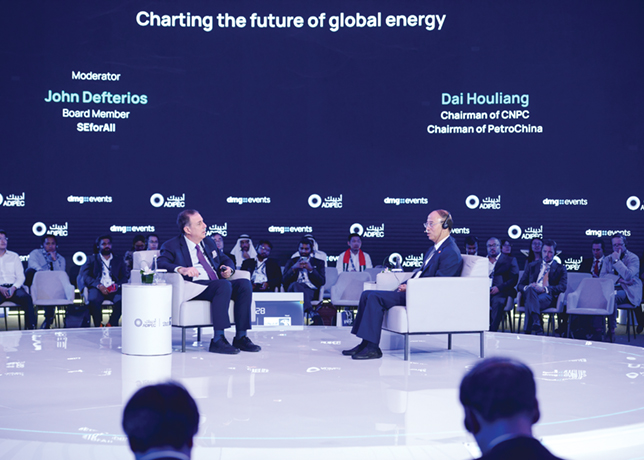
Its popularity may have been boosted by Chinese President Xi Jinping namechecking the system in his keynote speech at the conference.
“To further support global AI development and advance global AI capacity building, I hereby announce that in the next five years, China will provide developing countries with 5,000 opportunities in AI training and seminar programmes… and enable 30 countries to use the AI-powered meteorological warning system, or MAZU,” he told attendees.
Babar of PMD said MAZU can be tailored to a country’s geography, infrastructure and disaster risks by integrating local meteorological data.
Pakistani researchers and forecasters were trained to use a version calibrated to Pakistan’s data, he noted.
MAZU has also been deployed in Djibouti, Ethiopia, Mongolia, Jordan, Sri Lanka and the Solomon Islands.
China is also supporting over 40 countries with cloud-based, virtual trials of the system.
“What makes the platform valuable is that it brings conventional meteorology, satellite and radar data, ground-station observations and local calibration together with AI insights and warnings,” said Asim Javid, CEO of AI Geo Navigators, which uses AI, mapping data and remote sensing to gauge weather and environmental risk.
“Having all these inputs integrated in one place changes how forecasters work.”
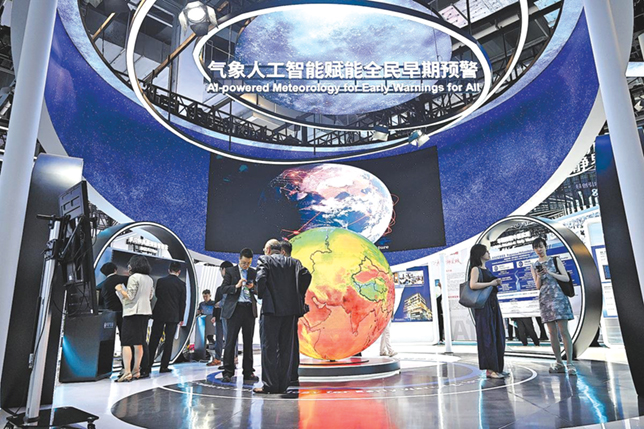
China is supporting over 40 countries with cloud-based, virtual trials of the MAZU system
FROM INSIGHT TO REAL-WORLD VALIDATION
While AI-based weather tools support early warning systems, these are not “stand-alone systems sufficient to address our gaps… at least, not yet,” said climatologist Imran Khalid.
An effective early warning system, Babar explained, requires a whole-of-government approach built around four basic components: Disaster risk management, detection and forecasting, dissemination and communication, and preparedness and response.
This holistic approach is endorsed by Junaid Yamin, Co-Founder, WeatherWalay, a Pakistani subscription weather forecast service.
“No single institution can tackle climate change alone. It requires breaking silos, sharing data and aligning government, business and civil society around a common mission,” said Yamin.
Javid echoed this, arguing that weather data should be “open source”.
“Rain and heat trigger many weather-related hazards, affecting businesses from telecom and banking to agriculture,” he said.
“Access to weather data can help businesses design products that reduce disaster losses.”
The WMO has been pushing for more “free and unrestricted exchange” of observational weather data through its 2021 unified data policy and its 2024-27 strategy, the latter emphasising partnerships with the private sector.
ONLY AS GOOD AS THE DATA FEEDING IT
Explaining how weather forecasts are generated, Babar said the atmosphere is “inherently chaotic”.
Even small changes in air pressure, temperature, wind and humidity can make accurate forecasting impossible through conventional methods alone, he noted.
That is where systems like MAZU can help.
“It can solve complex mathematical equations in seconds, enabling forecasters to make faster, more timely decisions,” noted Babar.
But these systems are only as good as the weather data feeding it.
“Unless we have good data, we will still be guessing and we will still be blind to the [potential] weather impacts,” said Khalid.
Such programmes can predict major events such as monsoons and heatwaves.
However, precise forecasts, such as when the monsoon will reach a particular valley in a mountainous region, or whether heat will trigger a glacial lake outburst flood, require dense, evenly distributed radar coverage that Pakistan lacks, he noted.
“Pakistan is a hard case,” noted Javid.
Ground stations are sparse, and in the country’s northern mountainous regions, terrain elevation can change dramatically over a few kilometres.
“Events that kill people happen at scales smaller than most global models [can forecast],” he noted.
MAZU cannot predict weather at the 1-km level, he said, and neither can most US and European models, which generally operate at around a 9-km resolution.
“It still depends entirely on the observations and models behind it,” Javid explained.
“Without detailed ground data, AI tools can effectively hallucinate, producing confident local forecasts with no real observational basis, resulting in serious consequences,” Khalid warned.
He said models can miss highly localised events, such as intense rain over a few neighbourhoods, or a cyclone’s precise landfall timing and location, leaving communities unprepared.
This includes training on historical weather patterns and flagging uncertainties about results it produces where there are data gaps.
He questioned the PMD’s technical capacity to manage the system, citing a World Bank-funded weather radar project that was ultimately scrapped, and an obsolete existing radar network long overdue for replacement.
Javid also pointed to another consideration: Accountability.
The use of an AI-supported system, such as MAZU introduces additional model outputs, or predictions based on processed data, and automated guidance.
These should be documented, while the authorised PMD forecaster retains responsibility for putting out the public warning, he noted.
“If a warning goes out, or an event is missed, someone has to be able to explain what produced that call. That needs traceability [of technical decisions] and a forecaster in the loop,” he said.
“Every warning should have a clear audit trail showing the observations, model outputs, thresholds and professional judgement behind it.”
He added that MAZU should make this judgement “sharper, not optional”.
To see if MAZU really works better than existing systems, Javid said he would use three simple measures, and “set the rules before the season starts, not after seeing what happened”.
First, he said, he would test how accurate MAZU’s forecasts are against PMD’s existing system and an independent benchmark, such as a recognised global forecasting system.
The second test would be hazard detection: “Can MAZU accurately identify dangerous weather events, not just predict ordinary weather?”
The third would be its practical value: how much extra warning time does it provide, and how many false alarms does it generate?
“For a deputy commissioner [the most senior administrator of a district], three extra hours to prepare can matter more than a small gain in temperature accuracy.”
He added that he would test it for “two monsoon seasons at minimum, along with winter and mountain [terrain] cases. If MAZU proves better on forecast skill, hazard detection and lead time, it adds real value. Otherwise, it’s a well-designed platform, not a validated one”.
Zofeen was previously Pakistan editor at The Third Pole. She is an independent journalist based in Karachi and writer at the Thomson Reuters Foundation, Dawn and the Guardian. She also contributes regularly to the Inter Press Service. This article was originally published on Dialogue Earth under the Creative Commons BY NC ND licence.