






























Sulphur management has long been treated as a cost of doing business; a regulatory box to tick rather than a source of value.
In the Middle East, where refineries and gas processing plants operate at some of the largest scales in the world, that thinking is starting to shift.
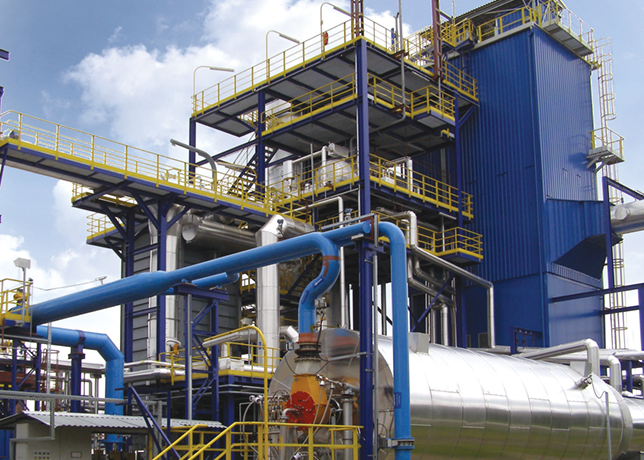
Wet gas sulphuric acid (WSA™) technology offers operators a way to turn sulphurous off-gas into a marketable product while cutting energy costs at the same time.
“This is a proposition with obvious appeal in a region defined by both hydrocarbon scale and industrial diversification ambitions,” Marie Vognsen, Topsoe, tells OGN energy magazine.
REGIONAL CHALLENGE, NOT JUST A REFINERY ONE
Sulphur recovery discussions tend to default to refineries, but the Middle East’s sulphur challenge is broader than that.
The region is home to some of the world’s largest gas processing complexes, many of them handling sour gas with significant hydrogen sulphide (H₂S) content.
Wherever sour gas or crude oil is processed, whether in a gas plant’s acid gas removal unit or a refinery hydrotreater , the resulting sulphurous off-gas needs to go somewhere.
Historically, that has meant the Claus process: Well-established and well-understood, but increasingly limited by the demands of modern operations.
The Claus process converts H₂S into elemental sulphur, and with tail gas treatment it can achieve high recovery rates. But it comes with real operational baggage.
Both tail gas units and incinerators add cost and complexity: The former through energy-intensive amine regeneration, the latter through external fuel combustion.
Claus units also struggle with lean or fluctuating sulphur streams, and with sour water stripper (SWS) gases in particular, where ammonia content can form salts that poison catalyst and foul equipment.
For gas plants and refineries running variable feedstocks – a common reality as crude slates diversify and gas fields mature – these limitations are real.
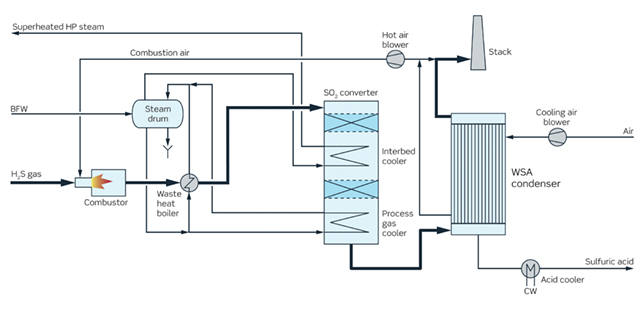
Figure 1 ... WSA flow chart
THE WSA ALTERNATIVE
Interestingly, the vast majority of above elemental sulphur is converted to sulphuric acid before its application in many different industries.
WSA takes an entirely different approach, and removes additional processes/ plants in generating sulphuric acid from elemental sulphur.
Rather than converting H2S into elemental sulphur it converts H2S directly to commercial-grade sulphuric acid (H₂SO₄) – the most widely used industrial chemical in the world after crude oil.
The process uses only air, cooling water and boiler feed water, with no chemical additives and no waste streams.
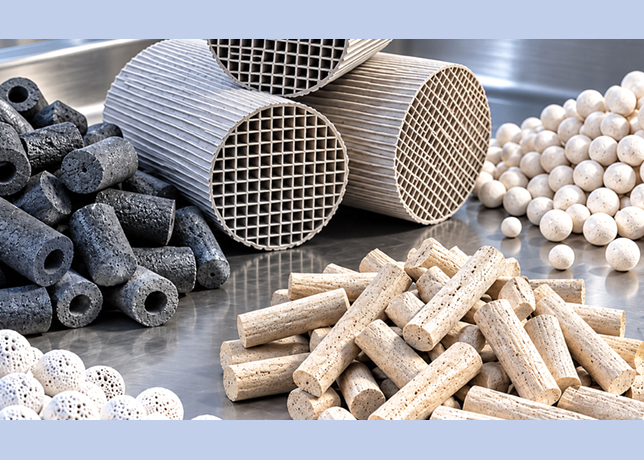
Topsoe’s process runs in three stages: H2S in the feed gas is first combusted to form SO₂ and water; the SO₂ is then oxidised to SO₃ across a multi-bed converter using Topsoe’s proprietary VK-W catalyst.
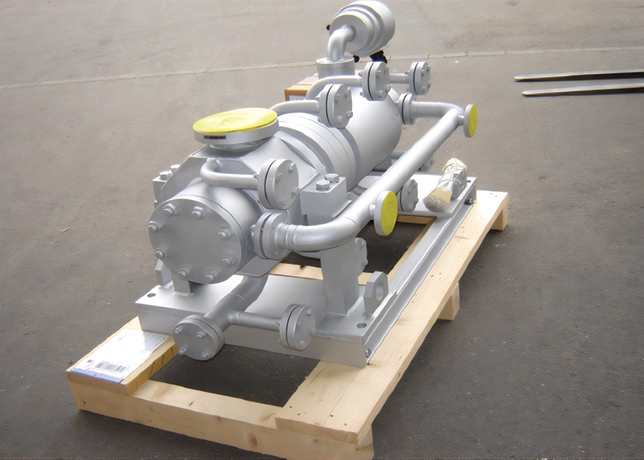
Finally, the SO₃ is hydrated by the water vapour already present in the process gas, forming sulphuric acid, which condenses in Topsoe’s purpose-built WSA condenser, recovering heat as it does so (Figure 1).
The result is commercial-grade acid and a clean gas stream, with SO₂ emissions that can be engineered down to below 10 ppmv.
THE EFFICIENCY CASE
The energy efficiency numbers are impressive.
More than 90 per cent of the thermal energy released by the process chemical reactions is recovered as high-pressure superheated steam, which can be integrated directly into plant operations to offset steam otherwise generated by fossil-fuel-fired boilers.
That is a direct operating cost reduction, independent of any emissions target.
Operationally, WSA units are compact, running close to atmospheric pressure, which simplifies both safety cases and maintenance planning.
Because the process operates at lower pressure than Claus, acid gas from the amine regenerator and sour gas from the sour water stripper can be supplied at reduced pressures – easing reboiler duties on the units feeding it.
And because WSA runs in full combustion mode, it avoids two persistent Claus headaches: Ammonia slip from the combustion chamber and soot-related catalyst bed choking.
FROM COST TO COMMERCIAL ASSET
The sulphuric acid produced is not a by-product to be disposed of, it is a saleable commodity, with established markets in fertiliser production, metallurgical leaching, water treatment and chemical manufacturing.
For operators in the Middle East and beyond, that creates a genuine second revenue line from what was previously a compliance obligation.
IndianOil’s Haldia refinery, for example, has used a WSA plant to convert acid off-gas into a product now feeding fertiliser and special chemicals production, while delivering the largest carbon savings recorded across the IndianOil group’s project portfolio.
PetroPeru’s Talara refinery has taken a similar approach, feeding WSA-derived acid into the copper mining and fertiliser sectors and reducing Peru’s reliance on imported chemicals, while the steam generated offsets natural gas otherwise burned on site.
Benchmarking against a modified Claus process with tail gas treatment at a greenfield refinery – both configurations targeting 99.9 per cent sulphur recovery – found WSA offset six times more than the Claus direct CO2 emissions and delivered higher-value steam output.
The economics increasingly favour the acid route too: At April 2026 Brazil CFR pricing, sulphuric acid traded at roughly $1,100 per tonne of sulphur-equivalent against around $870 per tonne for elemental sulphur – a meaningful margin for operators weighing which product to make.
A PRACTICAL PATH TO ADOPTION
None of this requires an overnight infrastructure overhaul.
Ageing Claus units can be phased out and replaced incrementally, letting operators build acid-handling experience and offtake relationships before committing further capacity.
Topsoe supports the transition end-to-end, from licensing and basic engineering through proprietary catalyst supply and commissioning, with its ClearView™ digital platform providing real-time monitoring and optimisation once the plant is running.
With more than 175 WSA units operating worldwide, handling process gas flows from 9,000 to over 1,000,000 Nm³/h across refining, gas processing and other industrial applications, the technology is de-risked and established.
For Middle East operators looking at both refineries and gas plants through an efficiency and value-creation lens, WSA offers a proven route to lower operating costs, a saleable product and a more resilient sulphur management strategy, regardless of where regulation moves next.
Topsoe is exhibiting at Stand 16190, Hall 16.