































































Sulphur recovery units (SRUs) are critically important to many natural gas processing facilities, oil refineries, chemical plants and even steel mills.
Although typically not a significant commercial output of these plants, elemental sulphur is recovered in the process of reducing harmful plant emissions.
Hydrogen sulphide (H2S) and sulphur dioxide (SO2) are both known pollutants that can be toxic to life at elevated levels.
As such, they are globally regulated, requiring their removal from process emissions.
The critical component of most SRUs – a modified Claus plant – has been consistently redesigned and modified to improve sulphur recovery efficiency to levels of 99 per cent or better.
However, many existing Claus plants were designed for, and are operating at, recovery efficiencies at lower levels.
For existing SRU operators that have recovery efficiencies that do not meet local regulation requirements, building a new, high recovery efficiency Claus unit can be financially and operationally difficult.
Instead, a tail gas treatment unit (TGTU) can, or in hundreds of cases, has been added to an SRU.
A TGTU is installed immediately after a Claus plant and converts any exiting sulphur (Sx) or sulphur components – SO2, carbonyl sulphide (COS), carbon disulphide (CS), etc – present in the tail gas leaving a Claus plant to H2S.
This H2S is then captured and returned to the front end of the Claus unit, where it is again processed for elemental sulphur recovery.
The result is extremely low, and well within regulation levels of H2S and SO2 being released to the environment.
As we have presented in a previous article a key facilitator in the reduction of SO2 in the TGTU is through the use of H2 injection in the reduction gas generator (RGG).
Hydrogen is an important reaction element within the TGTU.
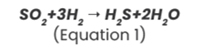
Under temperatures of 240-320 deg C, hydrogenation reactions occur across multiple sulphur-bearing species, converting them into H2S; see equation 1 for example:
It should be noted that H2 is typically present in the Claus tail gas, but it is critical that an excess amount is maintained in order to ensure reduction of other sulphur compounds.
Therefore, SRU plant operations use concentration measurements from process gas analysers to measure H2 levels.
If H2 levels are not consistently above a pre-defined level, additional H2 can be introduced into the TGTU for the required sulphur reduction.
A proven sensor for measuring H2 concentration in a TGTU, is a thermal conductivity detector (TCD).
Hydrogen has a significant ability to conduct heat, as compared to other gases that would typically be expected to be present in a TGTU gas stream.
This unique characteristic enables a TCD to continuously detect even slight changes in H2 concentrations in a sampled TGTU gas stream, when other technologies may take a significant amount of time to provide results.
In an effort to further increase SRU throughput and efficiency, some process changes have been implemented in the Claus plant, that are resulting in higher and often varying levels of carbon dioxide (CO2) being present in the TGTU process gas.
In measuring H2 with a TCD, this can be an issue, as CO2 is known to cross-interfere with TCD-based hydrogen readings.
AMETEK has provided trusted TCD based analysers for hundreds of TGTU measurement points globally.
However, a modified solution is required by end users that are experiencing changing CO2 concentrations in their operations.
To address this need, AMETEK has released the 993X Gas Analyser that incorporates multiple gas sensor technologies to provide an active CO2 compensation measurement and correction.
Using an infrared (IR) detector to measure the concentration of CO2, cross interference on the H2 measurement output can be corrected.
Even with increasing and changing levels of CO2, the impact on reported H2 concentrations is minimal.
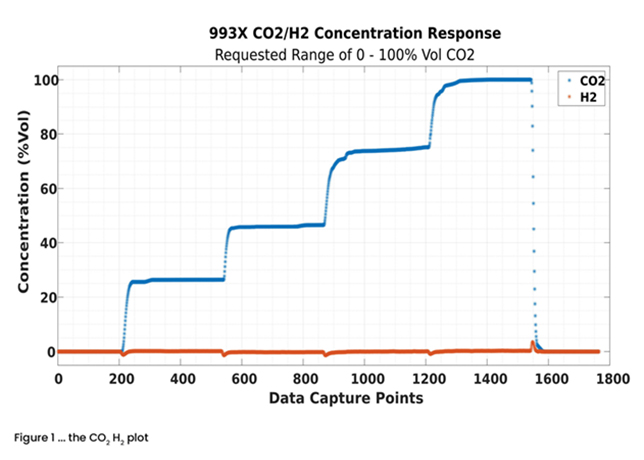
During factory validation, CO2 is introduced at multiple levels to assess the impact on the H2 sensor.
The concentration level of CO2 flowing through the analyser ranges from a minimum of 0 per cent to a maximum of 100 per cent, with steps changes occurring at 25 per cent, 50 per cent, and 75 per cent.
Utilising this information, a software adjustment can be made to the H2 output value providing a dynamic correction.
In the Figure 1, the H2 output remains stable, even as CO2 is introduced to the analysers at significantly elevated and changing levels.
The operational benefit is an accurate and real-time H2 measurement even during process changes or upsets.
If necessary, action can be taken to immediately increase H2 levels in the TGTU. This will protect the downstream scrubbing media and reduce the likelihood of a significant emissions event.
With ever increasing emissions regulations and focus on reductions in SRU down time and operating costs, the management of H2 levels in a TGTU is critically important.
So real time measurement of H2 is not a ‘nice to have’ but a requirement.
Knowing the current concentration of H2 enables decisions and adjustments to be made that ensure optimal TGTU operation.
But one also needs to be aware that changing concentrations of other components present in the tail gas stream, notably, CO2, can impact the measurement of H2.
Therefore, the use of a fit for purpose analytical instrument like the AMETEK 993X should be a high priority.
AMETEK Process Instruments is exhibiting at Stand 12525, Hall 12.