




















In 2025, the Alliance to End Plastic Waste (AEPW) claimed to have reduced 138,162 tonnes of unmanaged plastic waste and valorised 165,317 tonnes, bringing cumulative totals since inception to 378,147 tonnes reduced and 418,529 tonnes valorised, alongside generating $641 million in funding commitments from third parties and impact investors since 2019.
Beyond the metrics, education and behaviour-change initiatives reached over 1.5 million people since inception, while 559 organisations were engaged in 2025 to finance, develop, and implement projects.
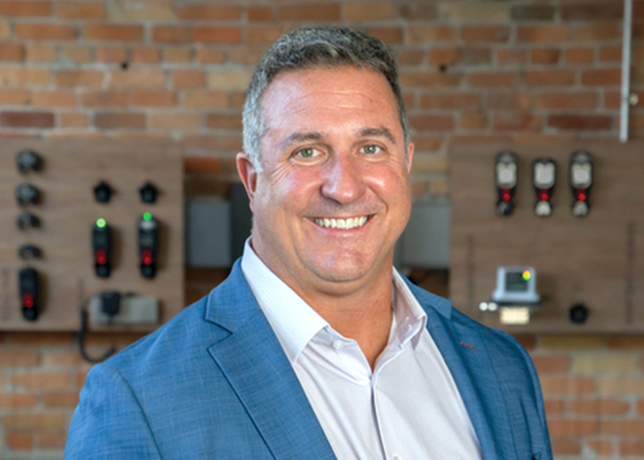
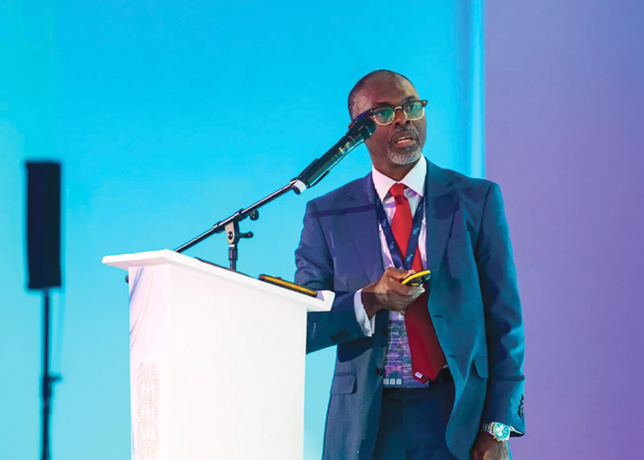
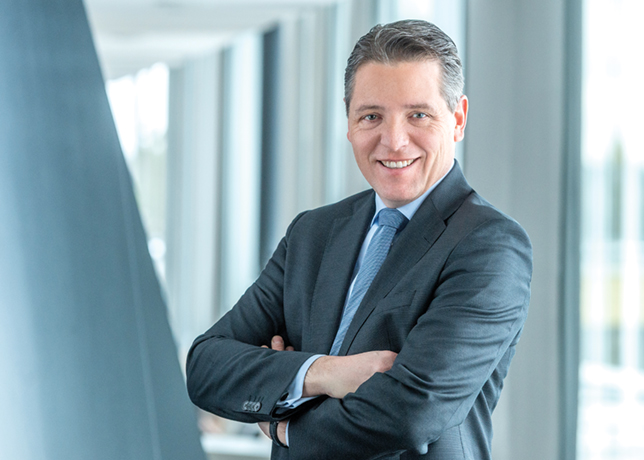
As noted by Jacob Duer, President and CEO, AEPW, addressing the challenge of plastic waste and plastic circularity is a multi-faceted issue that requires deep knowledge and sensitivity to socioeconomic, geopolitical, and cross-cultural considerations.
Economic volatility and geopolitical uncertainty continue to provide strong headwinds, slowing investment cycles and increasing risk sensitivity across the value chain, while global generation of plastic waste reaches approximately 360 million tonnes a year, a figure that has grown more than seven-fold in the last four decades.
Despite these headwinds, the organisation has shifted decisively from smaller, standalone projects to large-scale, integrated programmes focused on systems change in a select number of countries and thematic areas.
Through rigorous impact measurement, cumulative achievements since inception in 2019 include allocating $583 million of catalysed funding to mission-related activities, collecting a total member revenue of $509 million, and allocating $314 million directly to mission-related activities.
Furthermore, cumulative metrics show that the organisation has reached 1,509,498 participants through education programme.
During the single reporting period for 2025, the organisation installed 31,815 tonnes per year of technical capacity to collect and properly manage mixed solid waste, and secured total funding commitments of $100 million along side $58 million in total funding allocated.
REGIONAL IMPLEMENTATION OF INTEGRATED COUNTRY PROGRAMMES
Under Strategy 2030, AEPW has established country programmes in Brazil, the GCC beginning with Saudi Arabia, India, Indonesia, and South Africa, working in collaboration with national governments and development finance institutions with, at least, $100 million in co-financing for each territory to address both national and systemic barriers and support long-term sustainability.
In Brazil, which is the world’s fourth largest producer of plastic waste and Latin America’s most prominent producer of plastic resins, over 70 per cent of solid waste generated ends up in sanitary landfills, compared to Europe where the figure is 22 per cent.
Indonesia produces 32 million tonnes of unmanaged plastic waste, making it the second-largest contributor of mismanaged plastic waste globally.
The alliance’s strategy in Indonesia involves scaling proven solutions through coordinated interventions across the waste management system in partnership with AAIB’s solid waste management for sustainable urban development (SWM-SUD) project through loans with $150 million across more than 10 cities and districts.
In 2025, the Asian Infrastructure Investment Bank (AIIB) commissioned a mini Material Recovery Facility (MRF) in March 2026 as part of a 12-village pilot, to be incorporated into multiple project cities and regencies. It also committed up to $40 million for principles from the Malang Regency pilot.
In South Africa, where municipal systems are fragmented and capacity-constrained, strategy moves beyond pilots toward system-level implementation through projects such as the African Reclaimers Organisation, Green Corridors, and Eco Renew.
Having signed memorandums of understanding (MoU) with the Department of Forestry, Fisheries and the Environment and the Development Bank of Southern Africa, the organisation started a feasibility study in 2025 for an anchor project to develop integrated municipal-level solid waste management systems across six cities.
Meanwhile the African Reclaimers Organisation Phase III has advanced into detailed planning and Eco Renew concluded the first phase of expanding its facility to meet demand for recycled low-density polyethylene pellets.
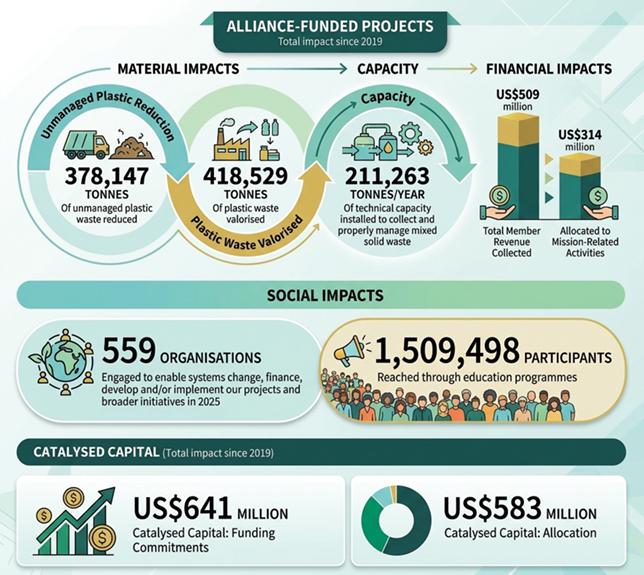
AEPW’s funded projects and their total impact since 2019
ADVANCING THEMATIC CIRCULAR SYSTEMS & FLEXIBLE PLASTICS
AEPW’s first Thematic Programme focuses on advancing circularity for flexible plastics, which are among the most widely used yet hardest-to-recycle materials due to their lightweight nature, diverse material compositions, and frequent use of multi-layer structures.
Technical solutions alone are insufficient for flexible plastics, as long-term success depends on creating economically viable recycling systems that can consistently produce high-quality recyclates with reliable end-markets.
This is underpinned by a market-driven strategy that ensures recyclate outputs meet end-market requirements before investments are made in infrastructure and technology.
Europe and North America serve as the initial focus of the Flexibles Thematic Programme, reflecting their more advanced development of required key conditions.
In the US, a study of recycled plastics from commercial and industrial sources has been commissioned to identify and quantify end-use applications, while in Phoenix, Arizona, support for RME Defeats Waste introduces on-site material baling and on-demand collection to help low-volume commercial waste generators recycle flexible plastics.
The RME Defeats Waste project has enabled a food manufacturing site to recover more than four tonnes of flexible plastic waste within three months and aims to deploy 35 mini balers across Metro Phoenix.
In Europe, work continues with London-based Nextek supporting COtooCLEAN technology, which uses supercritical carbon dioxide to remove contaminants from post-consumer flexible plastic films to enable recycling into high-quality, food-grade packaging applications.
Furthermore, the organisation advanced HolyGrail 2.0, driven by the AIM-European Brands Association, to prove the commercial viability of digital watermarks for accurate sorting of packaging waste.
This helped achieve industrial-scale plastic detection efficiency rates between 87.9 per cent and 93.8 per cent averaging 56,000 detections per day across 5,949 unique SKUs over a 100-day period.
The subsequent stage, HolyGrail 2030-Circular Packaging, shifts to market adoption programmes with early-adopter market demonstrations launched in Belgium for flexible polypropylene food packaging and Germany for rigid polypropylene food packaging, alongside a study on future infrastructure needs for flexibles collection and recycling building upon insights from the Circular Economy for Flexible Packaging in the EU.
Case studies in the technology portfolio further demonstrate progress. These include Fych Technologies in Spain, which developed patented processes for delaminating multi-layer plastics to eliminate internal inks and adhesives without degradation and using pure steam to eliminate volatile organic compounds (VOCs), semi-volatile compounds, and unwanted odours operating on a renewable energy framework at less than half the carbon footprint of virgin plastic production and heavy chemical recycling methods.
Additionally, Swiss company Bloom Biorenewables converts non-edible biomass into bio-based chemicals and materials through a chemical fractionation process, closing a Series A financing round of $15 million in April 2025 with participation from the Lombard Odier Investment Managers Plastic Circularity Strategy fund.
MOBILISING CAPITAL & UNLOCKING INSTITUTIONAL INVESTMENT
Mobilising capital remains one of the most significant challenges in advancing a circular economy for plastics at scale, particularly in emerging markets where waste management infrastructure remains underdeveloped and projects face financing hurdles due to perceived risk, limited track records, fragmented value chains, and uncertain revenue streams.
The organisation addresses this challenge by supporting financing approaches that mobilise capital at scale, collaborating with financing institutions to co-design financing mechanisms, and contributing technical expertise, concessional capital, and access to grant funding to help de-risk projects and reduce the overall cost of capital.
A key milestone includes participation in the Green Investments Partnership, a blended finance programme established under the Singapore Government’s Financing Asia’s Transition Partnership initiative and managed by Pentagreen Capital.
The initiative provides technical expertise in assessing recycling technologies, which increased its committed capital at second close with participation from public, private, and philanthropic providers including DBS and Cathay United Bank.
The organisation has continued its involvement in the Plastic Circularity Strategy fund co-designed and seeded with Lombard Odier Investment Managers.
The fund deploys growth equity capital into core impact propositions and recently reached its final close, alongside conceptual design work for a plastic waste outcome-based financing facility focused on Africa with a large commercial bank and an Asia Pacific-focussed facility.
Exploratory discussions are also underway with multilateral development banks regarding a potential financing facility focused on waste recycling across South and Southeast Asia.
Particular attention is paid to countries experiencing high levels of plastic leakage into the environment such as India, Indonesia, Vietnam, and Thailand.
Experience across blended finance programmes, private-sector investment vehicles, and development finance partnerships indicates that attracting capital requires investable project pipelines, financing structures that appropriately allocate risk, pooled capital vehicles with risk-sharing features, clear pathways to profitability within three to five-year investment timeframes, and access to continuous financing over seven to 15-year periods.
Demand-side signals, such as multi-year offtake agreements from end-market users and policy interventions like Extended Producer Responsibility schemes further strengthen project bankability and long-term economic viability.
Operational resilience is reinforced by interventions, such as bridging critical financing gaps through restructuring strategies, exemplified by issuing a Convertible Loan Note facility in 2025 to provide immediate liquidity and working capital support for an African recycling business facing operational continuity risks.
Sustained progress toward global plastic circularity depends on scaling integrated country programs, unlocking flexible plastic markets, and catalysing institutional investment to build resilient, long-term waste management infrastructure worldwide.