




























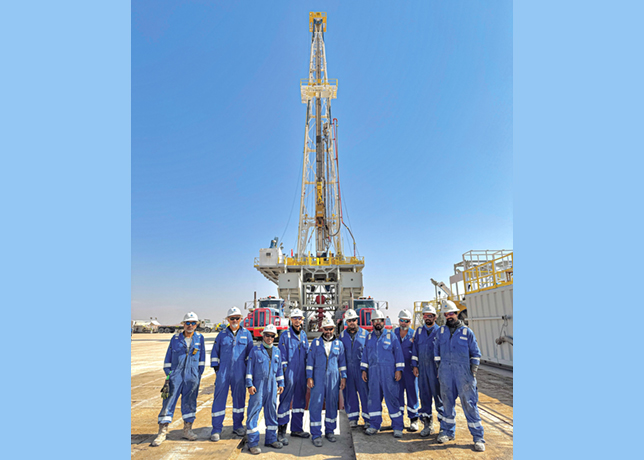



















The number and the size of discoveries have been declining at quite an alarming rate and with exploration budgets being cut across the industry, the number of wells drilled is likely to decrease further, finds research firm IHS in a study
Discoveries of new oil and gas reserves in 2014 was the lowest in 20 years, as not a single new 'giant field' with reserves of more than 500 million barrels of oil was found, a report citing research company IHS says.
The figures published by IHS excluded shale and other onshore reserves in North America.
'The number of discoveries and the size of the discoveries has been declining at quite an alarming rate … you look at supply in 2020-25, it might make the outlook more challenging,' the report quoted Peter Jackson of IHS as saying.
IHS says that the report is only preliminary and following later revisions, 2014 may prove to be the worst year for oil and gas exploration since 1952.
The shale boom in North America led to an oversupply in oil and triggered a sharp decline in oil prices in 2014. However, Jackson says that shale gas accounts only for about 5 per cent of global oil production.
The report highlights also that exploration budgets are being cut across the industry, so the number of wells drilled is likely to decrease further even if there is an increase in energy demand.
The revelations trigger the need for rising production from the existing sources, including shale gas fields. There are large shale gas reserves in China, Argentina and Russia, but a lot of work has to be done before the fields can be tapped to their maximum capacity.
Global reserves
Meanwhile as per Oil & Gas Journal’s (OGJ) annual survey, worldwide proved reserves show increases compared with a year ago. Reserves estimates for crude oil and lease condensate now total 1.656 trillion bbl, up from 1.647 trillion bbl reported in last year’s survey. Global natural gas reserves are 6.96 quadrillion cubic feet (qcf), climbing from 6.94 qcf a year earlier.
In 2014, global oil production is projected to average 76 million barrels per day (mbpd), up 1.8 per cent from a year earlier, led by higher output from the US.
Reserves changes
Australia’s proved crude oil and condensate reserves total 1.19 billion bbl, down from 1.43 billion in the previous survey, according to the most recent estimates from Geoscience Australia. The country’s gas reserves are now 30.4 trillion cubic feet (tcf), 29.4 per cent lower. The reserve estimates are classified based on development status of Commercial Category I.
Thailand’s Department of Mineral Fuels reported yearend 2013 proved reserves of 257 million bbl of crude and 204 million bbl of condensate. This compares with a combined 448.8 million bbl of crude and condensate recorded previously.
The newest oil reserves figure for China is 24.65 billion bbl, up from 24.38 billion bbl a year earlier. China’s latest gas reserves stand 5.5 per cent higher at 164 tcf. India posted small increases in reserves for both oil and gas, while Bangladesh registered a sizable decline of 12.7 per cent in its gas reserves.
In Western Europe, reported collective crude oil and lease condensate reserves slipped 5per cent to 10.6 billion bbl, as limited gains in Turkey and UK were more than offset by declines in the rest of the region. Gas reserves for this group of countries also fell 3.8 per cent.
According to the Norwegian Petroleum Directorate, Norway’s proved oil reserves declined 5.6 per cent to 5.5 billion bbl, and gas reserves declined 2 per cent to 72.3 tcf.
As a result of annual production and the relocation of probable reserves into the proved category, the UK’s latest proved reserves have been estimated at 2.98 billion bbl of oil and 8.5 tcf of gas, according to the Department of Energy and Climate Change.
Since 2013, the Netherlands’ resource reporting has been according to the Petroleum Resource Management System. Due to the introduction of PRMS, the Netherlands’ reserves reported last year are now modified to 149.7 million bbl of oil and 33.7 tcf of gas. The latest estimates from the Ministry of Economic Affairs show declines in both categories.
Estimates of proved oil reserves for countries in the Western Hemisphere total 549.6 billion bbl compared with last year’s 545 billion bbl. Gas reserves for the group now stand at 701 tcf, up from 669 tcf a year earlier.
Peru reported a large increase-17 per cent-in oil reserves to 741 million bbl because of a revaluation of reserves on Block 64 at Situche Central and other production sites.
The most recent estimates released by the Argentine Petroleum and Gas Institute reveal declines of 16per cent in both categories. Lower estimates for both oil and gas reserves also have been reported by Mexico.
According to Houston-based Ryder Scott Petroleum Consultants, Trinidad and Tobago’s proved natural gas reserves declined to 12.24 tcf in 2013 from 13.1 tcf in 2012, reflecting high production and low replacement.
Opec reserves
According to the most recent estimates from the Organization of Petroleum Exporting Countries’ (Opec) annual statistical bulletin, total oil reserves held by its member countries are now 1,206 billion bbl, up 0.4 per cent from a year ago. Gas reserves fell slightly by 0.1 per cent to 3,356 tcf.
Since the previous edition of this report, Opec has reported increases in oil reserves for Iran, Iraq, Qatar, Ecuador, and Venezuela.
Saudi Arabia’s oil reserves are slightly down 61 million bbl to 265.79 billion bbl, while its gas reserves are up 3 tcf to 293.7 tcf.
As a comparison, nearly all member countries in Africa reported declines in both oil and gas reserves. Oil reserves of this subgroup have registered a loss of 226 million bbl since the previous survey, while gas reserves are now 1.8 tcf lower than a year ago.
The share of the world’s oil reserves in Opec is little changed, standing at 73 per cent. Opec controls 48 per cent of total global natural gas reserves.
US, Canadian reserves
The US Energy Information Administration reported that, as of yearend 2012, US crude oil and condensate proved reserves increased year-over-year by 4.5 billion bbl, or 15.4per cent, to 33.4 billion bbl, because of a large volume of extensions to existing fields particularly in Texas and North Dakota as well as relatively constant oil prices during the report period.
Proved reserves in 2012 increased in three of the top five largest crude oil and lease condensate states, including Texas, the Gulf of Mexico federal offshore, and North Dakota.
Texas had the largest increase by a wide margin-about 3 billion bbl-which accounts for 67 per cent of the net increase in 2012. The Texas increase is primarily from ongoing development in the Permian and Western Gulf basins in the western and south-central portions of the state.
North Dakota reported the second-largest increase of 1.1 billion bbl, contributing to 25 per cent of the 2012 overall net increase, driven by development activity in the Williston basin.
Proved reserves of US dry natural gas decreased 7.8 per cent to 308 tcf and wet natural gas reserves decreased 7.5 per cent to 322.7 tcf in 2012. The average reference price of natural gas companies used to estimate reserves declined 34per cent between 2011 and 2012.
This prompted large downward net revisions to the proved reserves of existing gas fields, canceling out almost all the gains from total discoveries in 2012.
OGJ estimates that, as of yearend 2013, US crude oil and lease condensate proved reserves totaled 38 billion bbl and dry gas reserves increased to 338.8 tcf.
The latest estimate reported by the Canadian Association of Petroleum Producers (CAPP) indicates a slight decline (0.4 per cent) in Canadian oil reserves to 172.5 billion bbl. Oil sands reserves now total 167.2 billion bbl compared with 168 billion bbl last year.
According to CAPP, Canada’s gas reserves are recently estimated at 71.8 tcf, up from 66.7 tcf a year ago.
Oil production
Combined crude oil and condensate output in the Western Hemisphere will increase 6.9 per cent this year to 21.6 mbpd, led by strong increases in the US, Canada, and Brazil.
The US is the leading contributor to forecast regional and global supply growth, increasing 1.1 mbpd in 2014. Outputs in Canada and Brazil are projected to reach 3.5 mbpd and 2.2 mbpd, up 5.8 per cent and 8.2 per cent, respectively, from a year earlier.
Led by a reduction in Denmark, oil production in Western Europe is forecast to post a 0.5 per cent decline this year.
In Africa, production is forecast to fall 6per cent in 2014 to 7.6 mbpd, with reduced output in Algeria, Angola, and Libya.
Nigeria’s crude oil and condensate production averaged 2.19 mbpd in 2013, according to Nigerian National Petroleum Corp, and is expected to be roughly stable this year.
Preliminary estimates show slight growth of 0.3 per cent in Eastern Europe and the former Soviet Union area. Russia oil output is estimated to increase to average 10.49 mbpd this year vs. an average of 10.42 mbpd last year.
In the Asia-Pacific region, the collective oil output this year will slide 0.8 per cent due to declines in Indonesia, Thailand, Vietnam, and Brunei. Averaged oil production in China for 2014 will increase slightly to 4.18 mbpd from 4.17 mbpd a year earlier.
OGJ estimates that Opec production averaged 30.6 mbpd in 2013 and expects a fall of 0.2 per cent in 2014. Non-Opec production, meanwhile, is expected to rise by 1.4 mbpd in 2014.

