





















































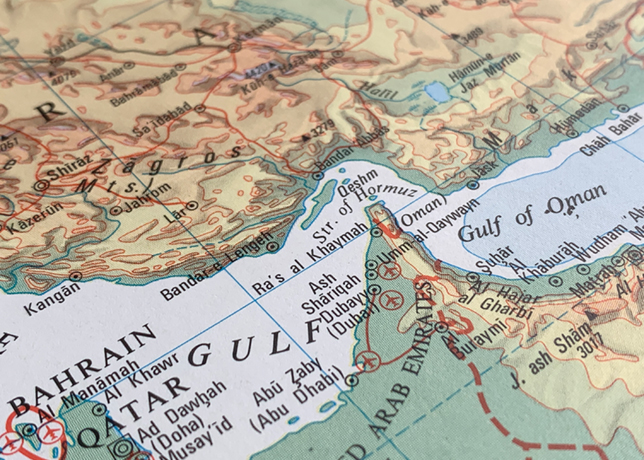

The Strait of Hormuz remained a principal conduit for global oil flows in 2025, with average shipments of 20 million barrels a day (bpd) of crude oil and products, equivalent to around one quarter of world seaborne oil trade.
Saudi Arabia accounted for 6.23 million bpd of the 19.87 million bpd exported through the Strait that year, including 5.43 million bpd of crude and 0.80 million bpd of products.
During H1 2026, disruption to shipping through the Strait required Aramco to activate established contingency arrangements across its domestic infrastructure, international storage and logistics network.
The company reported that it maintained production and exports by using the East-West Pipeline, storage capacity and export terminals, while coordinating supplies through the Arabian Gulf, Red Sea and Mediterranean routes.
Aramco’s reported second-quarter hydrocarbon production was 9.46 million barrels of oil equivalent a day (boed), down from 12.61 million boed in the first quarter.
Liquids production was 7.57 million bpd in the second quarter, compared with 10.56 million bpd in the preceding quarter.
The company attributed the lower volumes sold during the period to regional uncertainty, while higher prices for crude oil, refined products and chemicals supported revenue.
The company reported $67.18 billion in adjusted net income for the first half, compared with $52.03 billion in the corresponding period of 2025.
Its average realised crude-oil price in H1 2026 was $90.1 per barrel, compared with $71.5 per barrel in the same period last year.
EAST-WEST PIPELINE SUPPORTS WEST-COAST EXPORT RESPONSE
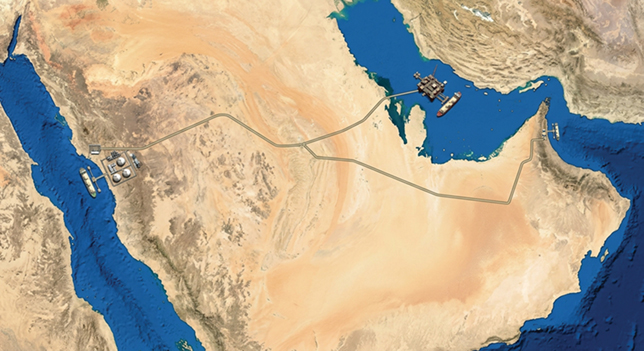
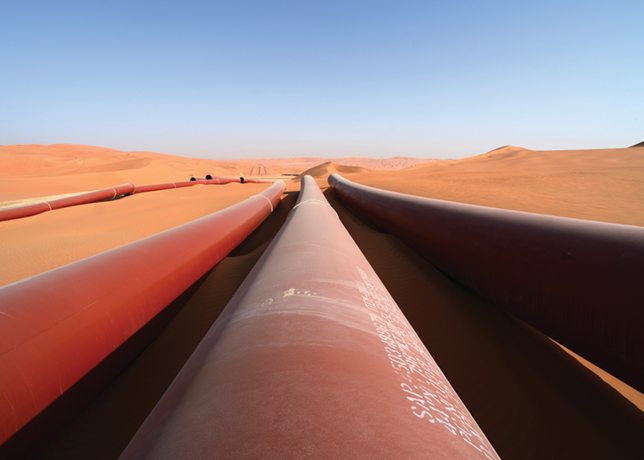
The East-West Pipeline, also known as the Abqaiq-Yanbu pipeline system or Petroline, connects eastern Saudi oil facilities to Yanbu on the Red Sea coast.
Aramco stated that it sharply ramped the system to its maximum capacity of 7.0 million bpd during Q1 2026, enabling higher crude exports through the Kingdom’s west coast.
The International Energy Agency (IEA) states that the system comprises two crude-oil lines with total design capacity of 5 million bpd.
Aramco reported in March 2025 that it had increased capacity to 7 million bpd; the IEA said sustainable flows at that level had not been tested as of early 2026.
It estimated that about 2 million bpd of pipeline capacity was in use at that point, leaving between 3-5 million bpd available, subject to operating conditions and west-coast export capacity.
Aramco said its first-quarter response included rerouting crude volumes through the East-West Pipeline to alternative export routes and drawing on domestic and international storage.
Its first-quarter report described the measures as part of business-continuity plans developed through scenario planning and said the effects of the regional events were not material to the company’s financial position, operating results or cash flows at March 31, 2026.
The company’s downstream network also processed approximately 51 per cent of Aramco crude production during the first quarter.
Despite temporary disruption at some domestic refining and processing facilities, downstream supply reliability was 96.3 per cent, supported by the integrated global network, product-flow optimisation and logistics operations.
STORAGE, TERMINALS & MULTIPLE ROUTES WIDEN OPTIONS
Aramco continued to deploy the East-West Pipeline in the second quarter, while enhancing west-coast export infrastructure and repositioning the Yanbu export terminal as a strategic hub for western-region shipments.
It reported downstream supply reliability of 98.4 per cent for the quarter, supported by logistics flexibility, domestic and international storage, and alternative export routes.
The company stated that it maximised throughput and exports from west-coast refineries and terminals, deployed its full fleet, and optimised vessel turnarounds.
It also cited storage across Asia, Europe and the Middle East as part of the arrangements used to serve customers during the period.
These assets form part of a regional system in which bypass options remain limited.
The IEA estimates that Saudi Arabia and the UAE together had 3.5-5.5 million bpd available crude-export capacity on routes that bypass the Strait of Hormuz.
The UAE’s Abu Dhabi crude oil pipeline connects Habshan to Fujairah and has reported capacity near 1.8 million bpd.
Aramco reported that it remained prepared to resume eastern-region exports rapidly when regional conditions improved, supported by contingency plans, strategic inventories and its integrated logistics network.
Its first-half presentation identified the Arabian Gulf, Red Sea and Mediterranean as the three routes used in its coordinated supply response.