




















Walk through any major pipeline or fabrication project in the Kingdom today and the direction of travel is clear: mechanised carriages track around pipe joints, programmed orbital systems lay down weld after identical weld, and high-deposition processes move through heavy sections at rates no manual welder could match.
The question facing the oil and gas industry is no longer whether welding will be automated, but who will operate, programme and maintain the systems that do it.
The Maharat Construction Training Centre (MCTC) was built to answer that question.
Established in February 2022 as a not-for-profit institution through the merger of two strategic partnership institutes, MCTC brings together the expertise of Saudi Aramco, the Technical and Vocational Training Corporation (TVTC) and the Human Resources Development Fund (HRDF).
Its mandate flows directly from Saudi Vision 2030: Close the skills gap, develop Saudi technical talent and prepare the national workforce for industries that are changing faster than traditional vocational training can follow.
-on-a-pipe-section.jpg)
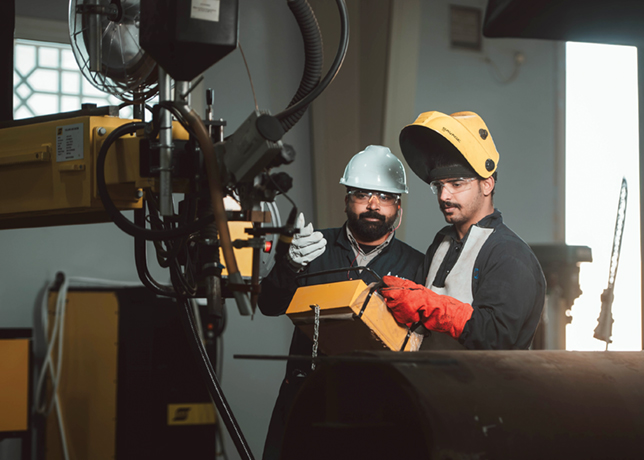
A Maharat trainee performs flux-cored arc welding (FCAW) on a pipe section
INSIDE THE AUTOMATED WELDING WORKSHOP
What sets MCTC apart is the practicality of its approach.
Rather than teaching automation from a textbook, the centre’s advanced welding workshop puts trainees in front of the same technologies now being deployed across pipeline, process-piping and fabrication work in the Aramco network.
The programme begins where every pipe weld begins: The root pass.
Trainees gain hands-on exposure to Surface Tension Transfer (STT), the controlled short-circuit process that has transformed open-root pipe welding.
By managing metal transfer and heat input with precision, STT achieves the required penetration while guarding against burn-through, delivering the consistent, low-spatter root that the integrity of every subsequent pass depends on.
From there, the workshop moves into mechanised and automated pipe welding.
In semi-automatic orbital welding, a carriage or welding head carries the torch around the circumference of the pipe while the operator manages parameters and technique, a natural fit for pipe-spool fabrication, where hundreds of similar circumferential joints demand repeatable conditions.
Fully automatic orbital welding takes this further: Travel speed, current, voltage, wire feed and oscillation all run to a programmed, qualified procedure, so that once a welding programme is established, joint after joint can be produced under identical, controlled conditions.
The heavy end of fabrication is covered too.
Submerged Arc Welding (SAW) training gives personnel practical knowledge of high-deposition welding for thick materials, large-diameter pipe, tanks and pressure equipment, while Miggytrac mechanised MIG/MAG systems demonstrate how even long structural and tank welds can be brought under controlled, consistent travel without a full robotic installation.
For oil and gas operators and contractors, the benefits of this technology set are well understood: Higher productivity, weld-to-weld consistency, tighter process control and predictable production across high-volume work.
What has been missing is a pipeline of people trained to use it.
That is the gap MCTC’s workshop is closing.
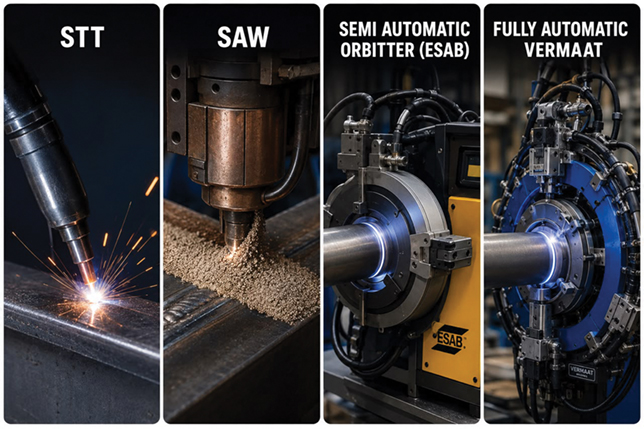
Automated and semi-automated welding processes
PARTNERSHIPS WITH THE TECHNOLOGY LEADERS
MCTC’s advanced welding capability is anchored in partnerships with three of the leading names in welding technology: ESAB, Lincoln Electric and VERMAAT.
ESAB brings deep experience across welding, cutting, automation and orbital systems; Lincoln Electric’s technology underpins the STT and mechanised pipeline welding training; and VERMAAT, a specialist in welding automation for pipe fabrication, provides direct exposure to advanced automatic orbital systems.
The result is training connected to the actual equipment trainees will meet on site, not a classroom approximation of it.
International recognition has followed, and on March 13, 2025, MCTC received SENSE recognition from the American Welding Society, aligning its programmes with AWS QC10 and QC11 standards and positioning the centre to offer internationally recognised SENSE Level I and II welding certifications alongside its TVTC-accredited diplomas and AWS-accredited automated and semi-automated welding programmes.
THE WORKFORCE VISION 2030 NEEDS
The next generation of welding professionals will need more than a steady hand; they will need to operate and programme robots, run automated welding cells, work with sensors and process monitoring, use simulation and offline programming, and troubleshoot and maintain the systems themselves — the full toolkit of Industry 4.0 fabrication.
MCTC is expanding its programmes precisely along these lines, extending from automated and semi-automated welding into robotic welding and digital welding technologies.
The impact reaches beyond individual careers.
Every Saudi welder trained on automated systems strengthens Saudisation, raises industrial productivity and deepens the Kingdom’s capacity to deliver its own energy and infrastructure projects.
In under three years, MCTC, working alongside Saudi Aramco, TVTC, HRDF, AWS and its technology partners, has reshaped vocational training in the construction sector.
The ambition now is larger still: To establish MCTC as a regional centre of excellence for advanced and automation welding, producing a workforce that is skilled, certified, productive and safe, and ready for the automated era of Saudi industry.