
















































Companies supplying the global energy industry are earning a record share of their revenue overseas, but they continue to avoid expanding into new export markets.
Developing business in new countries was the least-deployed business strategy for the 10th consecutive edition of the report, according to the latest Survive and Thrive report by the Energy Industries Council (EIC), a global energy trade association.
This is despite the average share of revenue from exports increasing to 57 per cent in 2025 from 49 per cent in the previous year, its highest level in four years.
But this growth is coming primarily from established markets.
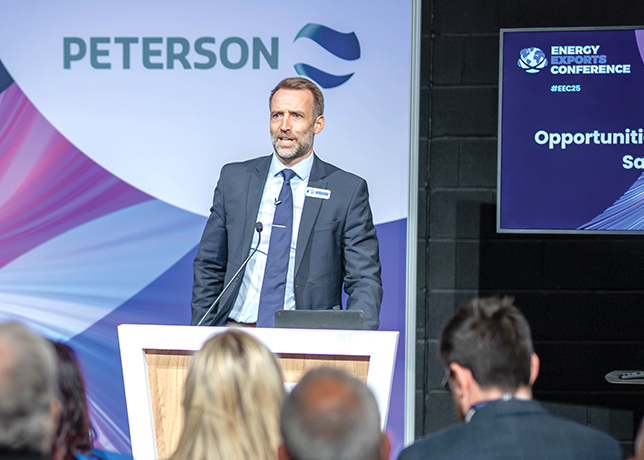
“Most companies are growing through markets where they already have customers, partners and delivery experience,” Ryan McPherson, EIC’s Regional Director for Middle East, Africa and CIS Region, tells OGN energy magazine in an exclusive interview.
The report is based on interviews and case studies from 136 energy supply-chain companies based in the UK and Ireland, Europe, the Middle East and Africa, Asia-Pacific, North America and South America.
It shows that 75 per cent of companies made record revenues in 2025, while 91 per cent expect continued growth this year, forecasting average revenue growth of 32 per cent.
In place of expansion strategies, companies are pivoting in 2026 towards resilience, which accounted for 18 per cent of business strategies.
That’s up eight percentage points from the previous year.
In a similar vein, optimisation jumped to 19 per cent from 12 per cent, while diversification remained the most common strategic response at 25 per cent.
The findings point to growing confidence in existing operations rather than confidence in the wider investment environment.
The report also reveals a gap between announced energy ambitions and projects reaching construction.
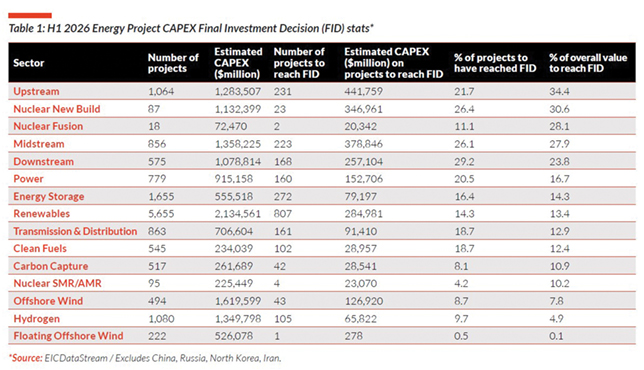
Around one-quarter of upstream, midstream and downstream projects under development have reached final investment decision (FID), compared with 13 per cent in renewables, 10 per cent in hydrogen, 8 per cent in carbon capture and 8 per cent in offshore wind (Table 1).
Less than 1 per cent of floating offshore wind projects have secured FID.
Oil and gas continues to underpin much of the industry’s revenue base.
The majority of respondents, 94 per cent, are active in the sector, which generates an average of 59 per cent of company revenue.
Meanwhile, participation in renewables declined to 49 per cent from 59 per cent, although renewables’ average contribution to revenue increased modestly to 13 per cent.
The report also found that companies are spreading commercial risk amid uneven project delivery across parts of the energy transition by diversifying their activities beyond energy.
Average non-energy revenue reached 32 per cent, while non-energy sectors ranked among the leading investment priorities in Asia-Pacific, the Middle East and Africa, and Europe.
Below are excerpts from the interview:
Why has developing business in new countries remained the least-deployed strategy for the tenth consecutive year despite export revenues climbing to 57 per cent?
Because earning more overseas is not the same as entering a completely new country.
Most companies are growing through markets where they already have customers, partners and delivery experience.
Most of the times, entering a new country requires capital and local knowledge, before there is any clear return.
Companies are exporting more, but that’s happening in places where they’re already active.
Given that 75 per cent of companies reported record revenues in 2025, how concerning is it that this growth relies almost exclusively on established markets rather than geographic expansion?
What our data shows is that there is a strong preference for familiar markets.
That’s not necessarily a weakness; if anything, it’s often good risk management.
The concern is that companies could become too dependent on a narrow group of markets if entering new countries continues to be costly and difficult.
With resilience and optimisation jumping significantly as corporate strategies for 2026, to what extent are supply chain firms retreating into protective operational silos?
What our evidence shows is there’s greater discipline around costs, productivity and risk.
Companies are using a strong revenue period to make their operations more robust because they don’t assume current conditions will last.
This could evolve into a real problem only if that caution starts to restrict investment and hiring.
How do you reconcile the industry forecasting average revenue growth of 32 per cent this year with the widespread reluctance to take risks in unfamiliar international territories?
Companies develop this growth forecast mostly based on revenue they expect to generate from markets they’re already active in.
They understand the customers, the regulatory environment and the route to work.
That gives them confidence about revenue without making them more willing to place speculative bets elsewhere.
They are optimistic about their existing position, but selective about where they take new risk.
With only 14 per cent of renewables, 10 per cent of hydrogen and 8 per cent of carbon capture projects reaching final investment decision, what is causing this severe execution bottleneck in the energy transition?
The report points to a combination of financing, slow approvals, infrastructure constraints and uncertainty over future revenues.
In many cases, the project pipeline is large, but too little of it is given the go-ahead to begin construction.
The supply chain cannot invest against ambition alone. It needs projects with finance, credible schedules and a clear route into construction.
How alarming is the finding that floating offshore wind projects have achieved a final investment decision rate of less than 1 per cent?
It is clearly a warning sign, and it shows that the sector has a large development pipeline but very little committed activity.
That doesn’t mean floating wind has no future, but it does show that project maturity and bankability remain serious problems.
The supply chain will not build specialist capacity unless it can see a sustained flow of funded projects.
Given that oil and gas still underpins 59 per cent of company revenue while participation in renewables dropped to 48 per cent, is the supply chain quietly pivoting back to traditional hydrocarbons for security?
I would describe it as a commercial reallocation rather than a strategic rejection of renewables.
Companies move their people and capital towards work that is funded and ready to proceed, and at the moment, oil and gas still provides more of that certainty.
The supply chain is still active in the transition industries, but it cannot hold capacity indefinitely for projects that don’t reach investment decisions.
When industry leaders state that businesses do not need more targets, which specific government policies or approval processes are most urgently failing the supply chain?
The main issues are unstable policy, slow permitting, delayed grid connections and weak coordination around infrastructure.
Companies are being asked to make long-term investments while fiscal and regulatory conditions can change within brief political cycles.
There are also gaps in project-backed finance and export support, particularly for smaller firms.
Without a predictable policy framework and a bankable project pipeline, how can governments realistically expect private capital to unlock stalled low-carbon infrastructure?
Governments cannot expect capital to move just because a target has been announced.
With investors, clarity on revenue is always a top priority, then of course a clear approval process, adequate infrastructure and how risk will be shared.
Governments don’t have to finance every project, but they do have to create conditions in which projects can be financed.
Without that, capital will move to sectors or countries where the risk is better assessed and understood.
With non-energy sectors now accounting for 31 per cent of average company revenue, are supply chain firms actively diversifying away from the energy industry altogether to safeguard their balance sheets?
For most companies, this looks more like a hedge than an exit from energy.
Their engineering, manufacturing, and logistics capabilities can often be used in adjacent sectors, which helps retain people and keep facilities active when energy projects are delayed.
Although that is sensible business management, it is also one that should concern policymakers if energy companies increasingly have to look outside the sector for dependable work.