












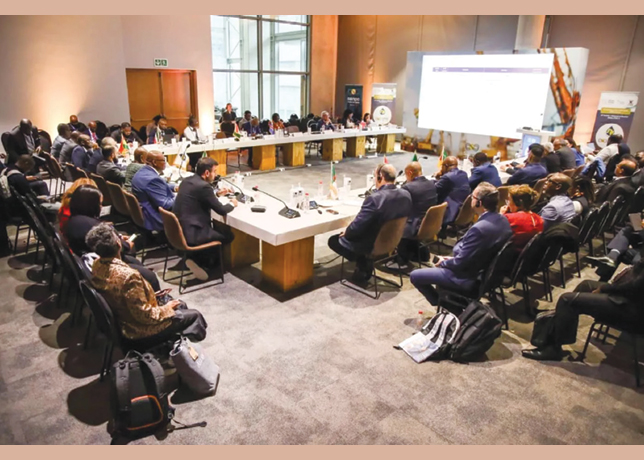














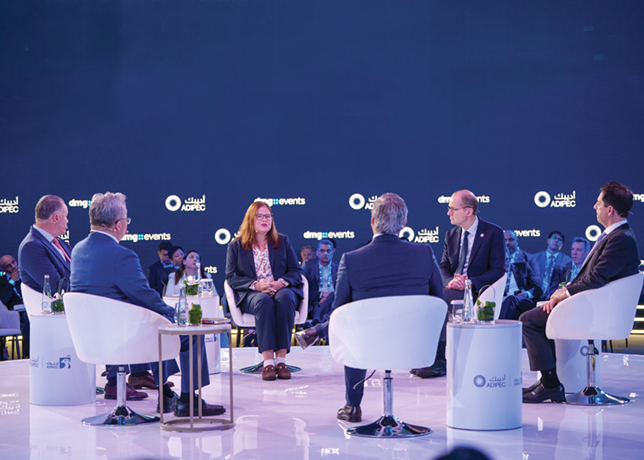
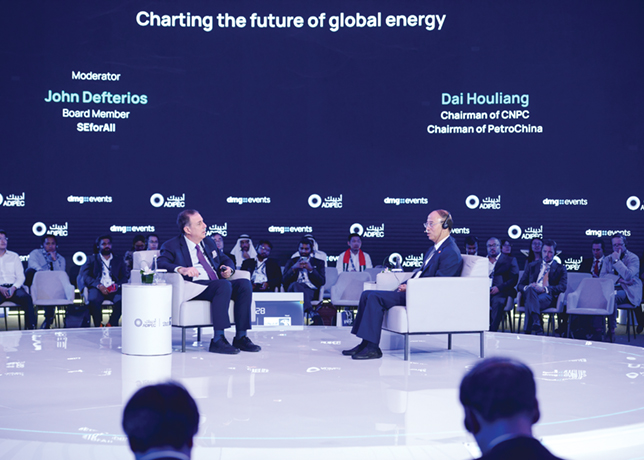
Global energy leaders converge on Abu Dhabi from November 2-5 to confront mounting geopolitical turbulence, infrastructure vulnerabilities, and structural demand growth across international markets.
ADIPEC highlights the Middle East’s role in global energy supply and its growing influence through investments in natural gas, renewable energy, chemicals, and infrastructure.
Taking place at the Abu Dhabi National Exhibition Centre, the event is held under the patronage of His Highness Sheikh Mohamed bin Zayed Al Nahyan, President of the UAE, and hosted by ADNOC.
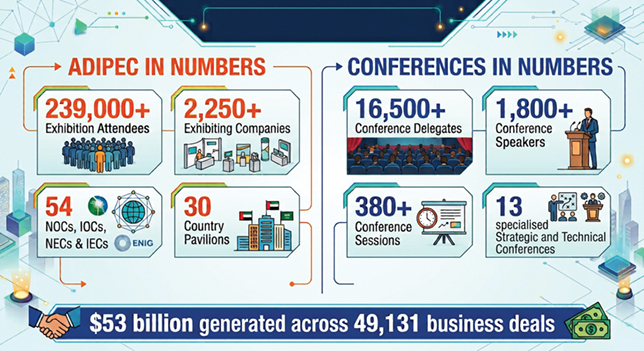
Organisers dmg events expect 239,000 attendees from more than 170 countries, alongside over 2,250 exhibiting companies across 16 halls, 1,800 speakers, and 30 country pavilions.
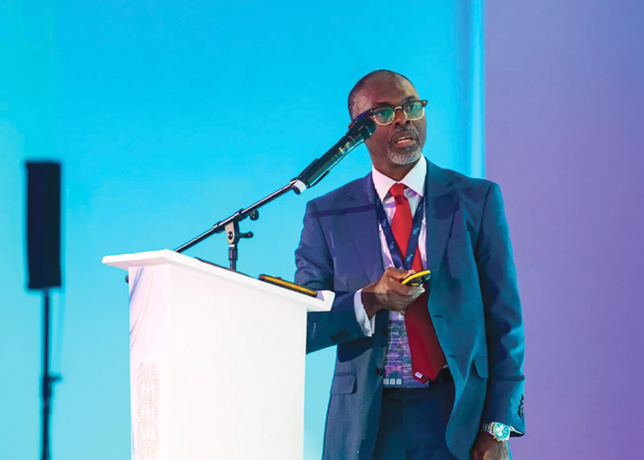
Abdulmunim Saif Al Kindy, Chair of ADIPEC, stated: “This year’s ADIPEC comes at a defining moment for the global energy industry. We face the challenge of a more disrupted and exposed system, meeting a more energy intensive economy. But, while shocks and conflicts disrupt the system, the world needs more energy, in more forms, delivered more reliably to meet rising demand. And we need the investment, advanced technology and partnerships to make that happen. That is the agenda for action at ADIPEC 2026.”
Confirmed regional and international leaders attending include Suhail Al Mazrouei, UAE Minister of Energy and Infrastructure, and Karim Badawi, Egypt’s Minister of Petroleum and Mineral Resources.
Other participating ministers include Saleh Kharabsheh from Jordan, Dr Mohamed bin Mubarak Bin Daina from Bahrain, Joseph Al-Saadi from Lebanon, and Dr Khalifa Rajab Abdulsadek from Libya.
International participants feature Katharina Reiche, Federal Minister for Economic Affairs and Energy from Germany, Dr Alparslan Bayraktar from Türkiye, and Takagi Kei from Japan, alongside Jassim Alshirawi, Secretary General of the International Energy Forum.
NEW STRATEGIC ADDITIONS
The newly restructured ADIPEC Strategic Conference reflects the shifting realities of the global energy landscape, where mounting demand, geopolitical volatility, and infrastructure pressures demand a move from high-level dialogue to concrete execution.
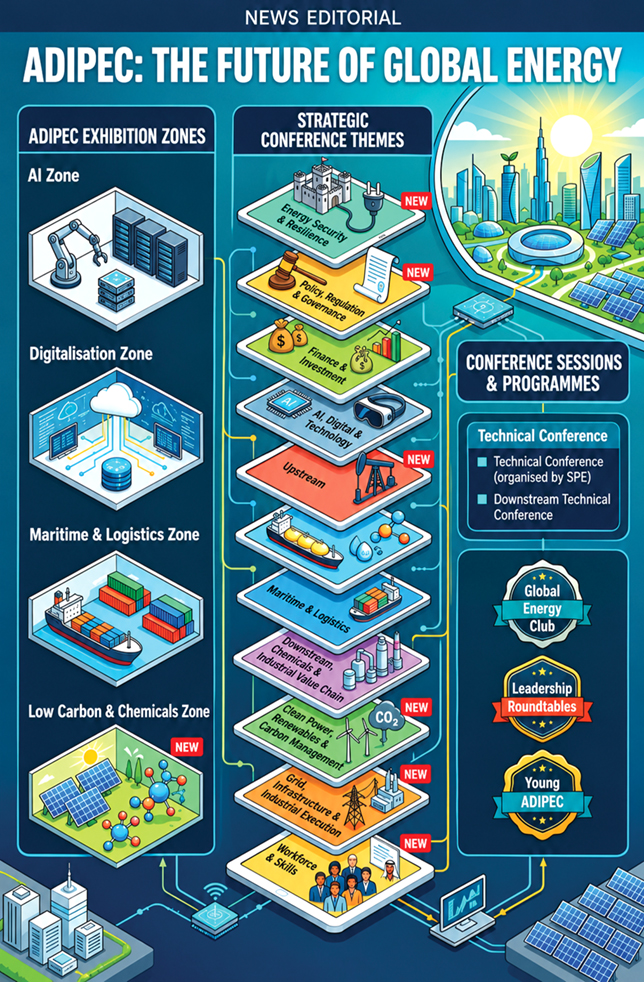
To tackle these complex challenges head-on, the conference has introduced six new dedicated pillars designed to align international priorities, accelerate investment decisions, and strengthen system-wide resilience.
• The Energy Security and Resilience conference convenes ministers, energy producers, utilities, infrastructure operators, security experts, and investors to shift resilience from a defensive priority to a core pillar of energy strategy.
Discussions will centre on preparedness for external shocks, contingency planning, system flexibility, infrastructure protection, supply chain resilience, and practical measures to absorb disruption while maintaining affordability and reliability.
• The Policy, Regulation & Governance conference brings together ministers, regulators, private sector executives, investors, legal experts, multilaterals, and strategic advisers to address the friction between growing market complexities and lagging regulatory frameworks.
Discussions will focus on establishing regulatory certainty, market design, permitting reform, institutional coordination, and governance models that accelerate capital deployment and project delivery.
• The Upstream conference convenes operators, independents, investors, EPCs, and technology leaders to reinforce supply continuity and convert resources into resilient production amid geopolitical pressure and tighter capital discipline.
Discussions will centre on portfolio architecture, partnership models, recovery optimisation, contingency readiness, project delivery, and technological deployments that enhance asset performance and capital efficiency.
• The Clean Power, Molecules & Carbon Management conference will gather energy producers, project developers, off-takers, traders, policymakers, and investors to shift low-carbon technologies and cleaner molecules from policy-led aspiration to delivery-led discipline.
Discussions will focus on project bankability, molecule infrastructure, trade corridor development, market design, industrial decarbonisation, manufacturing competitiveness, and regulatory frameworks required to scale renewables, hydrogen, nuclear, and CCUS.
• The Grids, Infrastructure & Industrial Execution summit will address physical bottlenecks in energy delivery by bringing together grid operators, utilities, infrastructure developers, EPC contractors, industrial manufacturers, technology providers, and investors.
Discussions will centre on grid modernisation, midstream and offshore infrastructure expansion, energy storage, critical mineral supply chains, port readiness, permitting reform, and procurement strategies necessary to build integrated physical systems.
• And the Workforce & Skills conference will convene senior energy executives, operators, project leaders, technology providers, and workforce decision-makers to address cross-sector talent friction, generational shifts, and severe role shortages across complex operations.
Discussions focus on leadership succession, knowledge transfer, localisation strategies, cross-sector talent mobility, and building workforce readiness for digital and AI-enabled operations to sustain long-term system performance.
These six new focus areas operate alongside five established strategic streams, including Finance & Investment; AI, Digital & Technology; Natural Gas & LNG; Maritime & Logistics; and Downstream, Chemicals & Industrial Value Chains.
All together, these complete the 11-programme agenda designed to address capital deployment, digital transformation, fuel flexibility, supply chain integrity, and industrial integration.
Beyond the strategic discussions, ADIPEC integrates practical technical expertise, immersive technology showcases, and elite networking channels to drive comprehensive industry alignment.
The Technical Conference delivers field-proven engineering solutions across upstream system performance, refining, and chemical processing, while the dedicated ADIPEC Exhibitions, featuring specialised AI, Digitalisation, Maritime & Logistics, and Low Carbon & Chemicals zones, allow providers to demonstrate scalable applications ranging from predictive analytics and robotics to hydrogen and carbon capture networks.
High-level alignment is further reinforced through the invitation-only Global Energy Club and the Chatham House Rule Leadership Roundtables, where ministers, CEOs, and investors candidly align on policy, capital mobilisation, and strategic priorities, while the Young ADIPEC initiative develops STEM-focused talent to support the next generation of energy leadership.
Together, these interconnected conference streams, technical showcases, and executive forums consolidate ADIPEC’s position as the premier global platform for aligning policy, mobilising capital, and driving real-world execution across the modern energy ecosystem.