





















Blackline Safety is bringing its newest portable gas detector to the Gulf’s biggest energy stage, ADIPEC, this November.
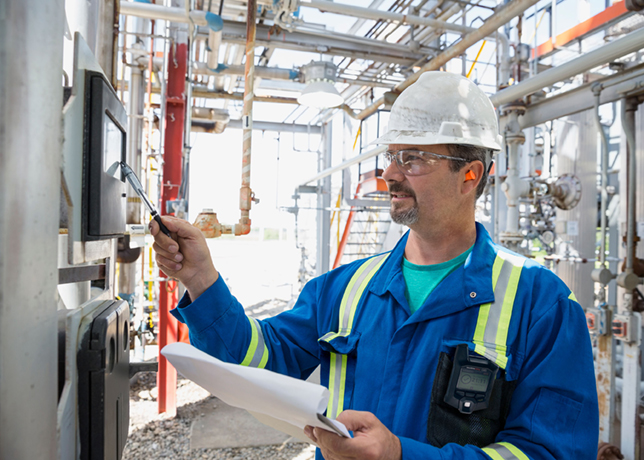
G8, the most connected safety wearable ever made, combines multi-gas detection, lone-worker monitoring, GPS location and push-to-talk communication in a single, intrinsically safe device.
By bringing multiple layers of protection and communication together, G8 can help operators understand their worksites better, improving both day-to-day operational efficiency and worker safety.
Since shipping began in March, G8 has already picked up multiple industry safety awards, and the team is looking forward to demonstrating it for the first time in the Middle East, alongside the popular G6 single-gas detector, and EXO 8 area monitor, which are already helping organisations manage worker safety in the region.
But G8 isn’t the only new technology Blackline is bringing to Abu Dhabi. The company will also showcase its new ZoneAware™ geofencing functionality now available across all its portable gas detection and lone worker devices, through Blackline Live software.
This zone intelligence capability adds operational context to location data, helping energy companies understand where workers are, how they are moving through a site, where activity is concentrated, and where previously manual safety process can be automated or simplified.
ADDING SITE CONTEXT WITH ZONE INTELLIGENCE
ZoneAware™ builds on industrial geofencing by enabling organisations to draw, name, and manage digital zones across a live map of their worksite.
These zones represent real operational areas, such as muster points, confined spaces, gas collection areas, break areas, access roads, or hazardous high-risk areas.
As connected safety devices move through these zones, their location data is automatically tied to context.
Instead of seeing only raw coordinates, teams can understand activity in terms that reflect how the site actually operates.
While ZoneAware™ is relevant across industries, its true value becomes more evident when you see how it plays out in real operational scenarios, with streamlined mustering during drills and real evacuations a real benefit across oil and gas, petrochemical processing and large infrastructure projects, where mustering has traditionally relied on paper roll calls, supervisor headcounts and radio coordination.
While that model holds up on a small site, it strains on a super-complex, a sprawling pipeline network, or any operation where crews and contractors are spread across long distances, remote valve stations and multiple simultaneous work fronts.
With ZoneAware™, muster zones are clearly defined on the map.
When an alert is triggered, safety leads can instantly see how many workers are in evacuation zones versus muster points. Workers check in automatically when they enter the muster zone with their devices.
The result is a continuously updated muster list showing who is on site, where they are, and whether they’ve reached the assembly point, replacing a manual headcount with automated accountability.
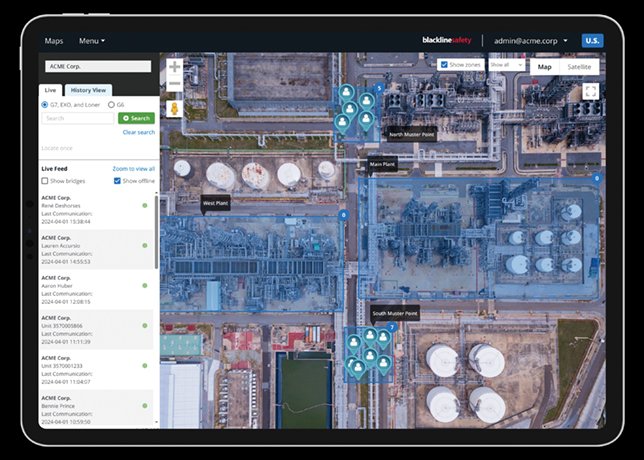
During a drill or real evacuation, workers check in automatically when they reach a muster zone, giving safety leads a live headcount instead of a manual roll call
FROM EMERGENCY RESPONSE TO EVERYDAY OPERATIONS
The same zone-based visibility extends beyond emergency response into daily operations.
Teams can maintain live headcounts, monitor occupancy and entry and exit points, understand how workers are distributed across a facility, and track activity within high-hazard areas without relying on the same level of manual checks.
That means better situational awareness for HSE teams, but also less administrative work, faster coordination, and better operational visibility across complex worksites.
It also creates a clearer record of how a site is actually being used. Over time, occupancy and movement data can help teams identify patterns, investigate recurring issues, and provide evidence for process improvements.
AlertLink, a complementary feature, pushes proximity-based alerts directly to workers’ devices when they move near a defined hazard, closing the loop between detection and field-level response.
For Middle East operators managing contractor-heavy workforces across fixed facilities and distributed assets, the convergence of personnel safety and operational visibility is becoming increasingly important. Knowing where people are, and how close they are to gas or other hazards is becoming less a differentiator, more an expectation.
A GROWING MIDDLE EAST COMMITMENT
This November marks Blackline’s eleventh consecutive year at ADIPEC, and its presence in the Middle East deepens year on year.
In August 2025, the company began rollout of a multi-year purchase agreement with ADNOC covering up to 28,000 devices, with thousands of connected gas detectors and location beacons now in the field.
A dedicated Abu Dhabi office to support energy, utilities and petrochemical customers is also being fitted out — signalling the company’s long-term regional commitment.
SAFETY AS A SUSTAINABILITY METRIC
For an industry under pressure to demonstrate ESG credibility, the numbers are worth noting.
Blackline’s platform now protects more than 165,000 workers across 75-plus countries, with its 24/7 Safety Operations Centre monitoring over 64,000 devices at an average alert response time under 60 seconds.
The company also sources 45 per cent of its own energy from renewables, holds ISO 14001 certification, and has grown its e-waste recycling by nearly 40 per cent year over year.
Blackline Safety will showcase Zone Intelligence, e-mustering and real-time head counting at ADIPEC, alongside its G6, G8 and EXO 8 connected safety portfolio.
With large-scale energy and industrial projects becoming increasingly complex, solutions that provide continuous visibility of personnel, hazards and site activity are moving from operational advantage to operational necessity, reflecting a broader shift towards connected safety across the region’s industrial sector.
Blackline Safety is exhibiting at Hall 2, Stand 2460, in the Canada Pavilion.