

















































A major Canadian pipeline operator completed a complex 48-inch valve replacement while keeping product flowing, using a double isolation and temporary bypass solution delivered by STATS Group.
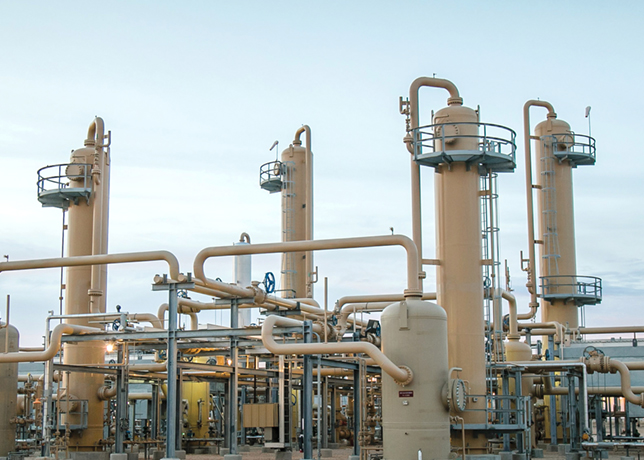
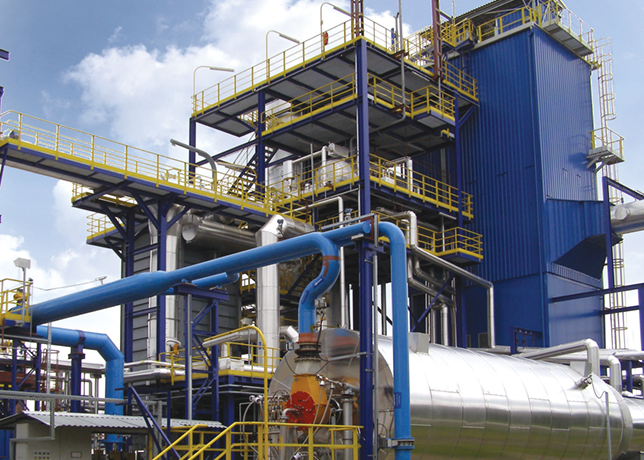
The project was carried out on a high-throughput liquids pipeline that forms part of one of North America’s largest pipeline systems.
Originally constructed in the early 1970s, the line is a critical supply asset where a prolonged shutdown would have created significant operational complexity, cost and potential disruption for customers.
The work involved removing a 48-inch valve that no longer served its original purpose and installing a pretested replacement pipe section.
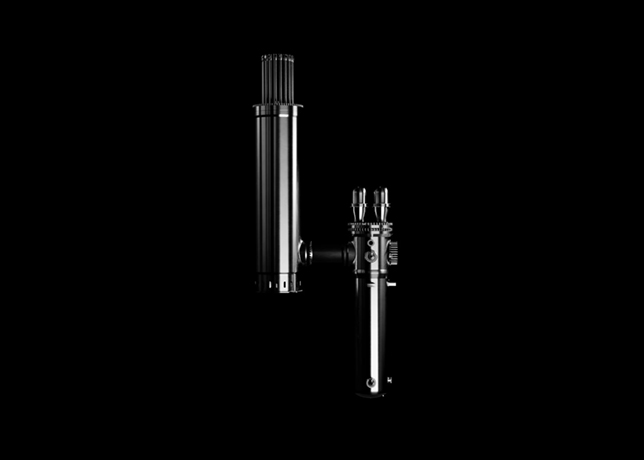
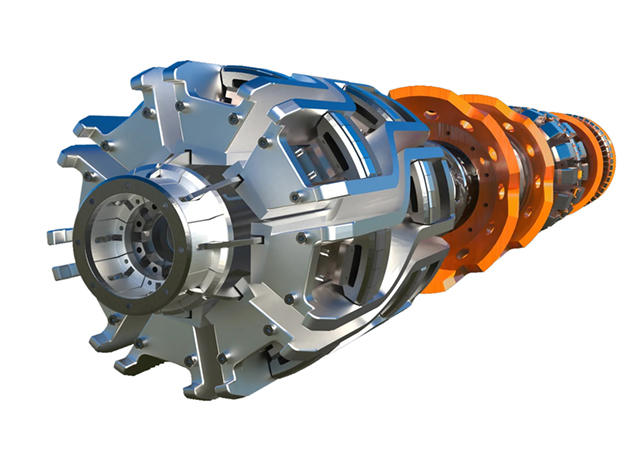
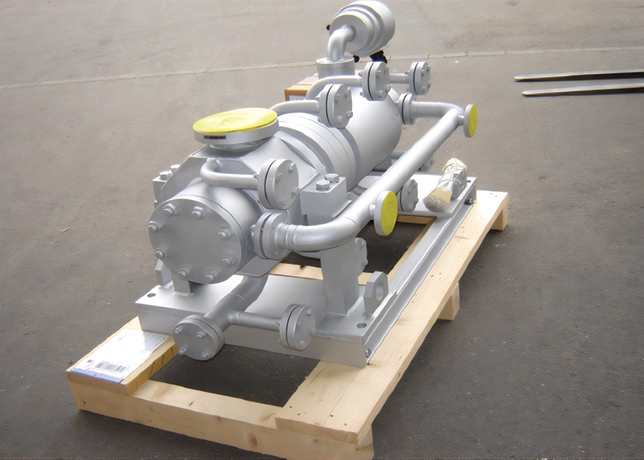
To create a safe worksite without stopping the line, STATS deployed two BISEP® line stopping tools and an integrated temporary bypass.
The scope represented the first 48-inch double BISEP isolation with bypass of its type on the operator’s Canadian assets.
It followed a successful single BISEP isolation and bypass completed on the same system in 2024 to support an earlier valve repair.
Kurt Anderson, Business Development Manager at STATS Group, says: “Our aim was to give the operator a safe, reliable and predictable way to complete essential maintenance while protecting throughput and avoiding an extended outage.”
TESTED ISOLATION & CONTINUOUS FLOW
The BISEP system provides leak-tight double block and bleed isolation through a single hot tap intervention.
Its two elastomer seals expand against the pipe wall and can be independently tested and monitored, enabling the integrity of the isolation to be confirmed before work begins.
Once deployed, the annulus between the seals was bled and monitored to create a verifiable zero-energy zone between the live pipeline and the worksite.
Pipeline pressure acting on the tool’s pressure head also helped maintain the isolation independently of its hydraulic control circuit.
This tested barrier gave the operator confidence to drain the isolated section and proceed with cutting and welding while the bypass maintained service.
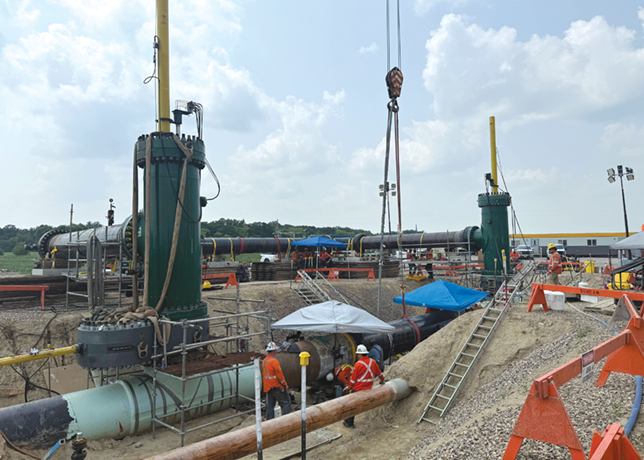
During the operation, product flowed through the temporary bypass at approximately 4,000 cu m per hour and around 300 psi.
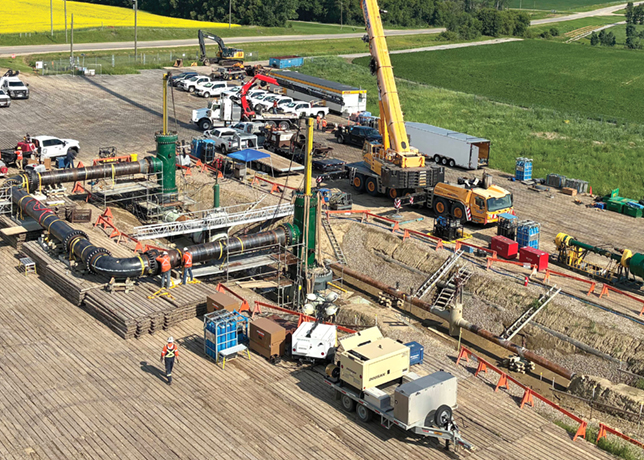
A dual 48-inch BISEP isolation and bypass in Canada
CAREFUL PLANNING REDUCES EXECUTION RISK
STATS and the operator developed the execution plan collaboratively over several months.
STATS supplied the split tees, double block and bleed slab valves, hot tapping equipment, BISEP tools and field technicians, while the operator installed the split tees and prepared the replacement pipework.
The work was staged to minimise activity during the final tie-in window.
In the preceding week, the slab valves were installed and the 48-inch hot taps completed using a SureTap® ST1530 machine.
The line stop tools and temporary bypass were then assembled and pressure tested at operating pressure.
The complete bypass system was flooded from the operating line before the main intervention, confirming readiness and reducing the number of critical activities required on execution day.
48-HOUR EXECUTION WINDOW ACHIEVED
On the day of the intervention, the two BISEP tools were lowered simultaneously while the pipeline remained operational.
The flow was diverted into the bypass, the seals were independently tested, and STATS issued the isolation certificate once integrity had been confirmed.
The operator’s maintenance team then drained the short-isolated section, removed the redundant valve and installed the new pipe spool.
After welding and non-destructive examination, the replacement section was flooded and pressure equalised.
STATS retracted the tools and returned flow to the normal pipeline route.
Completion plugs were installed in the split tee flanges, allowing the temporary slab valves to be removed and the fittings secured with blind flanges.
The entire sequence, from isolation to restoration of normal operations, was completed within the planned 48-hour window.
Maintaining throughput throughout the work also avoided a potential 96-hour outage associated with traditional isolation methods.
For an asset of this scale, the result demonstrated that a major intervention could be completed safely and predictably without sacrificing delivery commitments.
SAFETY, COST & ENVIRONMENTAL GAINS
The benefits extended beyond continuity of supply.
By using a monitored dual-seal barrier as the primary isolation, the project reduced reliance on additional vapour-management measures and simplified the construction and reinstatement sequence.
Positioning the split tees closer together reduced excavation and backfill requirements by approximately one third compared with alternative approaches.
Avoiding traditional mud plugs and the need to track and receive vapour tool pigs also removed associated cost, schedule pressure and operational risk.
Hot tapping and line stopping also avoided depressurising a long section of pipeline or displacing large product volumes.
For liquids assets, that means less product handling, lower waste generation and a smaller worksite footprint, supporting both environmental performance and responsible asset stewardship.
A MODEL FOR AGEING PIPELINE ASSETS
The project reflects a wider shift in pipeline maintenance.
Rather than treating isolation as a constraint that automatically demands a shutdown, operators can use high-integrity line stopping and bypass technology to create a controlled worksite while continuing normal service.
Anderson adds: “Large-diameter interventions demand extensive preparation long before tools are deployed. Early engagement enabled the teams to align engineering, equipment supply, hot tap execution, bypass configuration, pressure testing, certification and reinstatement before work began.”
“The result shows how a carefully engineered double BISEP isolation and bypass can support major maintenance on critical infrastructure while keeping product moving. The intervention was delivered within the planned window and the pipeline was returned safely to normal operation.”
For owners managing ageing assets, rising throughput demands and tighter safety and environmental expectations, the project demonstrates a practical alternative to prolonged shutdowns.
High-integrity isolation and bypass technology can reduce disruption, control risk and extend the reliable operating life of essential pipeline infrastructure.
STATS UK is is exhibiting at Stand 7234, Hall 7.