



















































As geopolitical volatility exposes vulnerabilities in global supply chains, bio-based chemical production is emerging as a critical commercial buffer against severe market disruptions.
The recent surge in acetone prices following the Strait of Hormuz crisis has intensified pressure on industrial operators to diversify away from fossil fuel dependence.
Modern bio-fermentation technologies present an immediate pathway to stabilise solvent markets by transforming abundant waste materials into high-purity, low-carbon alternatives.
Integrating these scalable solutions alongside conventional petrochemical infrastructure allows manufacturers to capture growing demand for sustainable materials without requiring expensive facility overhauls.
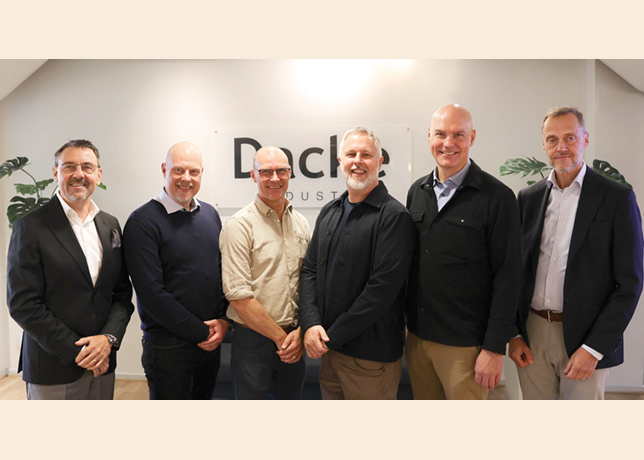
In an exclusive interview with OGN energy magazine, Bettina Brierley, Chief Commercial Officer, Celtic Renewables, says: “Scaling back dependence on and exposure to oil and gas for essential chemicals in favour of low-carbon alternatives is more than ever a long-term commercial and environmental imperative."
Adopting drop-in bio-feedstocks also strengthens the competitive posture of regional exporters navigating stricter international environmental regulations and tightening carbon reporting frameworks.
Governments mandating minimum bio-based thresholds in chemical manufacturing stand to secure a distinct first-mover advantage in a rapidly evolving global market.
Below are excerpts from the interview:
Given that the Strait of Hormuz crisis has caused acetone prices to quadruple, how rapidly can bio-based chemical producers scale capacity to offer a genuine hedge against geopolitical shocks in global solvent markets?
There are already proven technologies and processes, such as bacterial fermentation, that are ready to scale in a timeframe that would hedge against geopolitical shocks by reducing the chemical sector’s exposure to and reliance on fossil fuels.
It typically takes between two to three years to scale a biorefinery from demonstrator level up to industrial-scale commercial facility operations.
Green chemical production is one of the industries with the potential to bring about the just transition to a low-carbon economy that is environmentally sustainable, delivers high-value jobs, and benefits workers, communities and regions alike.
But to do so, it’s imperative that scale-up companies operating in low-carbon technologies like green chemical production receive the investment and support they need to build the necessary infrastructure to operate at scale and compete with their fossil-based peers.
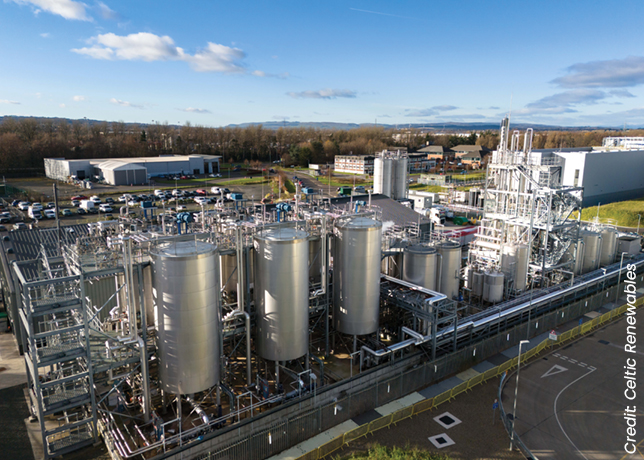
Celtic Renewables biorefinery at Grangemouth near Falkirk in Scotland
Considering the chemical industry abandoned fermentation feedstocks for petrochemicals in the 1950s, what specific technological advances render modern bio-fermentation commercially competitive at global scale today?
ABE fermentation was developed in the early 20th century and used crop-based feedstocks to manufacture solvents at an industrial scale.
But it was then largely abandoned after the Second World War thanks to the rise in petrochemical products that were heavily promoted by oil and gas companies.
Celtic Renewables has reinvented the ABE fermentation process to use by-products and waste materials instead of crop-based feedstocks.
The number one advantage of modern bio-fermentation is its ability to transform at scale waste materials into bio-based chemicals that possess similar properties to their fossil-derived equivalents.
This in turn reduces greenhouse gas emissions.
From a purely operational perspective, can your bio-acetone and bio-butanol serve as immediate, 100 per cent drop-in replacements within existing chemical manufacturing facilities without requiring capital-intensive plant modifications?
Our bio-based chemicals require no modifications to existing manufacturing facilities; they are drop-in replacements that don’t need any changes to infrastructure or equipment.
Celtic’s bio solvents already meet the most stringent existing pharmaceutical chemical specifications and their purity is like for like with fossil-derived counterparts.
How do the production economics and long-term price parity of bio-butanol and bio-acetone hold up once crude oil prices inevitably stabilise after this current supply disruption?
Price levels for bio-based solvents at the moment range from between 1.5 and twice the price of crude oil, depending upon the industry.
These prices will come down and achieve parity with their fossil fuel-based equivalent as new larger biorefining facilities are built and come online to boost production capacity.
The economics and long-term price parity for bio solvents will also be influenced by governmental mandates for the use of green alternatives and increased carbon taxes.
The carbon tax increase is an unknown at this point; however, if this taxation scheme is used to support the use of greener alternatives they are set to increase by a larger proportion.
Beyond de-risking supply chains, how does converting low-value industrial by-products into high-value solvents alter the overall carbon intensity and profitability profile of primary feed suppliers?
Using locally sourced feedstocks at nearby productions sites reduces carbon intensity.
This alone means we save on transport emissions while de-risking the supply chain significantly.
Primary feedstock suppliers improve their profitability when they work with us because we solve their waste stream challenge.
Some waste streams might involve high energy consumption conversions while others end up in municipal waste disposal.
If a supplier’s waste stream ends up in an anaerobic digestion plant to produce biogas, feeding it through our fermentation process first increases the yield from the anaerobic digestion.
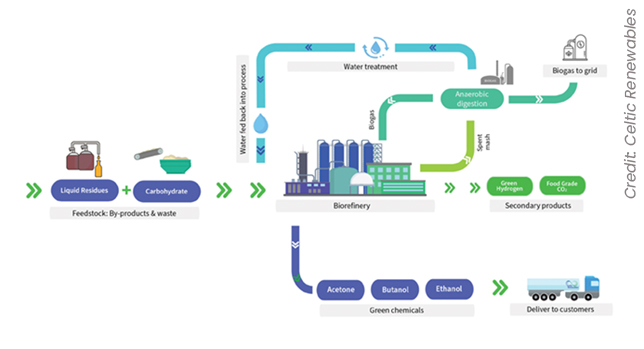
The ABE fermentation process is used to create bio-based chemicals such as bio-acetone, bio-butanol, and bio-ethanol from waste and by-product materials. It has the potential for integration into other processes including water treatment and anaerobic digestion
With major GCC petrochemical producers expanding aggressively into specialty downstream markets, what is the strategic case for integrating bio-based ABE (acetone-butanol-ethanol) fermentation directly alongside conventional steam crackers in the Middle East?
Integrating bio-based production processes alongside conventional steam crackers prepares petrochemical producers to take advantage of the surge in demand for low-carbon bio-based chemicals and materials that are already replacing their fossil-derived counterparts.
Petrochemical producers already have in place suitable infrastructure, which they can use as building blocks to add biorefining capability and diversify their operations.
Doing so enables them to have a foot in both camps.
They can take advantage of the growing international demand for low-carbon chemicals and continue to supply fossil-derived products and materials in a way that accelerates the transition away from fossil fuels in favour of low-carbon alternatives.
Adding ABE fermentation capabilities would allow today’s petrol-states to gradually phase out their oil and gas interests and transition suitable applications to bio-based materials.
This dual approach means they can continue to use fossil-derived materials where they are still needed the most, such as transport, and also transition other applications to a sustainable option.
While your current biorefinery model relies on UK agricultural and beverage waste, how easily can your proprietary technology be adapted to process alternative organic waste streams prevalent in hyper-arid GCC environments?
Our fermentation technology is adaptable to a wide variety of locally available by-product and waste materials.
A significant part of our growth and investment into research and development (R&D) focuses on the integration of new waste feedstocks that are readily available at a global level.
Our R&D team is currently undertaking trials that use cardboard and other everyday municipal waste materials, in addition to residues from dairy and cheese production.
Furthermore, advancements in the capture and extraction of cellulose from sewage opens up the potential for building biorefinery plants next to wastewater treatment facilities.
These biorefineries would have an inexhaustible supply of recovered cellulose available all year round as a feedstock with which to sustainably produce materials for use in the chemical, industrial and construction sectors.
To what extent can switching to drop-in bio-feedstocks protect the Western market share of Middle Eastern chemical exporters, who face tightening European Scope 3 reporting and mechanisms like CBAM?
The switch to bio-feedstocks is crucial for chemical exporters who want to not only protect but also grow their market share in Western Europe and beyond.
They really do not want to miss the boat on this: early adaptors are likely to be winners as scale up volumes are likely to be small in the first few years.
Current Scope 3 reporting mechanisms will only get stricter and focus on the real waste aspect of feedstocks used, to ensure that sustainable alternatives do not cause us other problems in the future.
For example, growing crops purely in order to manufacture chemicals is not a viable solution when one factors in the need for greater food security.
Our bio solvents already deliver a straightforward solution that doesn’t compete with agriculture over land use and represents a greenhouse gas saving of more than 60 per cent.
We’re ideally placed to provide what chemical exporters in the Middle East need to maintain and grow their share of the western market.
Is your growth model strictly focused on expanding company-owned UK assets, or are you actively seeking joint ventures and technology licensing deals with Middle Eastern sovereign wealth and energy funds?
Our current biorefinery is located in Grangemouth, Scotland, and our next commercial plant will also be located there.
At the same time, we are open to future biorefineries outside Scotland and the UK and eventually to license our technology to third party partners.
High volume users of bio solvents will most likely look for joint venture opportunities to secure enough volume for themselves; whilst regions might look for licensing opportunities as they are trying to deploy their waste feedstocks in another way or build up biotechnology hubs.
Solvents are an integral part of chemical manufacturing and are needed everywhere in the world.
With the shift in feedstock to more accessible feedstocks like municipal waste materials, our fermentation technology and biorefining processes can be licensed for use anywhere in the world where it is needed.
Should Middle Eastern energy ministries begin mandating minimum percentage thresholds for bio-based feedstocks in domestic chemical manufacturing to build long-term economic resilience against future external shocks?
Absolutely, and without delay.
Doing so would accelerate the transition to a more sustainable future for all of us.
Fossil fuels have been instrumental in driving innovation and growth: Raising living standards: and generating wealth and prosperity for the world; and they will still be needed for the foreseeable future.
At the same time, energy ministries in the Middle East and elsewhere should now mandate minimum percentage thresholds for sustainable bio feedstock use in order for the chemical industry to adopt non-fossil alternatives.
Governments who mandate a switch to sustainable bio-based chemicals won’t be weakening their domestic chemical industry.
On the contrary, they’re taking the lead and providing a template that encourages other countries to follow suit.
They’ll also secure first mover advantage in what will be a rapidly expanding and increasingly competitive international market.
We’re in the early stages of the end of the fossil fuel era.
The combination of the climate emergency and the pressing need to reduce harmful emissions, together with a resurgence in geopolitical tensions and uncertainty, are reshaping entire industries and supply chains alike.
Scaling back dependence on and exposure to oil and gas for essential chemicals in favour of low-carbon alternatives is more than ever a long-term commercial and environmental imperative.