


















































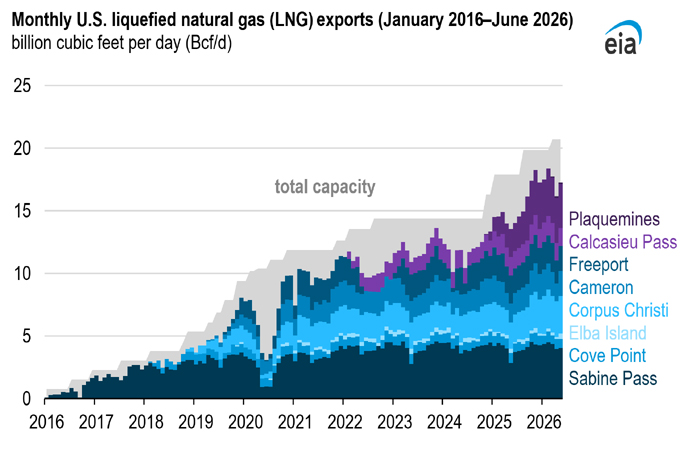
US liquefied natural gas (LNG) exports averaged 17.4 billion cubic feet per day (Bcf/d) in the first half of 2026, up 23 per cent from the same period in 2025, as new liquefaction capacity and strong international demand pushed shipments higher.
The increase represents the fastest growth in US LNG exports
since the country began large-scale exports in 2016, according to the US Energy
Information Administration (EIA).
The agency forecasts exports will average 17.3 Bcf/d in the
second half of 2026, before rising to 18.7 Bcf/d in the first half of 2027.
Higher output has been supported by new terminals and
expansions.
Plaquemines LNG is operating at full capacity, while Corpus
Christi Stage 3 is currently exporting from six of its seven liquefaction
trains.
Once fully operational, the two projects are expected to add
a combined 4.0 Bcf/d of nominal US export capacity.
Golden Pass LNG, which began exports in April 2026, is also
expected to increase production from Train 1 through the end of the year,
adding another 0.7 Bcf/d of nominal capacity.
Train 2 is expected to be completed in late 2026.
Strong global LNG prices provided an additional incentive
for US producers to maintain exports near maximum levels.
European and Asian benchmark prices rose sharply during the
first half of the year amid supply disruptions and strong demand.
The average price at Europe’s Title Transfer Facility (TTF)
benchmark reached $14.74 per million British thermal units (MMBtu) in the first
half of 2026, up from $13.10/MMBtu a year earlier.
It was the highest first-half average since 2022.
Meanwhile, the Japan-Korea Marker (JKM) averaged
$15.56/MMBtu, its highest level in four years, supported partly by hot weather
and stronger spot demand in Asia.
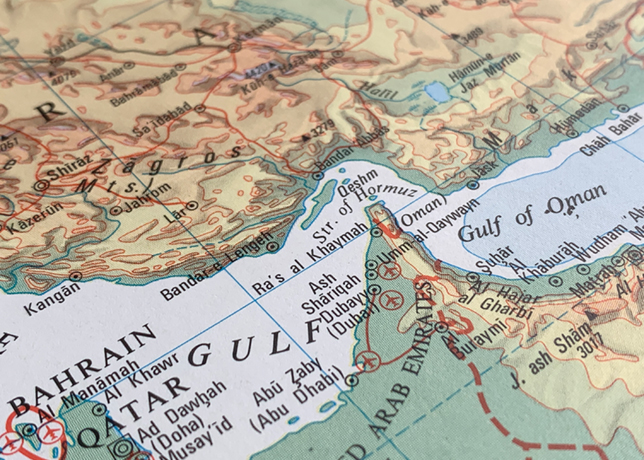
Supply disruptions linked to the Strait of Hormuz also
reshaped global LNG trade.
Shipments through the waterway were disrupted in March,
affecting about 20 per cent of global LNG supplies, primarily from Qatar.
Asian buyers, which receive about 80 per cent of Qatar’s LNG
exports, were forced to compete for limited spot cargoes.
As a result, US LNG shipments to Asia more than doubled
year-on-year in the first half of 2026, rising by 2.3 Bcf/d, or 108 per cent.
Exports to Europe increased 0.1 Bcf/d, while shipments to
Latin America and the Caribbean and the Middle East and North Africa climbed
0.8 Bcf/d, or 46 per cent.
Egypt, the Netherlands, Italy, France and the UK were among
the largest destination markets, highlighting the expanding global reach of US
LNG. -OGN/TradeArabia News Service