

























































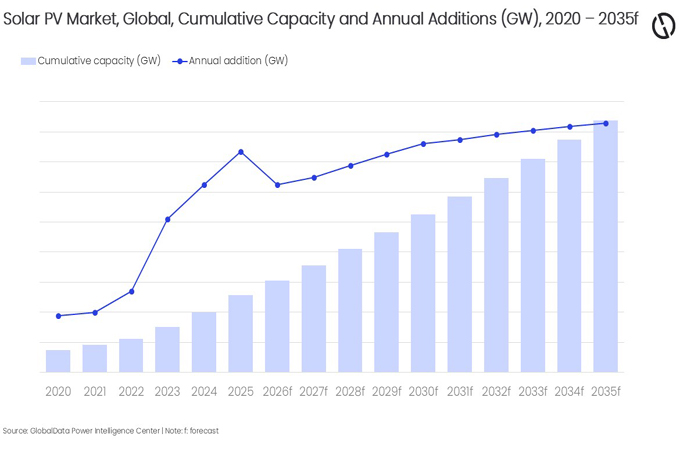
Solar photovoltaic (PV) remained the world's fastest-growing source of power in 2025, with annual capacity additions increasing by a record 17.5 per cent year-on-year.
However, new installations are expected to decline for the
first time since 2018 in 2026, as policy changes in China and the US, alongside
slowing demand in Pakistan, weigh on the market, according to GlobalData.
The company's latest report, Solar PV Market Report, Update
2026, forecasts that the slowdown will be temporary, with annual additions
expected to recover from 2027.
Global cumulative solar PV capacity is projected to grow at
a compound annual growth rate (CAGR) of 12.5 per cent between 2025 and 2035,
while solar generation is expected to expand at a similar rate, more than
doubling its share of global electricity by 2035.
Attaurrahman Saibasan, Power Analyst at GlobalData,
comments: “Solar PV has become the default choice for new generating capacity
in most markets due to low module prices, fast construction times, and strong
government targets. The 2026 dip reflects policy shifts in a few large markets
rather than a weakening of solar’s fundamentals, with China’s move to
market-based tariffs accounting for most of the decline.”
China remained the world's largest solar PV market in 2025,
accounting for more than half of global additions, followed by the US and
India.
India's installations increased by 87.2 per cent, supported
by utility-scale auctions and the PM Surya Ghar rooftop programme.
Pakistan recorded 34.3 per cent growth as households,
businesses and farmers increasingly adopted rooftop and off-grid solar systems
to reduce reliance on expensive grid electricity, making it the world's
fourth-largest market.
Meanwhile, Saudi Arabia more than tripled its additions as
several gigawatt-scale projects came online.
Middle East and Africa emerge as growth markets
Solar deployment also expanded across emerging markets.
Additions in the Middle East and Africa nearly tripled in 2025, while South and
Central America recorded growth of 32.9 per cent.
In comparison, Europe's additions increased by just 2.6 per
cent amid weaker rooftop demand, while North America experienced a 3.6 per cent
decline.
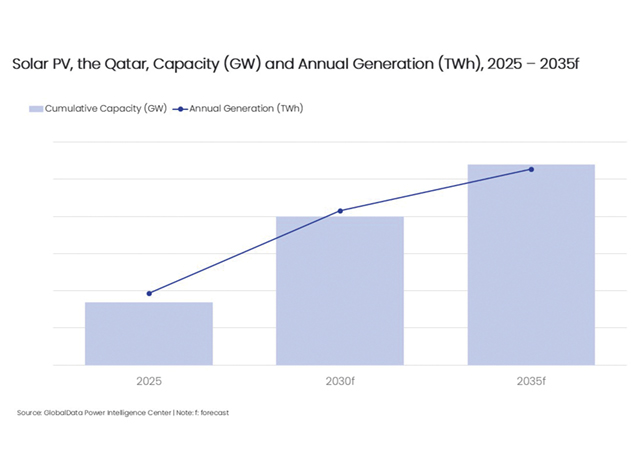
Over the 2025–2035 forecast period, the Middle East and
Africa is expected to become the fastest-growing region, with cumulative solar
PV capacity projected to increase at a CAGR of 20.9 per cent.
This compares with growth of 26.7 per cent between 2020 and
2025, reflecting the gradual maturation of regional markets.
Gigawatt-scale tenders in Saudi Arabia and the UAE are
expected to remain important drivers of regional expansion.
GlobalData's assessment of official national targets against
its forecasts across 16 countries indicates that India, Japan, Spain, France
and Egypt are expected to exceed their 2030 solar capacity goals.
Germany and Italy, however, are projected to fall short,
with weaker rooftop demand contributing to Germany's anticipated shortfall.
Costs and grid constraints shape market outlook
The global solar PV market expanded by 11.5 per cent in
2025, while average installed costs declined by approximately 41 per cent
between 2020 and 2025.
However, the prolonged decline in solar module prices has
stalled due to higher silver and cell costs, China's export tax rebate
adjustment effective April 2026, and industry consolidation under its
'anti-involution' campaign.
GlobalData expects the market to contract by 14.8 per cent
in 2026 before stabilising towards 2035.
Saibasan adds: “Grid and flexibility constraints are becoming
the main barrier to growth in leading markets. Curtailment is rising in China,
negative power prices are becoming more frequent in Europe, and grid connection
queues are delaying projects in the US, India, and Brazil. Trade measures add
further uncertainty, from US tariffs and Foreign Entity of Concern rules to
India’s domestic content requirements and resilience criteria in EU auctions.”
The report also highlights battery storage as an
increasingly important solution to grid congestion and renewable energy
integration challenges.
Falling battery costs
are improving the competitiveness of solar-plus-storage projects, enabling
developers to provide electricity beyond peak daytime generation periods.
Saibasan concludes: “Falling battery costs are the main
counterweight to grid congestion, curtailment, and negative power prices.
Solar-plus-storage is now competitive for firm supply in high-resource regions,
allowing solar to move beyond daytime generation and compete for
round-the-clock supply. Developers and investors that pair solar with storage
and secure grid access early will be best placed to capture the recovery from
2027.”
The report indicates that despite an expected temporary decline in 2026, solar PV will remain a major driver of global electricity capacity growth over the coming decade, with emerging markets, battery integration and grid investment shaping its next phase of expansion. -OGN/TradeArabia News Service