

























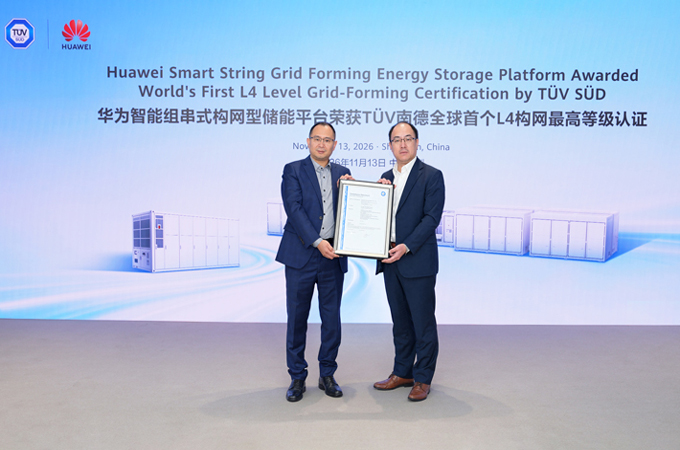
TÜV SÜD has awarded Huawei's Smart String Grid Forming Energy Storage System (ESS) Platform the world's first Level 4 (L4) certification for grid-forming capability, marking a significant development in the standardisation and commercial maturity of advanced energy storage technologies.
The certification was announced alongside the release of TÜV
SÜD's White Paper on Capability and Performance Grading for Grid Forming Energy
Storage Units and Systems. The framework establishes a five-level assessment
system, providing the energy industry with a standardised approach to
measuring, evaluating and certifying the contribution of grid-forming energy
storage systems to power network stability.
The milestone represents the first time an energy storage
system has achieved the highest L4 classification globally. It also signals a
shift from technical verification towards a more mature industry framework in
which grid-forming capabilities can be measured, compared and independently
certified.
The development comes as electricity networks increasingly
integrate renewable energy and power electronics, creating new requirements for
grid stability and resilience.
Standardising grid-forming capabilities
As the share of renewable energy increases, traditional
synchronous generators are being replaced by technologies that must
increasingly provide essential grid-support functions, including inertia,
voltage regulation and power oscillation damping.
Grid-forming energy storage systems are emerging as an
important solution by combining energy regulation with active grid-support
capabilities. Unlike conventional grid-following systems, which rely on an
external grid reference, grid-forming technologies can establish and maintain
voltage and frequency references, helping support network stability.
However, the capabilities of different systems vary
considerably, particularly in their response to disturbances, support for weak
grids, islanding operations and power system restoration.
TÜV SÜD's new white paper addresses the need for a unified
assessment framework, enabling utilities, developers and other industry
stakeholders to understand the capabilities of different technologies and
determine their suitability for specific applications.
The framework evaluates five core areas: grid formation,
frequency support, voltage support, system strength support and fault support.
It also considers response speed, support capacity and operating boundaries,
moving assessments beyond basic functional descriptions towards measurable
performance verification.
Importantly, the evaluation extends beyond individual
equipment to assess the performance and contribution of complete energy storage
plants.
Five levels of grid-forming capability
The white paper introduces a five-level maturity model,
ranging from L0 to L4, based on the actual contribution of equipment and plants
to electricity network performance.
The classifications are:
- L0
– Traditional Grid-Following: Systems depend on an external grid
reference and have no autonomous grid-forming capability.
- L1
– Local Voltage Grid-Forming: Systems can independently establish
voltage and provide local voltage support.
- L2
– Regional Auxiliary Grid-Forming: Technologies provide additional
system strength, supporting weak-grid operation and fault response.
- L3
– Conditional Full-Domain Grid-Forming: Systems provide inertia and
frequency support, alongside islanding and basic black-start capabilities,
although some synchronous generators remain necessary.
- L4
– Advanced Full-Domain Grid-Forming: The highest classification,
requiring advanced grid support, wideband oscillation suppression,
coordinated operation between multiple units and complete system
restoration capabilities.
The framework provides a structured pathway for assessing
technological development and identifying the level of support different
systems can deliver to electricity networks.
Huawei achieves highest certification level
Huawei's Smart String Grid Forming ESS Platform has achieved
the L4 classification, meeting the framework's highest requirements for system
support, dynamic stability and coordinated restoration.
Beyond voltage and frequency regulation, the L4 standard
requires advanced capabilities including wideband oscillation suppression,
multi-unit grid-forming coordination and complete system restoration.
At plant level, the requirements also cover advanced black
start, seamless switching between on-grid and off-grid operation, and fault
ride-through while operating independently of the wider network.
The certification provides independent third-party
recognition of Huawei's ability to deliver these advanced grid-forming
functions, moving the highest capability level from a theoretical assessment
category to a verified technical achievement.
Such capabilities could become increasingly important during
major grid disturbances, network separation and widespread power outages, when
energy storage systems may be required to maintain electricity supplies and
support the restoration of affected networks.
Supporting renewable energy integration
The certification and white paper come as power systems
prepare for higher levels of renewable energy penetration, with grid-forming
technologies expected to play a growing role in maintaining reliable
electricity supplies.
By establishing measurable performance requirements, the
framework provides a common reference for equipment manufacturers, project
developers, utilities and regulators. It is also expected to support greater
alignment between technology development, technical standards, engineering
practices and market requirements.
The ability to provide advanced grid support and restore
electricity networks could help address some of the stability challenges
associated with systems relying heavily on renewable generation.
The latest milestone highlights the evolving role of energy
storage beyond conventional electricity storage and discharge. With
standardised capability grading and independent certification now emerging,
grid-forming energy storage is moving towards wider deployment as a critical
component of future power infrastructure.
The developments also provide a technical foundation for electricity networks targeting up to 100 per cent renewable energy, where advanced grid-support capabilities will be essential to maintaining stability, resilience and continuity of supply. -OGN/TradeArabia News Service