

























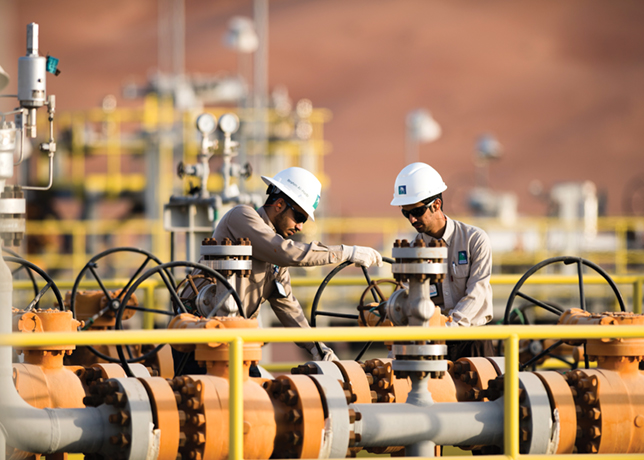





State oil giant Saudi Aramco has produced more than 65 billion barrels of oil from the world’s largest oil field, Ghawar, a top executive said.
The field has been pumping since 1951.
“Ghawar’s original reserves are over 100 billion barrels. Ghawar is still going strong, we are pampering Ghawar...We can sustain production for many years to come,” Saad Turaiki, vice president of Southern Area Oil Operations, said.
Aramco is pumping more than 5 million barrels per day (mbpd) from the giant field, more than half of its 8 to 8.5 mbpd crude production, Turaiki said.
The kingdom produced at 8.2 mbpd in March, a Reuters survery showed.
The five discovery wells at Ghawar, have produced more than 350 million (mbpd) and are still producing today at a combined rate of 6,000 bpd, Turaiki said at a conference.
Proponents of the theory that global oil output is at or near its peak have said Saudi reserves may be less than stated and that fields like Ghawar may be under strain.
Aramco plans to inject 40 million standard cubic feet per day (scfd) of carbon dioxide into the field. Carbon capture and storage is looked upon favourably by oil producers as they need to inject gas into oilfields anyway to maintain oil pressure. If they can use CO2 instead of natural gas, they can send the natural gas to local grids where it can be used by industry or in power plants. In 1959, it injected gas for 20 years in one of the fields’ areas Ain Dar to sustain the reservoir pressure.
It then injected water in 1964 to maximize recovery at the field, Turaiki said at the conference. “Saudi Aramco is not sparing any efforts to sustain production at Ghawar,” he told Reuters.
“We are not doing our pilot CO2 project because the field is depleting, water injection is enough,” he told Reuters.
The project would be implemented in Uthmaniyah, one of the field’s areas, and will start in 2013, Turaiki said.
A government official said in February the project would be launched by 2012. “We are doing it to quantify how much reserves we can recover and for the environment,” said Turaiki.
The kingdom’s raw gas production stands at nearly 10 billion cfd, Turaiki said.
