



















































Across the Middle East, refinery and upstream operators are under increasing pressure to maximise production efficiency, improve asset reliability and support digital transformation initiatives while processing heavier and more variable feedstocks.
Yet despite significant advances in process automation and operational analytics, many critical pressure vessels continue to operate with limited real-time visibility into what is actually happening inside them.
In separation systems, delayed coking units and heavy crude processing applications, operators are often dealing with unstable process conditions that make accurate interface measurement extremely difficult.
Foam formation, turbulent flow, emulsions, fouling, density variation and extreme temperatures can all reduce the reliability of conventional instrumentation, forcing operators into conservative operating strategies designed to compensate for process uncertainty.
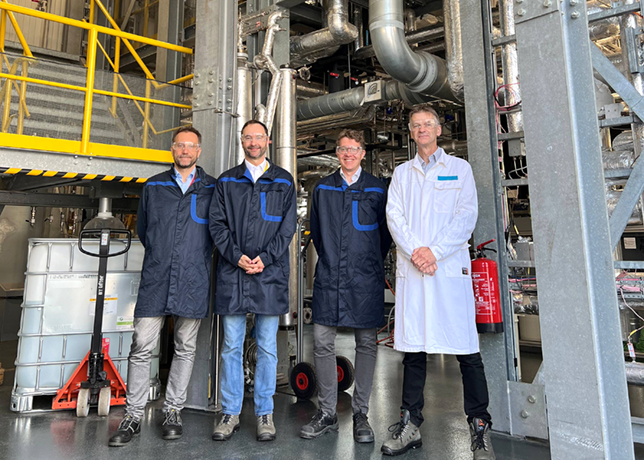
“The gap is rarely one of intent or investment. It has been due to a practical constraint of conventional instrumentation, and its consequences are felt directly in separation efficiency, chemical consumption, product quality and unplanned downtime,” Neil Murch, Head of Sales, Tracerco, and Logan Boatright, Business Development Manager, Tracerco, tells OGN energy magazine.
That challenge is becoming increasingly significant as refiners push for tighter operational control, improved product quality and greater efficiency from existing assets.

Neil Murch
WHY INTERFACE MEASUREMENT REMAINS DIFFICULT
In many refinery applications, operators rely on interface measurements to manage chemical injection, control separation performance, minimise carryover and maintain stable operation.
Traditional technologies including guided wave radar, capacitance, RF admittance, differential pressure and gamma systems, all offer advantages in certain applications, but many struggle in harsh operating environments where process conditions continuously change.
Internal probes can become vulnerable to fouling, corrosion and coating. Emulsions or rags can mask true interfaces, while changing densities and turbulent flow conditions can lead to unstable or drifting measurements.
In brownfield facilities, operators may also face practical installation challenges where vessel geometry, limited nozzle availability or shutdown constraints make retrofit projects difficult or prohibitively expensive.
In delayed coking applications, for example, conventional systems often provide only bulk level indication, giving operators limited visibility into the actual behaviour of foam characteristics and the true height of the coke within the drum.
As a result, many operators continue to rely heavily on experience or inferred process conditions, rather than direct process measurement.
MOVING BEYOND BULK LEVEL INDICATION
Improving visibility in these environments requires a different measurement approach that can provide reliable, non-contact interface measurement in large, complex and difficult-to-measure vessels where conventional technologies struggle to perform consistently.
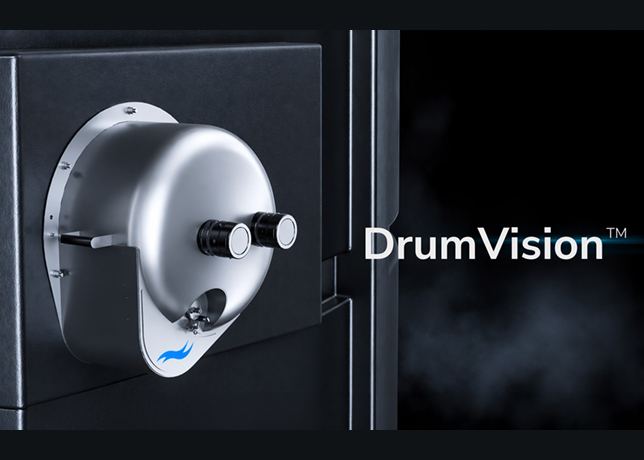
Using advanced neutron backscatter technology, Tracerco’s DrumVision™ does this by measuring hydrogen-rich process interfaces externally through the vessel wall without requiring intrusive installation or process penetration.
By operating entirely outside the vessel, the system avoids many of the operational limitations associated with traditional intrusive instrumentation.
The measurement principle itself is not new; neutron backscatter has been used in the industry for many years, particularly in delayed coking applications.
DrumVision represents an evolution of that technology, designed to improve reliability, operational practicality and process insight.
Unlike legacy systems, it incorporates modern solid-state detector technology, eliminating the need for gas-filled detection tubes that can require re-gassing or replacement over time.
This reduces maintenance requirements while improving long-term measurement stability and operational safety.
The externally mounted design allows installation without vessel penetration or shutdown, making the technology particularly well suited to brownfield and high-complexity process environments where vessel modifications and outages carry significant operational and commercial implications.

Logan Boatright
IMPROVING VISIBILITY IN DELAYED COKING OPERATIONS
The first major application focus for DrumVision has been delayed coking, one of refining’s most operationally demanding processes.
Within coke drums, fluctuating temperatures, foam generation and unstable interfaces create an environment where conventional measurement technologies often struggle to provide consistent process visibility.
Operators must manage anti-foam injection carefully to prevent excessive foam growth and downstream carryover, but without reliable real-time interface information, anti-foam strategies can become conservative and difficult to optimise.
Traditional instrumentation may indicate overall level within the drum, but provide no understanding of what is actually occurring between the foam and coke phases during the cycle.
DrumVision provides true three-phase visibility, allowing operators to distinguish between vapour, foam and coke inside the vessel in real time.
During European refinery trials, signal changes recorded by the system were correlated against live operational events throughout the coker cycle, including anti-foam injection, steam quenching, cooling water introduction and coke cutting activities.
The trials demonstrated how DrumVision can provide operators with a materially different and high level of process insight throughout the cycle, rather than simply indicating bulk foam level inside the drum.
This level of visibility creates opportunities to maximise yields by reducing outage space, improve anti-foam management strategies and reduce chemical overuse, and support more stable delayed coking operation.
The technology has also generated industry interest as a retrofit solution for ageing neutron backscatter installations currently operating in refineries worldwide.
Many of these legacy systems are approaching obsolescence, leaving operators with limited replacement options that provide equivalent process visibility.
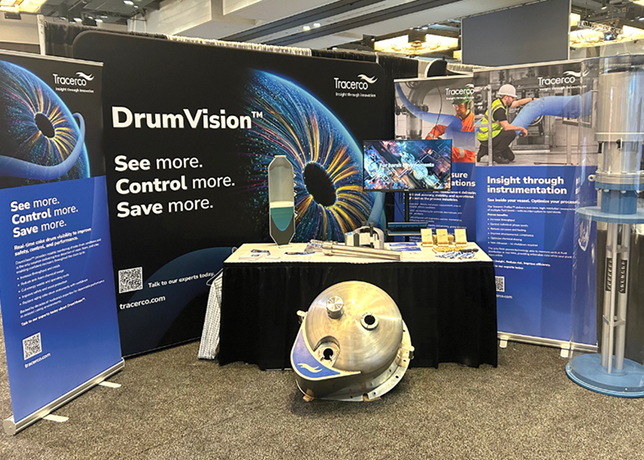
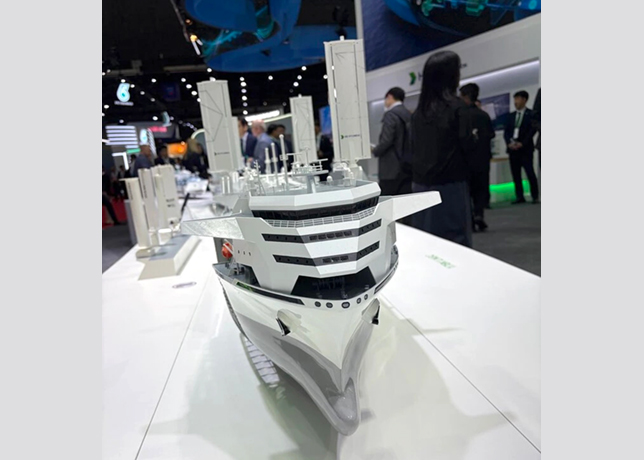
The DrumVision on display at an exhibition
BROADER OPPORTUNITIES ACROSS PRESSURE VESSEL APPLICATIONS
Although delayed coking provided the initial development focus, the operational challenges exist across a much wider range of refinery and upstream pressure vessel applications.
Primary separators, three-phase separators, desalters, slug catchers, flare knockout drums, produced water systems, fractionators and amine systems can all present conditions where maintaining stable level or interface visibility becomes operationally challenging.
In many of these vessels, conventional technologies struggle because of process fouling, density instability, emulsions or the practical limitations associated with intrusive installation and maintenance.
Some applications may also involve vessel geometries or process conditions where traditional technologies cannot easily be retrofitted or sustained in service over the long term.
By enabling fully external, non-contact measurement, operators gain stable real-time process visibility in applications that have historically been difficult to measure reliably.
In produced water and separation systems, improved interface visibility can support more stable separation performance and better water quality control.
In desalters and fractionation systems, operators can benefit from improved process stability, reduced chemical usage and carryover risk, and more consistent operational performance.
Rather than reacting to process instability after it occurs, operators are increasingly looking for technologies that allow earlier visibility into changing process conditions and support more informed operational decision-making.
SUPPORTING OPERATIONAL EXCELLENCE IN MIDDLE EAST
As facilities process increasingly challenging feedstocks while seeking greater efficiency and asset performance, interest is growing in measurement technologies capable of delivering more stable and actionable process insight in harsh operating environments.
For major national oil companies across the region, the transition from reactive plant operation toward predictive, data-driven process optimisation is a strategic priority, and interface measurement capability plays a direct role in supporting that ambition.
Tracerco is already engaged in discussions with a major operator in the region regarding DrumVision deployment opportunities, particularly in delayed coking and heavy crude processing applications where process visibility challenges remain significant.
With offices in Saudi Arabia and Abu Dhabi, alongside regional partnerships across the Gulf, Tracerco brings more than 65 years of experience delivering innovative measurement and process diagnostic capability to the global oil and gas industry.
That depth of expertise, combined with a technology platform designed specifically for the complex process environments common across the region, positions the company to support Middle East operators as they look to close the visibility gap in their most challenging vessels.
For many operators, improving process performance increasingly depends on improving visibility into the vessels and interfaces that have historically been the most difficult to measure reliably.