












































The closure of the Strait of Hormuz has underscored the extent to which a disruption in a single strategic waterway can reverberate across the global economy, affecting energy markets, industrial supply chains, inflation, transport and economic growth long after hostilities end.
Speaking about the crisis, Dr Sultan Al Jaber, UAE Minister of Industry and Advanced Technology and Managing Director and Group CEO of ADNOC, warned that the consequences extend far beyond oil, according to the report.
“And Hormuz as we all know it is not just an oil story. It is in fact an everything story,” Al Jaber told Atlantic Council in a virtually interview, noting the impact on LNG, jet fuel, fertilisers, ammonia, urea, aluminium, helium, critical minerals, plastics, consumer goods and broader cargo flows.
The disruption has pushed fuel prices up 30 per cent, fertiliser prices up 50 per cent and airfares up 25 per cent, while the global growth outlook for 2026 has been reduced to 3.1 per cent and inflation has exceeded 4 per cent.
The scale of the challenge is reflected in the policy response. More than 80 countries have introduced emergency economic measures since the conflict began.
Iran is making attempts to set up a permanent system to control the movement of ships through the strait and is reported to have introduced a toll for the vessels transiting.
This has been met by serious opposition from the Gulf states and the US.
Al Jaber stressed that even an immediate end to hostilities would not restore normal trade patterns quickly, estimating that it would take, at least, four months to recover 80 per cent of pre-conflict flows, with full recovery unlikely before the Q1 or Q2 2027.
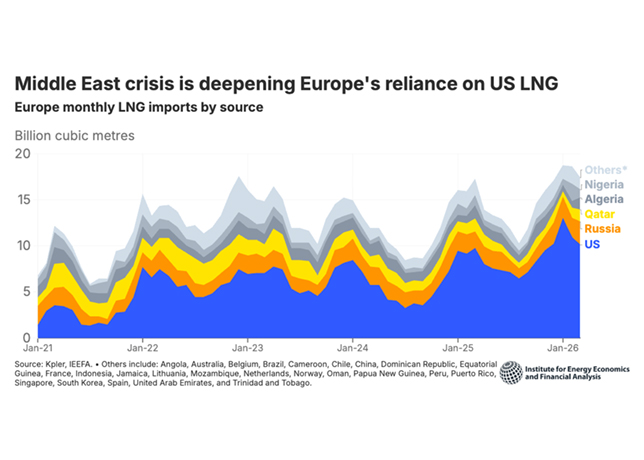
The Strait of Hormuz handles around 20 per cent of global oil and LNG supply, and damage to production and export infrastructure has compounded disruptions.
In Qatar, missile strikes on the Ras Laffan liquefaction complex rendered roughly 3 per cent of global LNG capacity inoperable.
Colby Connelly, Senior Fellow at the Middle East Institute, says the reopening of the waterway alone would not immediately restore supplies.
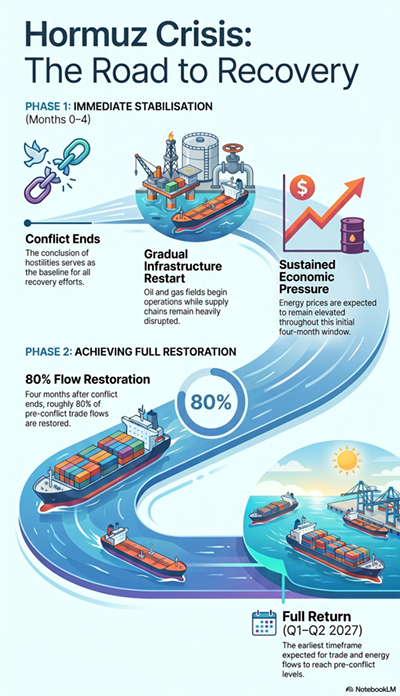
“Even after the waterway reopens, supply disruption will continue because restarting oil and gas fields is technically complex and can take months rather than days,” he says.
“As a result, energy prices are likely to remain significantly elevated from pre-war levels well after the conflict ends.”
Others industry leaders have also highlighted the operational realities of restarting production.
In March, Sheikh Nawaf Al Sabah, Chief Executive of Kuwait Petroleum Corporation, told CERAWeek 2026 virtually that Kuwait would require three to four months to fully restore production.
The crisis has strengthened the case for resilience-focused investment across the energy sector.
Al Jaber described resilience as a “critical success factor”, arguing that infrastructure capable of maintaining flows during disruptions becomes invaluable when crises emerge.
The UAE’s decision more than a decade ago to invest in export infrastructure bypassing Hormuz, including a second pipeline now nearly 50 per cent complete and targeted for accelerated delivery by 2027, reflects that strategy.
The future energy security will depend increasingly on diversified infrastructure, alternative export routes, efficiency improvements and more realistic risk planning.
Existing bypass routes in Saudi Arabia and the UAE have proven critical lifelines during the conflict, reinforcing a broader lesson that the cost of redundancy may be substantial, but the economic consequences of insufficient resilience can be far greater.