
























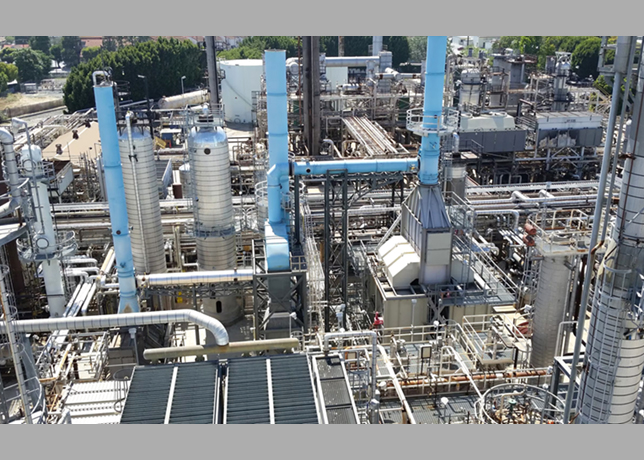



















For every refinery, gas plant, and metals complex that relies on a Claus sulphur recovery unit (SRU), the thermal reactor is the most financially exposed asset in the flowsheet.
It converts between 50 and 70 per cent of the facility’s total sulphur in a single extreme stage, and it runs at temperatures reaching 1,350 deg C, inside a corrosive bath of hydrogen sulphide and sulphur dioxide.
Its refractory lining is the only barrier between that process and the steel shell and, by extension, the site, the workforce, and the facility’s operating licence.
And yet, for most operators, this reactor is also the least-observed asset on site. That disconnect between risk and visibility is the gap a new class of surface-temperature monitoring is built to close.
THE SILENT CHAIN REACTION OF FAILURE
Executives who have lived through an unplanned SRU shutdown know how the sequence unfolds.
Conventional thermocouples, pushed into the hostile environment of a Claus combustor, begin to degrade within weeks, and within months, many have failed outright.
The plant is left with one to three functioning measurement points across an entire reactor shell, the definition of a blind spot.
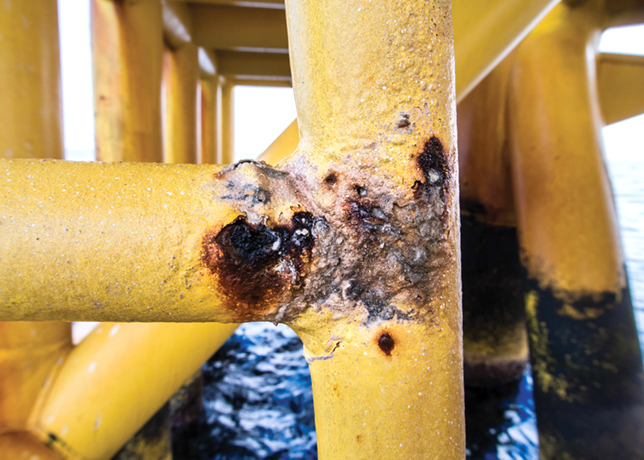
While operations continues to run on those sparse readings, the refractory quietly deteriorates behind the steel.
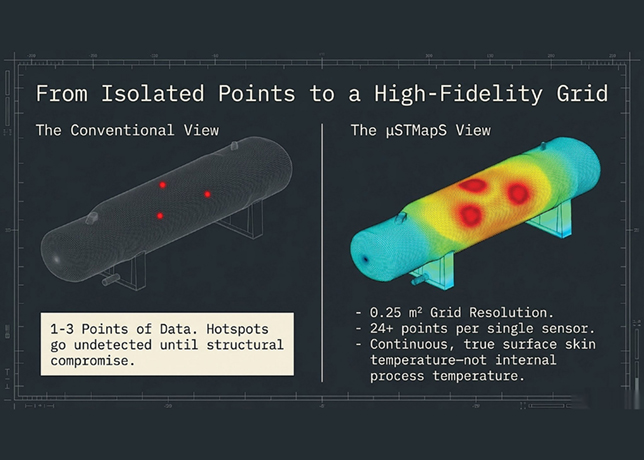
Conventional instrumentation produces one to three data points across an entire reactor, while μSTMapS produces over 24 points per sensor at 0.25 sq m grid resolution, mapping the true surface skin temperature
Hotspots develop where they cannot be seen, and by the time conventional monitoring catches up, the indicator is usually a structural anomaly, a gas release, or an emissions excursion.
The chain reaction — hostile environment, sensor destruction, thermal blind spots, silent degradation, final impact — is well understood. What has been missing is a practical way to break it.
THE FATAL FLAW OF CONVENTIONAL INSPECTION
The economic consequences are not theoretical. Across a typical SRU, more than 95 per cent of the reactor shell remains completely unmonitored at any moment.
Frequent thermocouple replacements drive maintenance opex upward year after year, and because those sensors only report point data in isolated zones, reliability teams have no meaningful basis for predictive refractory health trending.
Every decision is reactive, and every reactive decision costs more than the condition-based one that should have replaced it.
For leadership teams being asked to extend asset life, cut unplanned downtime, and guarantee emissions compliance simultaneously, the existing toolkit was not designed for the mission.
A DIFFERENT PHYSICS: DRIFT-FREE ACOUSTIC SENSING
The breakthrough on offer is not a better thermocouple. It is a different sensing principle altogether.
Precision surface temperature intelligence (μSTMapS) uses the fact that the speed of sound through a solid is a deterministic function of that solid’s temperature.
An ultrasonic pulse is launched along a precision Ni-Cr alloy waveguide that rests against the reactor shell.
As the surface heats and cools, the propagation speed of the guided wave changes in a measurable, repeatable way.
Three properties make this approach uniquely suited to SRU service:
• First, there are zero electronics anywhere in the extreme sensing zone; the measurement is acoustic, so there is nothing for heat or H2S to destroy.
• Second, the response is immune to the drift that plagues conventional contact sensors, because the underlying physics does not degrade with exposure.
• Third, a single 14-m waveguide can deliver up to 24 independent, simultaneous surface-temperature readings, covering structure that previously required dozens of penetrations to instrument, and even then only at isolated points.
The system is rated for skin temperatures from 100 deg C to 600 deg C, proven in service up to 1,150 deg C, and certified for hazardous-area installation (ATEX / Ex d IIC). Measurement accuracy is ±1.5 deg C with 0.5 deg C resolution.
FROM ISOLATED POINTS TO A HIGH-FIDELITY GRID
The operational upgrade is best understood as a change of scale.
A conventionally instrumented thermal reactor shows operators, at best, a handful of red dots; one, two, perhaps three data points across a vessel that may be more than ten metres long.
Hotspots outside those points simply do not exist in the operator’s field of view until the refractory has already failed.
The μSTMapS view replaces those isolated dots with a continuous, high-fidelity heat map at 0.25 sq m grid resolution.
Crucially, what is being measured is the true surface skin temperature of the shell (the condition that actually governs refractory integrity) rather than an inferred or averaged internal process value.
Reliability engineers finally see what the asset is doing, not what it is telling them through a handful of failing proxies.
INSTALLATION WITHOUT A SHUTDOWN
For most operators, the single largest barrier to upgrading reactor instrumentation has been installation risk, but μSTMapS removes that barrier.
The waveguides are mounted on the top side of the vessel using a magnetic clamping system — no welded penetrations, no refractory modifications, and no scheduled outage required.
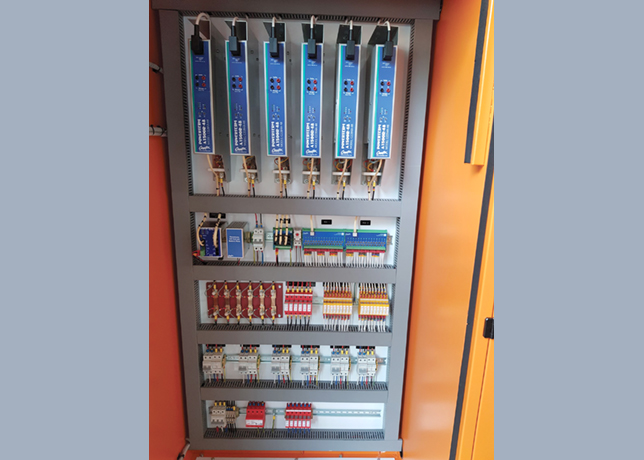
The system hardwires directly into existing DCS infrastructure, or streams continuously via Modbus and SIM-based IIoT gateways for cloud uplink. That deployment model matters at the board level.
Operators can instrument a live reactor between turnarounds, without the production loss, permitting burden, or mechanical-integrity risk associated with cutting into a pressure vessel.
AI THAT TURNS MEASUREMENTS INTO INTELLIGENCE
Dense data is only useful if it becomes decisions.
μSTMapS pairs the sensor grid with AI-driven analytics layered in two modes.
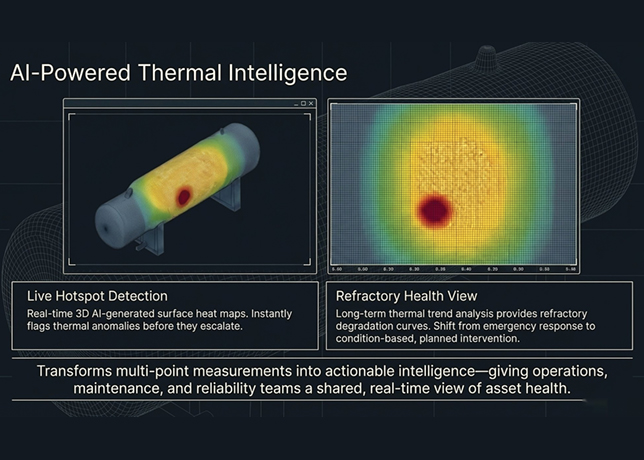
Live hotspot detection converts the real-time grid into 3D heat maps that flag thermal anomalies the moment they appear, rather than after they escalate.
Refractory health view applies long-term trend analysis to those same measurements, building degradation curves that let reliability teams move from emergency response to planned, condition-based intervention.
Operations, maintenance, and reliability functions share a single, real-time view of asset health.
THE TRIAD OF TOTAL ASSET INTELLIGENCE
For executives, the strategic value of continuous surface-temperature visibility resolves into three reinforcing outcomes.
Refractory integrity and shell safety improve because hotspots are caught early, catastrophic failures are pre-empted, and total furnace lifespan is extended through condition-based maintenance.
Reaction efficiency improves because precise temperature control maximises H2S-to-SO2 conversion and sulphur yield across the Claus train.
Emissions compliance improves because stable, continuously monitored temperatures minimise the formation of COS, CS2, and unconverted H2S that underlies regulatory exceedances.
Temperature control is mission-critical, and every deviation is a liability — but only when you cannot see it.
PROVEN AT SCALE
Operators deploying μSTMapS report have prevented unplanned shutdowns, lower maintenance opex through fewer sensor replacements and less downtime, measurable extension of total asset life, and a defensible evidence base for emissions compliance.
The technology is already in service worldwide across oil and gas, aluminium, power, and steel, such as BPCL, Reliance Industries, IOCL Panipat, IOCL Gujarat, Cairn Oil, and Vedanta, among others.
The question for leadership is no longer whether continuous, multipoint temperature visibility is achievable on an SRU thermal reactor.
It is whether running another operating cycle without it is a liability the organisation is still willing to carry.