

























































By Abdulaziz Khattak
The global sporting landscape is facing an unprecedented climate reckoning.
For decades, mega sporting events have operated under a model of unchecked expansion, drawing millions of international spectators, triggering massive infrastructure projects, and leaving substantial carbon footprints in their wake.
However, as the impacts of climate change, such as severe heatwaves, extreme rainfall, and rising sea levels that directly threaten grassroots and elite sports infrastructures, accelerate, the governing bodies of global athletics are under immense pressure to reform.
At the forefront of this shift is FIFA, which has committed to a structured pathway aimed at reducing its environmental impact, targeting a 50 per cent reduction in greenhouse gas emissions by 2030 and aiming to achieve net-zero emissions by 2040.

Yet, as the sporting world witnesses for the multi-nation FIFA World Cup 2026, a fundamental tension remains: can an event of this magnitude truly eliminate its climate impact, or do its structural realities render genuine decarbonisation impossible?
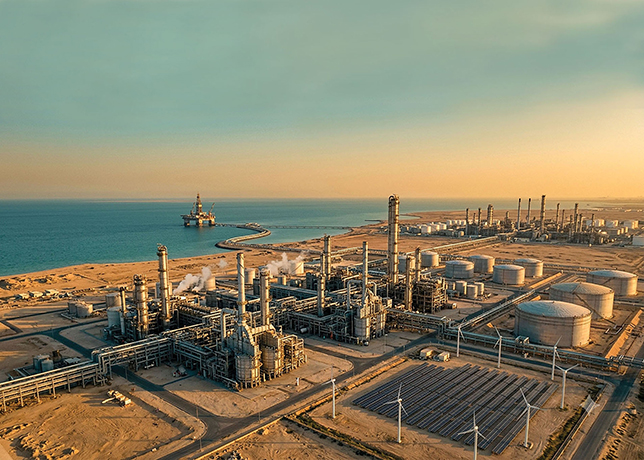
Energy sector leaders are increasingly backing global sporting events, with Aramco serving as a major worldwide partner of FIFA and holding rights across multiple tournaments, including the FIFA World Cup 26 and FIFA Women’s World Cup 2027.
STRUCTURAL CHALLENGE OF SCOPE 3 EMISSIONS
To evaluate the credibility of any net-zero claim, it is essential to look at the data through standard greenhouse gas accounting frameworks, which categorise emissions into three distinct scopes.
Scope 1 covers direct emissions from source operations and fuel use, while Scope 2 accounts for purchased electricity used across tournament facilities.
Through modern engineering, renewable electricity contracts, and energy-efficient building designs, event organisers exercise a high degree of direct control over these categories.
The primary barrier to achieving a sustainable tournament lies within Scope 3 emissions, which encompass all indirect impacts linked to the event, including team transport, broadcasting logistics, merchandise supply chains, spectator accommodation, and international travel.
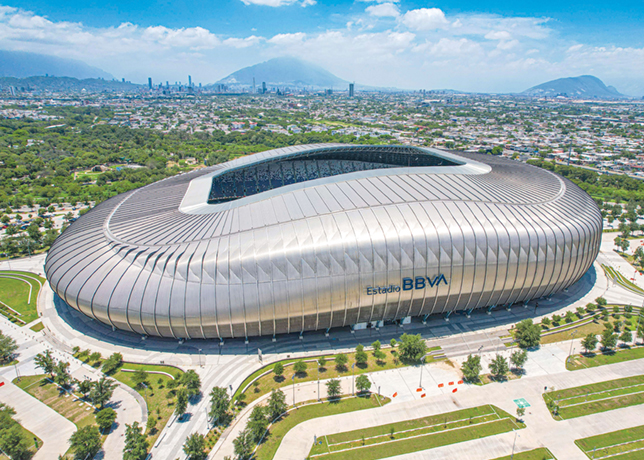
BBVA Stadium, Monterrey, Mexico
In massive global tournaments, Scope 3 emissions routinely constitute the vast majority of the total carbon footprint, driven overwhelmingly by aviation.
Because these activities occur outside the direct operational control of organising bodies, mitigating them is remarkably complex.
Organisers can power a stadium with 100 per cent renewable energy, but they cannot dictate how a fan travels from another continent.
Consequently, the broader system supporting the event remains heavily carbon-intensive, exposing a profound structural imbalance between operational sustainability and systemic travel demands.
FROM CARBON TRACKING TO OPERATIONAL STANDARDS
FIFA’s efforts to manage this imbalance have evolved significantly over the last two decades.
The organisation began estimating the carbon footprint of its main tournaments in 2009, establishing its first greenhouse gas accounting reports to understand the volume of attributable emissions.
By 2012, a mandatory requirement was introduced dictating that all official men’s FIFA World Cup stadiums must achieve international sustainable building certifications.
Operational mitigation was demonstrated during the 2018 tournament in Russia, where FIFA compensated for 243,000 tonnes of operational greenhouse gas emissions by investing in certified low-carbon projects both domestically and internationally.
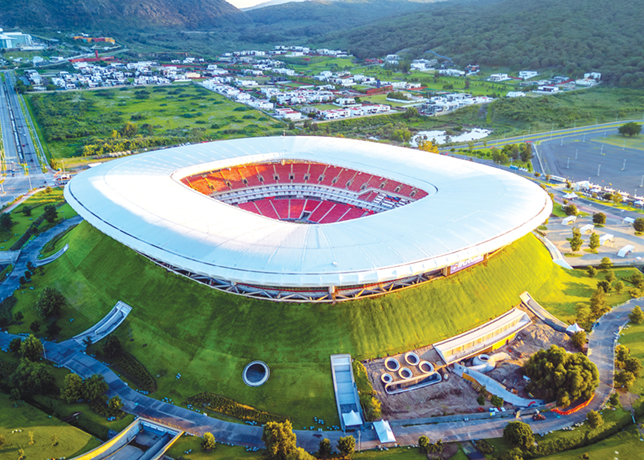
Guadalajara Stadium, Mexico
Notably, the FIFA World Cup Qatar 2022 was the first edition of the tournament to be certified to the international standard ISO 20121 for event sustainability management systems.
The event established new benchmarks for operational sustainability, with all eight tournament stadiums achieving Global Sustainability Assessment System building certification and utilising demountable components designed for long-term reuse and repurposing.
This operational framework has been extended to the currently underway 2026 FIFA World Cup, hosted across the US, Canada, and Mexico.
However, the unprecedented scale of the 2026 edition, which was expanded to 48 teams and 16 host cities, compounds the logistical and environmental challenges.
The environmental impact assessment for the tournament projects total emissions at a staggering 3.7 million tonnes of CO2 equivalent.
Crucially, travel-related activities account for approximately 85 per cent of this entire carbon footprint, with 51 per cent stemming from international journeys and 34 per cent from travel between host cities across North America.
This format highlights how expansion directly conflicts with the goal of systemic emission reductions.

HOST CITY INITIATIVES & STADIUM TRANSFORMATIONS
In response to these mandates, individual host cities have developed localised environmental sustainability plans.
For instance, Houston’s plan incorporates an Environmental Management System drawing from ISO 20121 standards, focusing on a “green corridor” that links major transit networks, utilising 100 per cent renewable electricity at key sites, and implementing sustainable field guidelines to mitigate heat and waste.
Similarly, Vancouver’s strategy at the FIFA Fan Festival involves strict single-use plastic reductions, a generator-free main site powered by BC Hydro, and food rescue partnerships to divert organic waste from landfills.
On a venue level, Mexican stadiums have undergone significant overhauls to secure required certifications.
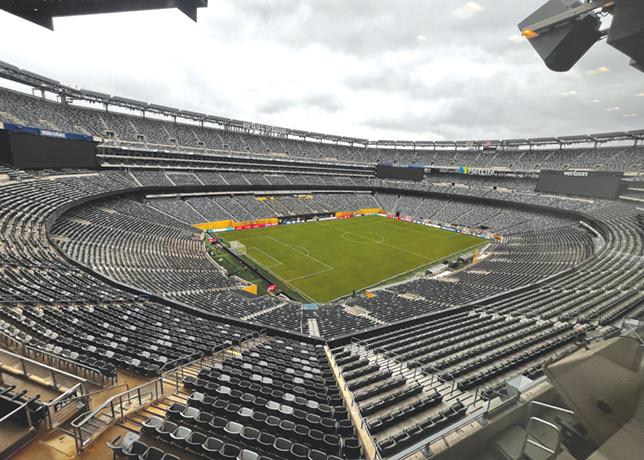
MetLife Football Stadium, New Jersey, US
The historic Mexico City Stadium (Azteca) updated its operational systems, replacing legacy infrastructure with water-efficient toilets and sourcing compostable materials to achieve a LEED Platinum operational rating.
Meanwhile, Monterrey’s BBVA Stadium, which achieved LEED Gold for operations and maintenance, integrated automated monitoring systems and transitioned completely to LED lighting, reducing its electricity consumption by 30 per cent.
Despite these localised successes, deep structural contradictions persist within tournament policies.
For example, while FIFA promotes water conservation, its strict regulations mandate that all World Cup matches be played on pristine natural grass irrigated exclusively with potable water rather than reclaimed water.
In water-scarce regions like Monterrey, natural grass requires up to 50,000 litres of potable water per day (50 times more than artificial turf) effectively consuming the daily water supply of 333 people per pitch.
This mismatch between local ecological constraints and institutional mandates forces a heavy reliance on carbon offsetting to balance the ledger.
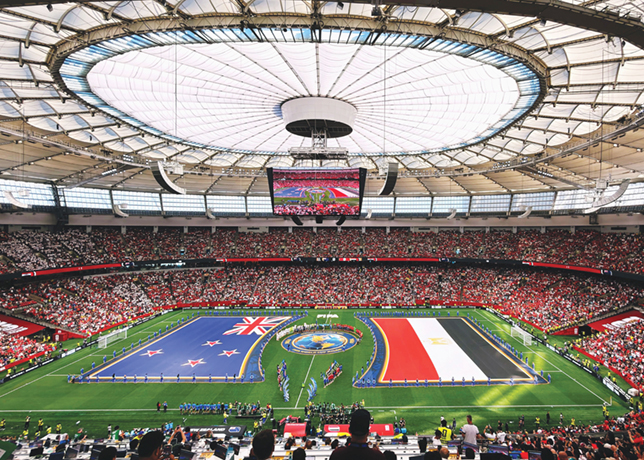
BC Place, Vancouver, Canada
Because direct aviation emissions remain virtually untouched by stadium-level interventions, organisers routinely purchase hundreds of thousands of carbon credits to claim carbon neutrality.
This practice remains highly contested among climate policy experts, who argue that offsets cannot replace genuine emissions reductions at the source.
For a net-zero strategy to be truly credible, global sports organisations must prioritise rigorous transparency, disclose full emissions profiles before offsets are applied, and pursue long-term structural changes in event travel and logistics.
Without these systemic reforms, mega sporting events risk using operational efficiency as a shield against the deeper, unresolved realities of their global travel footprints.