












































Industrial coatings have long served as critical materials for protecting surfaces against corrosion, weathering, abrasion, and chemical exposure while enhancing durability and aesthetics.
Today, however, the industry is entering a new phase of transformation; tightening regulations, shifting end-use markets, and evolving customer expectations are redefining how coatings are formulated, manufactured, and applied.
Historically, innovation in coatings centred on improving performance metrics such as adhesion, hardness, curing speed, and weather resistance.
While these attributes remain essential, manufacturers and end users are increasingly demanding lower carbon footprints, safer chemistries, and circular material solutions.
Three interconnected forces are shaping the industrial coatings landscape in 2026.
Firstly, regulations surrounding per- and polyfluoroalkyl substances (PFAS), volatile organic compounds (VOCs), and organotin compounds are accelerating reformulation efforts.
Secondly, electrification trends, including electric vehicles (EVs), data centres, and hydrogen infrastructure, are creating new performance requirements.
Thirdly, market consolidation among formulators and suppliers is redefining competitive dynamics and supply chain relationships.
As a result, industrial coatings are evolving from passive protective layers into multifunctional material systems capable of enabling electrification, sustainability, and low-carbon manufacturing.

PFAS alternatives remain a major challenge
VALUE CHAIN: FROM FEEDSTOCKS TO END MARKETS
The industrial coatings value chain spans multiple stages, beginning with raw material suppliers and extending through formulators, applicators, and end-use industries.
At the upstream level, chemical producers supply key feedstocks including acrylics, epoxies, polyurethanes, silicones, fluoropolymers, pigments, fillers, additives, and catalysts.
These ingredients determine coating properties such as adhesion, corrosion resistance, weatherability, gloss retention, flexibility, and curing behaviour.
Formulators combine these materials into finished coating systems tailored to application-specific requirements.
Applicators and original equipment manufacturer (OEMs) subsequently deploy these coatings across industries such as automotive, infrastructure, electronics, marine, packaging, and energy.
Increasingly, sustainability is being integrated across the entire value chain.
A notable example is the collaboration linking BASF’s zero-product-carbon-footprint (PCF) bio-attributed raw materials, Arkema’s super durable powder resin technologies, and AkzoNobel’s architectural powder coatings.
Such collaborations illustrate how decarbonisation is becoming a shared responsibility across the coatings ecosystem rather than an isolated effort.
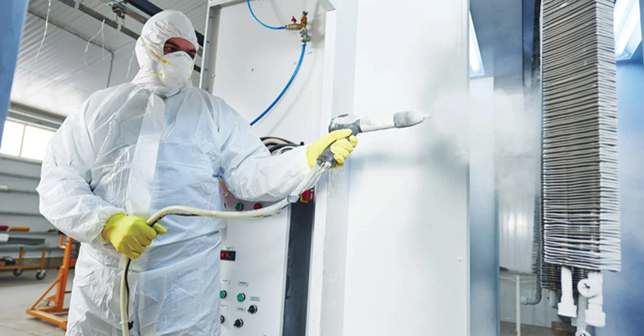
New regulations reshape industrial coating technologies
FROM COMPLIANCE TO COMPETITIVE ADVANTAGE
Regulatory developments are increasingly influencing formulation strategies and technology investments across the coatings industry.
• PFAS restrictions: PFAS chemistries have historically provided exceptional durability, chemical resistance, and low-friction properties.
However, growing regulatory scrutiny is accelerating the search for alternative technologies.
Manufacturers are increasingly exploring PFAS-free solutions to meet evolving regulatory requirements while maintaining performance.
• VOC regulations: VOC regulations continue to encourage the adoption of lower-emission technologies.
In several jurisdictions, industrial coating VOC limits are moving toward below 250 g/L, while advanced waterborne systems can achieve significantly lower VOC levels.
Powder coatings have emerged as an attractive option due to material utilisation rates that can exceed 95 per cent, reducing waste compared with conventional solvent-borne systems.
• Organotin restrictions: Restrictions on organotin compounds are driving the development of alternative catalyst systems capable of delivering rapid curing without compromising environmental performance.
• Carbon reduction targets: Across the value chain, manufacturers are increasingly pursuing lower-carbon materials, recycled content, and bio-based feedstocks as part of broader sustainability commitments.
Consequently, sustainability claims such as PFAS-free, APEO-free, tin-free, and low-VOC are rapidly evolving from differentiators into baseline customer expectations.
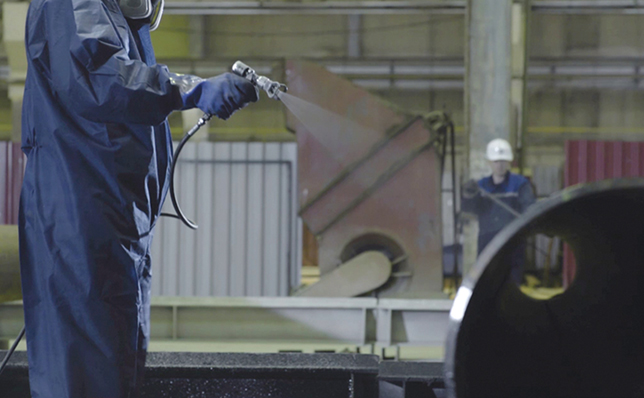
Powder coatings reduce waste and emissions
INGREDIENT & FORMULATION INNOVATION
Innovation in industrial coatings increasingly centres on balancing performance with regulatory compliance and sustainability.
• Advanced dispersants: Dispersants play a critical role in pigment stabilisation, viscosity control, and colour development.
BASF introduced Efka PX 4720, a high-performance acrylic dispersing agent designed to improve pigment wetting and dispersion efficiency.
Similarly, Borchers, a Milliken brand, launched Borchi Gen 0311, an APEO-free and tin-free dispersant for 2K solvent borne polyurethane industrial coatings.
While pricing information for newly launched specialty additives is rarely disclosed publicly, commercial adoption is ultimately determined by cost-in-use rather than purchase price alone.
Formulators evaluate whether improved dispersion efficiency, reduced additive loading, lower processing time, enhanced colour strength, or higher matting performance can offset the premium typically associated with next-generation additives.
Consequently, products such as BASF’s Efka PX 4720 and Borchi Gen 0311 will likely be judged not only on technical performance but also on their ability to improve overall formulation economics.
These developments illustrate how additive suppliers are increasingly aligning product performance with evolving regulatory expectations.
• Tin-free catalysts: Catalysts remain essential for accelerating curing reactions and improving production efficiency.
Metal-blend and organotin-free accelerators such as Borchi Kat 2115 are enabling rapid curing in 1K and 2K polyurethane systems as well as RTV silicone formulations, helping manufacturers meet both performance and compliance requirements.
• Advanced adhesion promoters: The increasing use of lightweight composites and engineering plastics in automotive and electronics applications has introduced new adhesion challenges.
Titanium acetylacetonate and specialised chelates are emerging as important solutions for improving adhesion on low-surface-energy substrates.
• Sustainable material platforms: Sustainability is also reshaping resin and pigment selection.
Arkema has expanded its portfolio with paints and wood coatings containing up to 93 per cent bio-based content while reducing titanium dioxide usage.
The company has also introduced powder coating solutions containing up to 40 per cent recycled content, reflecting the growing role of circular materials in industrial coatings.
THE SEARCH FOR HIGH-PERFORMANCE ALTERNATIVES
The transition away from PFAS represents one of the industry’s most significant innovation challenges.
Emerging alternatives include silicone coatings, sol-gel ceramics, diamond-like carbon (DLC) coatings, bio-based polymers, and plasma films.
While these technologies continue to advance, no single alternative currently replicates the complete performance profile of PTFE across all applications.
Consequently, future innovation is likely to focus on application-specific solutions rather than universal replacements.
The greatest challenge in PFAS replacement is not finding alternatives for individual performance attributes, but replicating the multifunctional nature of fluoropolymers within a single coating system.
While silicone, ceramic, DLC, and bio-based technologies continue to advance, formulators often face trade-offs between sustainability objectives and performance requirements, particularly in demanding industrial applications.
This performance gap remains one of the industry’s most important technical challenges.
REGIONAL DYNAMICS
Regional priorities in industrial coatings are increasingly diverging.
Europe remains at the forefront of sustainability-driven regulation, particularly in PFAS restrictions and VOC reduction initiatives.
These regulations are accelerating reformulation efforts and encouraging the adoption of lower-carbon technologies.
North America is benefiting from investments in infrastructure modernisation, EV manufacturing, battery production, and digital infrastructure, creating demand for advanced coating technologies.
Asia-Pacific continues to strengthen its position as both a manufacturing base and an innovation hub.
Recent developments include Beckers’ R&D centre in Shanghai, Peter Lacke’s plant expansion in Huizhou, China, and IMCD’s coatings laboratory in Jakarta.
These investments highlight the region’s growing role in formulation expertise, customer collaboration, and manufacturing expansion.
India is strengthening its position as a key destination for specialty chemicals and advanced manufacturing investments, supported by initiatives such as Make in India, manufacturing incentives, and efforts to expand domestic production capabilities.
For the coatings industry, this momentum is significant as demand continues to grow across automotive, infrastructure, electronics, renewable energy, and industrial manufacturing.
As companies diversify supply chains and reduce dependence on single-country sourcing, India is attracting increasing interest as both a manufacturing base and a growing market for coating resins, additives, pigments, and advanced application technologies.
MARKET CONSOLIDATION RESHAPES COMPETITIVE DYNAMICS
The industrial coatings industry is experiencing significant consolidation as companies seek greater scale, broader portfolios, and stronger market positions.
The proposed merger between AkzoNobel and Axalta represents one of the sector’s most significant transactions in recent years.
The withdrawal of a competing bid involving Nippon Paint and Sherwin-Williams further reinforced the strategic direction of the transaction.
Beyond mergers, leading players continue to invest in specialty technologies, sustainability platforms, and regional manufacturing capabilities to strengthen competitiveness.
INDUSTRIAL GAPS & FUTURE OPPORTUNITIES
Despite rapid innovation, several key challenges remain unresolved. These include:
• Limited PFAS-free substitutes that fully match PTFE performance.
• Raw material price volatility for specialty additives and resins.
• Balancing bio-based content with long-term durability.
• Uneven regulatory implementation across regions.
• Intellectual property barriers surrounding emerging chemistries.
As regulations evolve and new applications emerge, companies that combine advanced materials innovation with resilient supply chains and collaborative partnerships will be best positioned to capture the next wave of growth in industrial coatings.
* Riya Jain is a content and marketing specialist is associated with ChemBizR, a business research and consulting partner to global chemical companies. She writes on various topics in many business verticals. ChemBizR works to address critical business challenges and strategic growth initiatives, helping organisations transform their enterprises for sustainable growth in a highly competitive and rapidly evolving market environment.