


























































By Abdulaziz Khattak
Industrial oxidation chemistry is a cornerstone of modern manufacturing, accounting for nearly one-third of all chemical industrial processes.
While essential for making pharmaceuticals, dyes, and many specialty chemicals, industrial oxidation typically relies on high-temperature, high-pressure processes involving toxic oxidising agents.
This has motivated scientists to look into cytochrome P450 monooxygenases (P450s) as a compelling alternative.
These enzymes, found across virtually all living organisms, catalyse highly selective oxidation reactions at room temperature and ambient pressure, and several are already in use in pharmaceutical manufacturing.
Discovering and characterising new P450s is therefore an active area of research worldwide.
Even in one of the most extensively studied bacteria in microbiology, Bacillus subtilis strain 168, one of its eight P450 enzymes (CYP107J1) has remained functionally uncharacterised.
The main reason for this is that P450 enzymes do not work alone, but instead depend on redox partner proteins called reductases that activate them by transferring electrons.
In B subtilis, the genes encoding these partner proteins are not clustered alongside the P450 genes in the genome, making it challenging to identify the natural partners of CYP107J1.
Without them, scientists had to rely on partners borrowed from other organisms, which led to weak enzymatic activity and difficulties in characterising CYP107J1.
To address this, a research team led by Professor Toshiki Furuya from the Department of Applied Biological Science, Faculty of Science and Technology, Tokyo University of Science (TUS), Japan, turned to a strategy that sidesteps the redox partner problem entirely.
proteins.jpg)
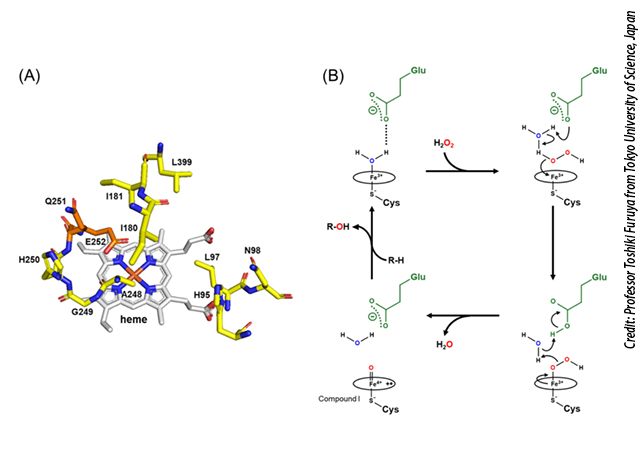
The engineered CYP107J1 enzyme is driven by hydrogen peroxide instead of NAD(P)H and does not require an electron transport chain and, therefore, no redox partner proteins
In their study, ‘Characterisation of the Orphan Cytochrome P450 CYP107J1 From Bacillus subtilis Through Peroxygenase Activity Engineering’, published in Volume 19, Issue 5 of Microbial Biotechnology on May 4, 2026, they characterised CYP107J1 by re-engineering it into a new form that requires no redox partners at all.
Other members of the team included second-year doctoral student Hideki Kato and Assistant Professor Takafumi Hashimoto, also from TUS.
This research was conducted in collaboration with the team of Dr Stephen Bell at the University of Adelaide.
The team first confirmed that natural CYP107J1 could oxidise 4-alkylbenzoic acids (compounds consisting of a benzene ring attached to a carbon chain) when paired with substitute redox partners in Escherichia coli cells.
The catalytic activity measured was, however, quite low.
Thus, the researchers then introduced two targeted amino acid changes into the enzyme’s active site, converting it into a peroxygenase driven by hydrogen peroxide (H2O2).
The mutations were designed rationally rather than through trial and error, as equivalent substitutions had previously conferred peroxygenase activity on a related enzyme called CYP199A4 in research by the team of collaborator Dr Stephen Bell.
Using structural modelling, the team confirmed that the corresponding residues in CYP107J1 were positioned appropriately in the active site.
This minor modification led to 28-fold higher catalytic activity toward 4-hexylbenzoic acid compared with the original enzyme with its substitute partners, without affecting selectivity for where on the substrate it places the hydroxyl group.
Unexpectedly, the engineered enzyme also converted indole into indigo, a commercially important blue dye.
By simply mixing the enzyme, substrate, and H2O2, the team could produce indigo at a rate that outperformed previously reported P450 peroxygenases used for the same purpose.
“The method used in this study simplified the driving mechanism of the P450 reaction itself, making it effective not only for analysing enzymes with unknown functions but also for applying them as catalysts for synthesising useful compounds,” says Prof Furuya.
Notably, the two-mutation engineering approach used here offers a practical template for unlocking other ‘orphan’ P450s without needing to first identify their natural redox partners.
This could expand the industrial use of engineered P450 enzymes as practical biocatalysts for manufacturing pharmaceuticals, dyes, and other valuable chemicals under mild reaction conditions.
Such efforts would ultimately make industrial oxidation chemistry a more sustainable activity overall.
The research team is currently working to further improve the catalytic activity of the modified CYP107J1 enzyme.
Prof. Furuya also highlights that many other molecules of this kind remain to be carefully investigated and leveraged in practical applications.
“Enzymes of the CYP107J subfamily are widely distributed among bacteria of the genus Bacillus. The findings from this study will facilitate further exploitation of their catalytic potential,” he concludes.
* Dr. Professor Toshiki Furuya is a Professor at the Faculty of Science and Technology in the Department of Applied Biological Science at Tokyo University of Science, Japan. His areas of research include applied biochemistry, microbial metabolism, enzyme catalysis, bioproduction, and bioremediation. He has published more than 45 articles in reputed journals, and has won many awards, including the 24th Excellent Paper Award by the Society of Biotechnology in 2016.