


























































Global maritime regulatory frameworks underwent a monumental shift regarding shipboard safety.
The International Association of Classification Societies (IACS) has published a comprehensive Recommendation on Onboard Lifting Appliances to facilitate the consistent global implementation of mandatory new safety standards.
These international requirements, introduced under the Safety of Life at Sea (SOLAS) Convention via Regulation II-1/3-13, officially entered into force on 1 January 2026.
Designed to eliminate structural failures that historically caused fatalities, injuries, equipment loss, and severe vessel damage, the regime applies strictly to new installations and existing equipment.
Operators must align existing machinery with the rules no later than the first renewal survey after the enforcement date.
The new framework establishes stringent protocols for the design, construction, installation, testing, examination, marking, maintenance, and operation of all onboard lifting appliances and associated loose gear.
Whilst the core regulations dictate uniform global enforcement, specific provisions mandate that national administrations determine the precise extent to which the rules apply to lighter appliances possessing a safe working load below 1,000 kg.
In the absence of explicit guidance from a flag state, the standard interpretation dictates that all clauses apply fully to all appliances regardless of weight capacity.
Furthermore, dual-use machinery designed to function as both a survival craft launching system and a standard cargo handling appliance must comply fully with both SOLAS Chapter III and the new lifting appliance rules, provided the functions are never utilised simultaneously and the life-saving capabilities remain permanently available.
OPERATIONAL PARAMETERS & COMPLIANCE BOUNDARIES
Lifting appliances are inherently hazardous marine machinery due to their limited structural redundancy, particularly within steel wire rope reeving systems.
To assist the maritime industry, the newly released guidance clearly delineates which onboard systems fall within or outside this regulatory scope.
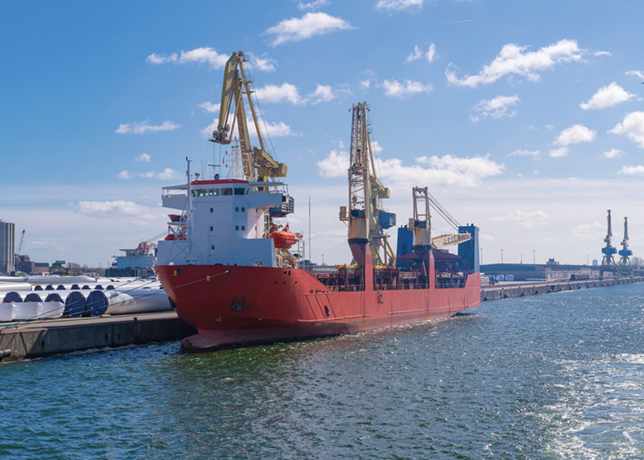
Standard cargo cranes, derrick systems, hatch cover gantry cranes running on deck rails, engine-room cranes, service davits, personnel handling cranes, open-sea lifting devices, and movable decks or car ramps operating with payload are explicitly included.
Conversely, the regulations explicitly exclude structural lifting eyes, elevators, escalators, conveyor systems, cable-laying installations, and car ramps or movable decks that move strictly without cargo or payload attached.
Removable or portable cranes and hoist trolleys temporarily mounted on runway beams are likewise excluded from the regime.
Existing lifting appliances installed prior to January 1, 2026, must be explicitly certified, marked with their safe working load, and subjected to thorough examination and load testing.
Equipment holds compliant status if valid certificates were issued before 2026 under accepted international instruments, such as the International Labour Organisation (ILO) Convention Number 152, by an approved administration or recognised organisation.
For uncertified legacy machinery, ship operators must formally nominate a safe working load based on original manufacturer drawings, manuals, or an official company declaration to ensure test loads are safely calculated.
Compliance for these specific legacy units is formally documented using standard factual statements.
Associated loose gear items, including hooks, hook blocks, shackles, swivels, grabs, and lifting beams, require rigorous proof testing, whereas sling gear, grommets, and wire rope slings are typically accepted based on manufacturer certificates if traceable.
SURVEY HARMONISATION & PORT AUTHORITY ENFORCEMENT
The regular maintenance of maritime certification requires careful coordination between independent survey schedules and the harmonised system of survey and certification.
Under standard guidelines, thorough examinations must occur annually for both lifting appliances and loose gear, whilst load testing for lifting appliances must be completed at least once every five years.
To enhance operational flexibility, annual examinations for cargo ships may be conducted within a window spanning three months before and after the anniversary date.
For passenger vessels, this annual examination window is restricted to the three months prior to the anniversary date.
Periodical five-year load tests for all vessel types must similarly occur within the three-month window preceding the anniversary date, and extensions beyond this target are barred unless authorised by an administration to allow a vessel to reach a designated survey port.
Major modifications or alterations completely invalidate existing approvals and drawings, forcing operators to execute comprehensive recertification procedures.
This process requires extensive plan appraisals, material verification, fatigue life assessments, and active survey tracking during fabrication.
If original documentation is missing, retroactive certification of the non-modified components becomes mandatory.
Shipmasters must also recognise that local port authorities enforce national dock work regulations under the ILO independently of flag state interpretations, requiring early consultation with local agents to prevent operational disruptions during port calls.
Initial verification occurs at the first cargo ship safety construction renewal survey or passenger safety survey on or after January 1, 2026, where vessels must undergo full load testing and thorough examinations to merge these safety regimes cleanly into current survey cycles.