































































By Abdulaziz Khattak
As global competition intensifies across quantum computing, cryogenics and next-generation energy technologies, helium-3, widely considered one of the world’s rarest and most valuable commodities, is increasingly making headlines.
Helium is already officially recognised as a critical raw material in Canada, UK and the European Union (EU).
Canada also includes helium on its national critical minerals list, while the EU’s Critical Raw Materials framework classifies helium as essential due to its high economic importance, limited substitutability, and concentrated supply.
Russia and China treat helium as strategic, with Russia’s Amur gas processing plant designed in part to raise Russia’s global helium position, to support the new Vostochny Cosmodrome and to support a new strategic initiative to bring high tech companies to the Russian Far East.
China added “helium/operations/business” to the 2025 Encouraged Foreign Investment Catalogue, which went into effect in February of 2026.’
In the Middle East, the US-Iran war has once again reminded markets that global energy supply chains remain deeply exposed to geopolitical risk.
Qatar sits at the centre of this vulnerability and according to the United States Geological Survey, in 2024 Qatar supplied 36 per cent of global helium supply.
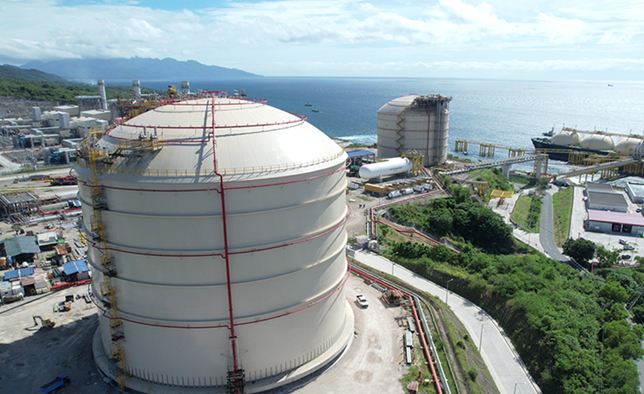
The country’s Ras Laffan Industrial City, operated and administered by QatarEnergy, hosts one of the world’s largest helium refining and liquefaction complexes.
Crucially, the same infrastructure, export routes and industrial systems that underpin Qatar’s LNG industry also produce and export a significant share of the world’s helium.
Following escalating tensions, QatarEnergy has halted LNG production, which by extension has also halted helium output, as helium is recovered as a by-product of natural gas processing and can only be produced alongside LNG at Ras Laffan.
HELIUM-3’S POTENTIAL
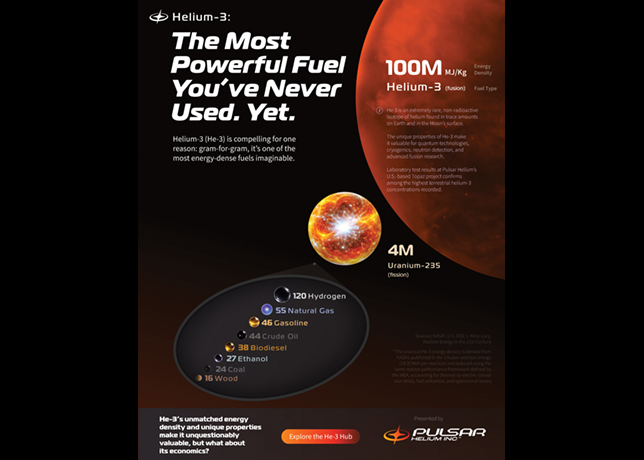
Pulsar Helium (Pulsar), a primary helium company based in Canada, in an infographic series has communicated and simplified the growing significance of helium-3, its applications, and the broader implications surrounding future supply scarcity.
The infographics explore helium-3’s extraordinary energy potential, often described as among the most energy-dense fuels known to humanity, while also illustrating the emerging economics surrounding the isotope amid expectations that global demand could increase more than tenfold between 2025 and 2035, with current demand likely curtailed by limited supply.
This illustrative campaign comes amid growing international discussion surrounding helium-3’s role in enabling frontier technologies, particularly quantum computing and fusion energy research.
Due to its extreme scarcity and strategic importance, helium-3 is considered one of the rarest and most valuable substances on the planet, with reported prices reaching approximately $18.7 million per kilogramme, more than 100,000 times the value of conventional helium (helium-4).
Against this backdrop, the significance of Pulsar’s terrestrial helium-3 discovery, which made global headlines following its announcement last October, has become increasingly apparent.
At its Topaz Helium Project in Minnesota, Pulsar has reported helium-3 concentrations of up to 14.5 ppb (parts per billion), based on multiple independent laboratory analyses (two US Federal laboratories, and the Woods Hole Oceanographic Institution).
These concentrations fall within the upper range of commonly cited lunar regolith estimates (approximately 1.4 to 15 ppb) and contrast sharply with the approximately 7 ppt (parts per trillion) concentration present in Earth’s atmosphere.
Historically, helium-3 has been obtainable only in extremely limited quantities, primarily as a by-product of tritium decay associated with nuclear stockpiles.
Against this backdrop, Pulsar’s unexpected discovery has attracted significant international attention, not only because of its rarity, but because it potentially offers access to helium-3 concentrations comparable to those being targeted through lunar extraction initiatives, without the immense technical and logistical challenges associated with extraterrestrial mining and transport.
HELIUM-3 APPLICATIONS
For the quantum computing industry, helium-3 already plays a critical role.
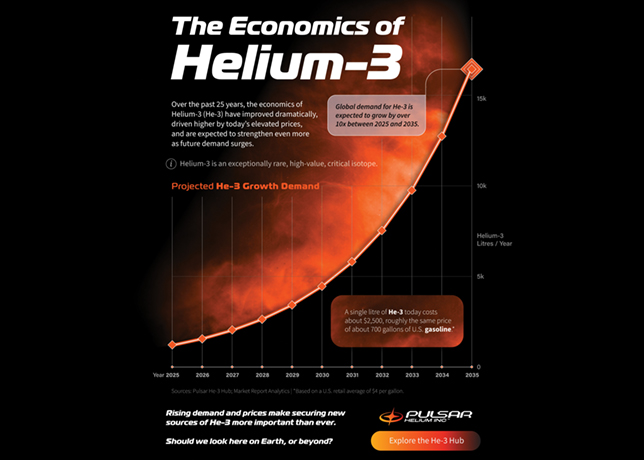
The economics of Helium 3
Dilution refrigeration systems, essential for cooling quantum processors to temperatures measured in millikelvin, rely on mixtures of helium-3 and helium-4 to create some of the coldest operational environments achievable on Earth.
Beyond quantum computing, helium-3’s potential applications extend even further. The isotope is highly effective as a neutron absorber, making it valuable for radiation detection technologies, border security and scientific instrumentation.
When hyperpolarised, helium-3 has also demonstrated utility in advanced MRI imaging, particularly in pulmonary diagnostics and lung imaging.
Perhaps the most widely discussed long-term application, however, remains nuclear fusion, with helium-3 fusion energy potential continuing to attract significant scientific, commercial and geopolitical interest.
Pulsar’s infographic series is intended to help communicate these dynamics more clearly to investors, stakeholders and the broader public at a time when helium-3 is increasingly intersecting with discussions surrounding national security, artificial intelligence, advanced manufacturing, quantum systems and future energy technologies.
As an exceptionally scarce keystone resource, helium-3 has the potential to influence future international power dynamics and underpin next-generation technologies.
Against this backdrop, there is potential scope for strategic partnerships and future commercial applications across sectors ranging from clean energy to national security.