





























































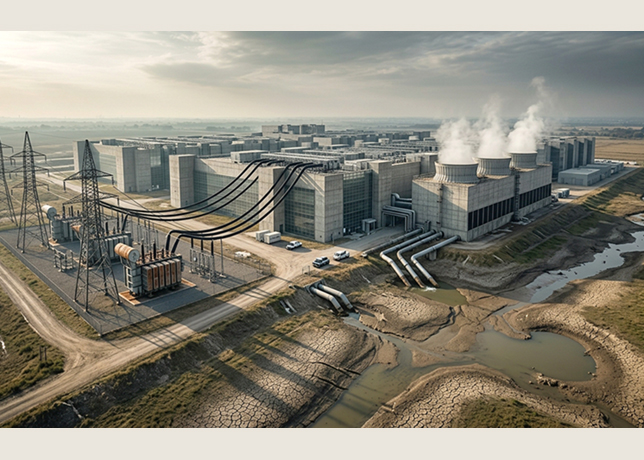
Across global industrial ecosystems, expanding digital infrastructure is generating severe environmental resource pressures, as fast-rising compute demands strain regional power grids, municipal water tables, and land availability.
The systemic scale of this expansion spans major economic markets across North America, Europe, the UK, Australia, New Zealand, Asia, and the Middle East, where physical infrastructure development interacts directly with localised resource constraints.
Rapidly expanding data centre footprints are intensifying competitive demands for primary utilities, placing infrastructure planning in direct conflict with ecological boundaries and local population needs.
In its investigation into these escalating resource demands, titled Environmental Cost of AI’s Energy Use: Carbon, Water and Land Footprints, the United Nations University Institute for Water, Environment and Health (UNU-INWEH) details how artificial intelligence (AI) infrastructure accelerates global resource depletion across carbon, water, and land metrics.
By 2030, global data centres powering AI are projected to consume 945 terawatt-hours (TWh) of electricity annually.
This projected demand is nearly triple the combined annual electricity consumption of Pakistan, Bangladesh, and Nigeria, which collectively host a population exceeding 650 million people.
Furthermore, this 2030 electricity consumption represents almost 3 per cent of projected total world electricity use and roughly twice the 2025 annual consumption of France.
Beyond electricity, the associated global water footprint of data centre energy will reach 9.3 trillion litres by 2030, matching the basic annual domestic water needs of all 1.3 billion people in Sub-Saharan Africa.
The physical land footprint required for this energy infrastructure will exceed 14,500 sq km, an area roughly twice the size of the Jakarta metropolitan region.
In 2025, global data centres consumed an estimated 448 TWh of electricity, which, if evaluated as a single nation, would rank as the 11th largest electricity consumer globally, positioned behind France and ahead of Saudi Arabia.
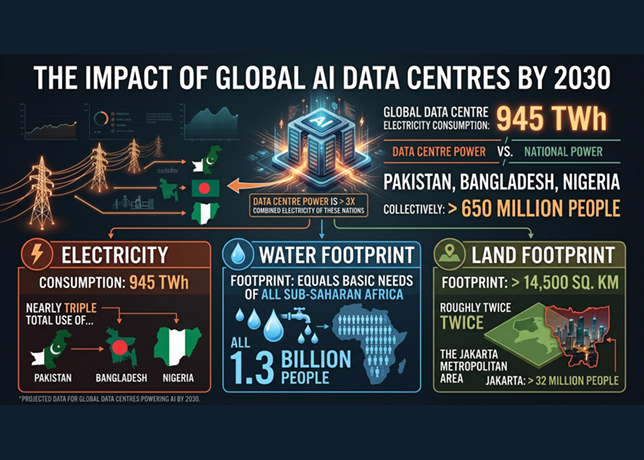
By 2030, global AI data centres will consume triple the combined annual power use of Pakistan, Bangladesh and Nigeria
REGIONAL DEPLOYMENT & LOCALISED ENVIRONMENTAL PRESSURES
The physical footprint of AI infrastructure is creating acute, localised environmental crises, often concentrated in regions already experiencing severe ecological stress.
In Ireland, rapid data centre construction resulted in the sector consuming 21 per cent of total metered electricity in 2023, surpassing the total electrical consumption of all urban households combined.
This concentration forced the national grid operator to institute a pause on new data centre grid connection approvals around Dublin extending until 2028, offering a concrete demonstration of grid capacity failure when compute growth outpaces energy planning.
In Queretaro, Mexico, expanding compute facilities continue drawing directly on municipal water supplies amidst prolonged regional droughts.
In Uruguay, official plans to construct a water-intensive data centre coincided with a severe 2023 drought that depleted Montevideo’s freshwater reserves, leaving tap water unsafe to drink.
Upstream and downstream components of the technology lifecycle compound these localised pressures.
By 2030, AI infrastructure is projected to generate up to 2.5 million tonnes of electronic waste annually, equivalent to discarding nearly 250 Eiffel Towers each year, much of which is exported to low-income economies featuring minimal environmental protections, while required critical minerals are extracted under weak regulatory oversight.
At the same time, access to AI infrastructure remains severely unequal, creating a stark digital and environmental divide.
Only 32 countries worldwide currently host specialised AI data centres, with over 90 per cent of total capacity concentrated in just two nations, the US and China.
Conversely, more than 150 countries possess little or no sovereign AI compute capacity.
Excluded nations frequently bear the environmental burdens of critical mineral extraction and electronic waste processing, while the economic, strategic, and sovereignty advantages of advanced compute flow exclusively to wealthy host jurisdictions.
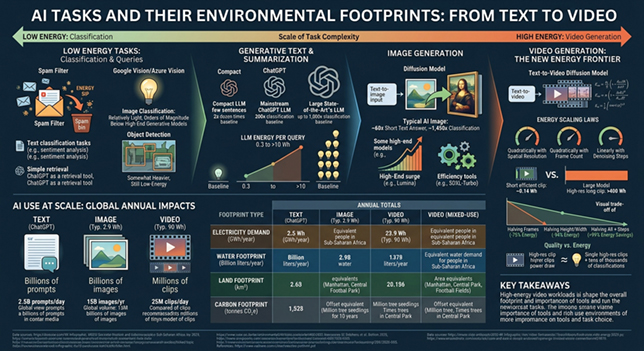
AI tasks and their environmental footprints
COMPUTATIONAL DRIVERS BEHIND OPERATIONAL RESOURCE CONSUMPTION
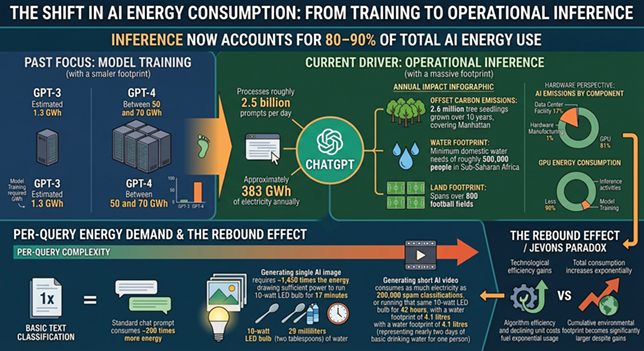
The primary driver of AI energy consumption has fundamentally shifted from initial model training to operational inference, which encompasses the continuous execution of deployed models to process daily user prompts.
While public attention historically centred on training, where model training required an estimated 1.3 gigawatt-hours (GWh) for GPT-3 and between 50 and 70 GWh for GPT-4, operational inference now accounts for 80 to 90 per cent of total AI energy use.
A single deployed product, ChatGPT, processes roughly 2.5 billion prompts per day, translating to approximately 383 GWh of electricity annually.
Offsetting the carbon emissions from ChatGPT’s annual electricity draw alone would require 2.6 million tree seedlings grown over 10 years, covering a land area equal to Manhattan.
Its associated annual water footprint equals the minimum domestic water needs of roughly 500,000 people in Sub-Saharan Africa, while its land footprint spans over 800 football fields.
From a hardware perspective, graphics processing unit electricity consumption accounts for 81 per cent of total AI emissions, data centre facility electricity accounts for 17 per cent, and hardware manufacturing contributes 1 per cent.
Within graphics processing unit energy consumption, inference activities account for over 90 per cent of electricity draw, compared to less than 10 per cent for model training.
Per-query energy demand varies dramatically depending on output complexity, resolution, and task design.
A standard conversational chat prompt consumes roughly 200 times more energy than basic text classification.
Generating a single AI image requires approximately 1,450 times the energy of basic text classification, drawing sufficient power to run a 10-watt LED bulb for 17 minutes and consuming 29 millilitres (two tablespoons) of water.
Generating a short AI video consumes as much electricity as 200,000 spam classifications, or running that same 10-watt LED bulb for 42 hours, with a water footprint of 4.1 litres, representing nearly two days of basic drinking water for one person.
Furthermore, efficiency gains at the individual prompt level are regularly offset by total volume growth due to the rebound effect, or Jevons Paradox.
As algorithms become more efficient and unit costs decline, total consumption increases exponentially, making the cumulative environmental footprint significantly larger despite technological efficiency gains.
MULTI-METRIC MEASUREMENT STANDARDS & GOVERNANCE FRAMEWORK
Evaluating AI sustainability exclusively through carbon emissions systematically mismeasures total environmental costs and creates dangerous ecological trade-offs.
Switching power generation from coal to bioenergy, for instance, reduces electricity carbon footprints by an average of 70 per cent, but increases associated water footprints more than thirty-fold and land footprints a hundred-fold.
Evaluating infrastructure through single-variable metrics conceals these shifts, transferring severe environmental burdens onto regions experiencing acute water scarcity or land stress.
Overall, projected 2030 data centre electricity consumption will generate 399 million tonnes of carbon emissions, requiring roughly 6.7 billion trees grown over 10 years to offset, approximately twice the total tree population of the UK.
Because low-carbon power sources do not inherently guarantee low-water or low-land consumption, single-metric evaluations fail to protect local ecosystems.
To prevent cross-border burden shifting and ensure infrastructure develops within planetary boundaries, a comprehensive governance roadmap established across six core principles: Transparency, efficiency by design, equity and environmental justice, lifecycle responsibility, global cooperation, and sustainable use.
Under this framework, governments must incorporate AI compute into broader energy planning, water governance, and land-use permitting while requiring mandatory, standardised reporting across carbon, water, and land metrics jointly.
Technology developers and industry operators are urged to address model selection, default output lengths, token caps, and routing settings as primary footprint determinants, establishing efficiency by design. Deploying organisations and users must adopt fit-for-purpose model selection, choosing the lowest-energy format suitable for a given task.
Data centre operators and utility providers must treat facility siting as an environmental decision using cumulative impact assessments.
Financial investors are advised to treat carbon, water, and land metrics as material risk factors within infrastructure portfolios, while international bodies must establish harmonised measurement standards and build equitable compute capacity across underrepresented regions.