
















































Confined Space Entry (CSE) is one of the riskiest industrial workplace procedures. From limited entry and exit points, to poor ventilation and high potential of toxic air contaminants, workers in these environments must be armed with the technology, training, and data to make the safest, most effective decisions.
According to the US Bureau of Labor Statistics, there are an average of 129 confined space entry deaths per year.
And the Canadian Centre for Occupational Health and Safety (CCOHS) reports that over half (56 per cent) of those CSE deaths are from atmospheric hazards.
“Making confined entries as safe as possible means understanding what these might be before entry, monitoring workers and their data during the entry, and reviewing the work after to make any process improvements for the future,” Samy Karam Gerguis, Region Sales Director, Blackline Safety, tells OGN.
HOW TO WORK CONFIDENTLY IN CONFINED SPACES
Preparing workers properly for confined space entries therefore means having a defined plan for every stage.
Focusing on the following four areas can help build confidence in your team and reduce the chance of serious injuries and fatalities (SIFs) on your worksite.
• Connectivity: Depending on the depth or location of the confined space, connectivity can become a critical control.
Cloud connectivity, specifically, enables the relay of essential real-time information from within the confined space to workers outside, and monitoring personnel.
Having layers of communication, like two-way voice or Push-To-Talk functionality, also offers confidence that workers can reach a real human should something go wrong.
According to CCOHS, an estimated 60 per cent of confined space fatalities are would-be rescuers.
Being able to transmit situational information, including real-time alerts during incidents, can be the difference between an informed rescue – where teams are equipped with everything they need to make a safe entry — like exact location and hazard type — and a blind rescue that leads to an escalated incident.
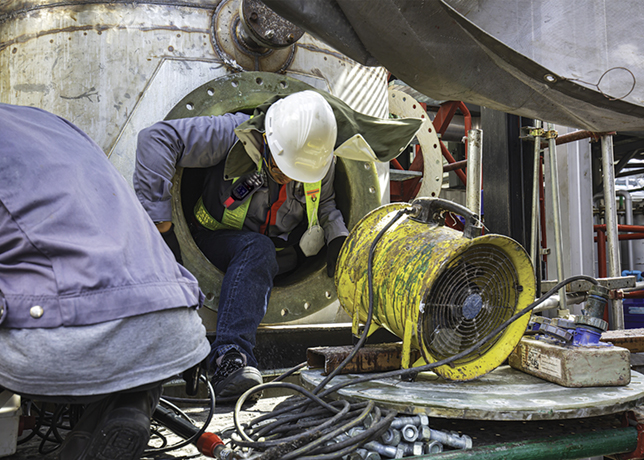
Confined space entry is one of the most dangerous procedures on a worksite
• Risk assessment: Proper entry procedures focused on gas detection are key to ensuring worker protection.
During events like shutdowns and turnarounds, in particular, where unfamiliar contractors are onsite, risks accelerate.
A pre-entry check with a connected wearable multi-gas detector can reveal the presence of toxic gases, oxygen deficiency, or a potentially explosive atmosphere.
This alerts workers to unsafe conditions before they enter the confined space.
The data can also be transmitted in real-time to remote monitoring teams for full situational awareness.
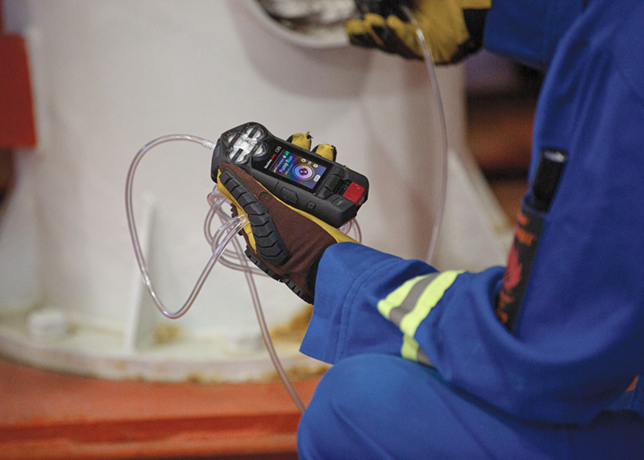
Pre-entry checks ensure gases and atmospheric hazards are detected
• Monitoring: Centralised confined space monitoring (CCSM), also known as remote, digital, or real-time confined space monitoring, is recognised in some jurisdictions as being equivalent to having an attendant worker physically present.
CCSM integrates real-time gas monitoring, cameras, access control, ventilation equipment, and two-way communication into a system monitored by a command centre.
This method ensures operators can monitor gas detection data from a safe distance, such that they can take timely action to protect workers without being exposed to atmospheric threats themselves.
• Review: With access to the right data and reports, leaders can make continuous, evidence-based safety improvements to this inevitable practice, all while boosting performance and managing compliance.
Leveraging analytics from connected devices used in CSEs can lead to proactive safety and supports better planning and preparation, which reduces the likelihood of unexpected situations during future entries.
Creating a layered safety plan for confined space entries puts in place the controls needed for safer work during this dangerous activity.
Focusing on these technological and strategic areas offers your teams the confidence they can do the job and still get home safely.
Blackline Safety is a technology leader driving innovation in the industrial workforce through Internet of Things (IoT).
With connected safety devices and predictive analytics, Blackline enables companies to shift towards increased safety and improved operational performance.
Blackline provides wearable devices, personal and area gas monitoring, cloud-connected software and data analytics to meet demanding safety challenges and enhance overall productivity for organisations.
With customers in more than 75 countries, Blackline provides a lifeline to tens of thousands of people, having reported over 336 billion data-points and initiated over eight million emergency alerts. For more information, visit blacklinesafety.com