











































Fifty years ago, cars had an odometer that rolled over at 100,000 miles, and the reason was simple: 100,000 miles was a major accomplishment in the late 1970’s, and there was little need to record mileage beyond that point.
The probability that a car would last longer than 100,000 miles was, relative to today, small.
A typical new car warranty then was only 12 months or 12,000 miles.
Today 100,000 miles is not an accomplishment, but an expectation, and many cars even have warranties that extend that far.
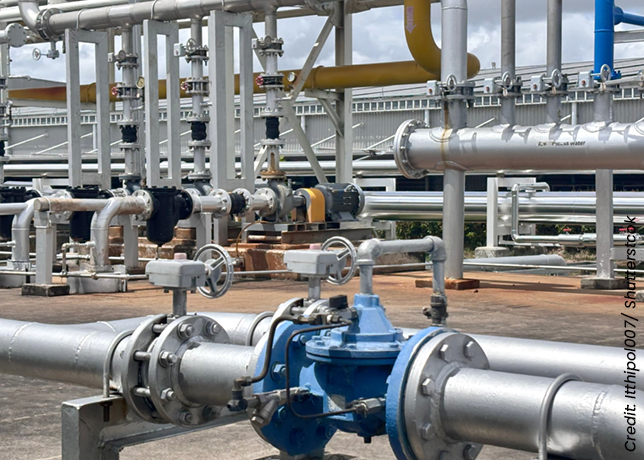
Industrial rotating equipment, particularly industrial pumps, have undergone a similar, though even more dramatic, transformation.
Where 90-day warranties and annual pump rebuilds were once common, users today have an expectation of five years or longer mean time between repairs (MTBR).
The practical application of reliability science has made this possible, and attention to bearing life in particular has been a major contributor to this new reality.
BEARING SEALS ENHANCE RELIABILITY
Given that bearing failure equals equipment failure, bearing protection is an essential topic to any conversation regarding reliability of industrial rotating equipment.
Bearings are protected from their two major causes of failure, contamination and lubricant loss, primarily by the bearing housing seals.
The proper selection and design of these bearing housing seals have a significant impact on pump reliability.
Some basic knowledge and understanding of bearing housing seals is thus a prerequisite topic for any practising rotating equipment reliability professional.
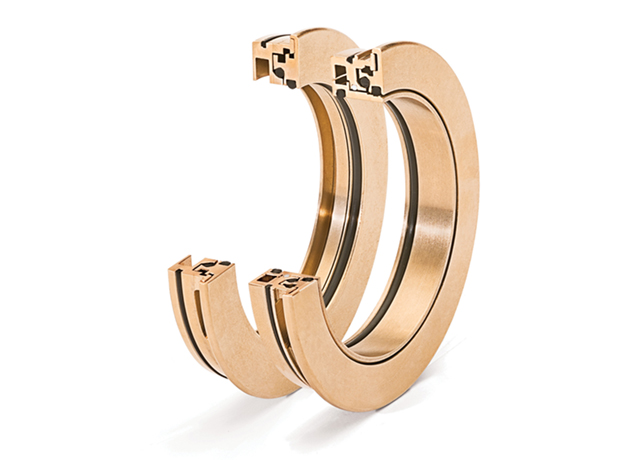
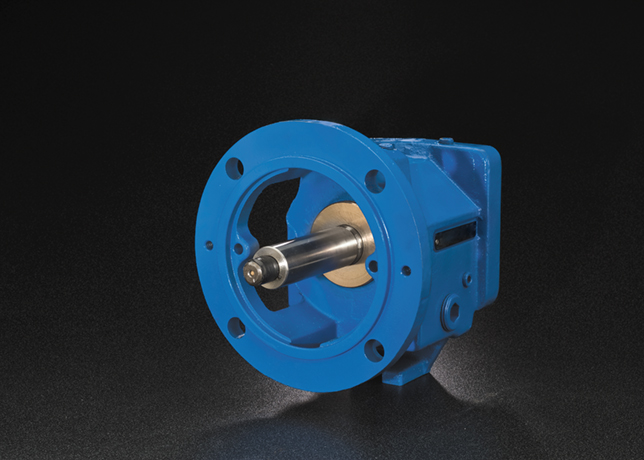
The new InproSeal VB45-S and VB45-U Bearing Isolators are the latest designs to provide permanent bearing protection for pumps
COMPARING CONTACT SEAL TYPES
There are essentially two broad categories of bearing housing seals: Contact and non-contact.
Contact seals rely solely upon contact to perform their sealing functions; if there is no contact, there is no seal.
Non-contact seals, conversely, do not rely on contact to perform their sealing function.
That is not to imply the design of non-contact seals never permit components to touch (for example, during installation or adjustment), but rather that contact is not a requirement for proper function.
For a non-contact seal, contact is not the mechanism by which the seal performs.
Contact seals are commonly further subdivided into lip seals and magnetic seals.
Lip seals broadly refer to any design utilising an elastomeric, usually circumferential contacting element.
This static contacting element is pressed against the shaft, often with the aid of a spring, to assure positive contact.
The elastomeric contacting element is often retained by a metal housing that is press-fit into the bearing housing about the shaft.
The primary advantage of lip seals is low cost, and the fact that they are also readily available in almost any size required.
The primary disadvantages are short life due to wear, and that by dynamically contacting the shaft they can cause shaft wear and damage.
Magnetic seals are optically flat, essentially simple unbalanced mechanical seals utilising magnetic attraction to load faces as opposed to mechanical springs.
The faces usually comprise different materials, such as carbon and stainless steel or other metals.
The primary advantage of magnetic seals over lip seals is that they do not damage the shaft, as all dynamic contact occurs within the seal and between the two faces.
Magnetic seals are considerably more expensive than lip seals.
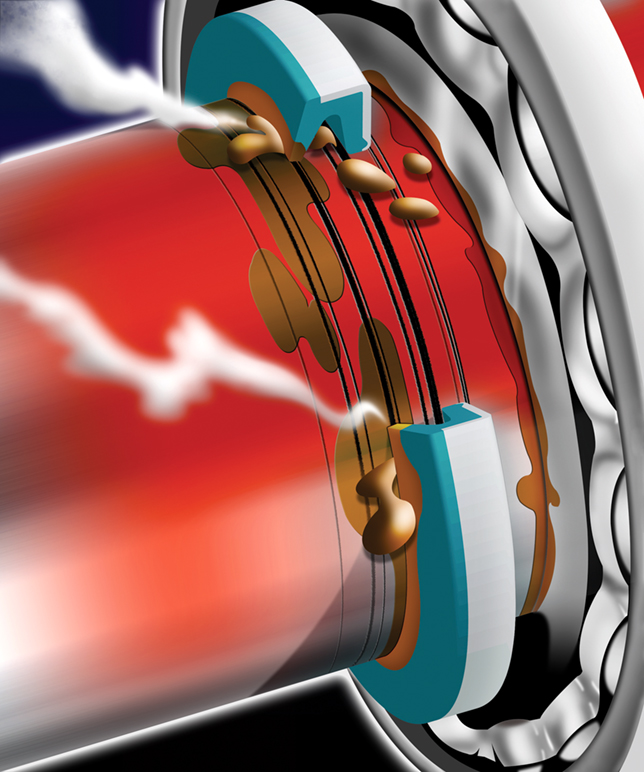
Contact seals, like lip seals, have a finite life expectancy as they will eventually wear at the point of contact or groove the shaft
Both types of contact seals have the advantage of being able to seal positive pressures or static levels (that is, heads) of lubricant.
Their common disadvantage is in that contact seals are friction devices that will wear out and at some point, fail.
Predicting when contact seal failure will occur, or what seal life can be expected of any particular seal installation, has remained unknowable.
While the magnetic face-type seals are thought to offer greater life expectancy than lip seals, the real-world life expectancy of either type of contact seal is mostly still unknown.
Non-contact seals can be divided into three distinct categories: Gap, traditional labyrinths or compound labyrinths, often referred to as Bearing Isolators.
Gap, or clearance, seals provide minimal protection at best, as they rely solely on a gap or tight clearance as the sealing mechanism to block anything larger than the gap.
Traditional labyrinths added a difficult path into the gap seal design to further hinder anything passing through the seal.
Traditional labyrinth seals are usually one-directional and thus are an impractical option for a bearing housing seal where both contaminant exclusion and lubricant retention are required.
Both gap and labyrinth seals are inexpensive.
INTRODUCING COMPOUND BEARING ISOLATORS
During the late 1970’s, the compound labyrinth design was introduced to the industry.
Compound labyrinth seals utilise both static and dynamic components to retain lubricant and exclude contamination.
Inpro/Seal®, the inventor of compound labyrinth seals, coined the phrase “Bearing Isolators” to differentiate them from more traditional labyrinth seals, and the term has been in common use ever since.
Inpro/Seal Bearing Isolators are non-contact seals, and thus have an unlimited life expectancy.
Since they do not fail under normal circumstances, they are rarely the cause of equipment downtime.
Being a non-contact seal, Bearing Isolators are not the correct selection when a pressure, such as a static level of lubricant, must be sealed or when a bearing housing may become submerged.
Against splash lubricant and contamination, however, they are almost always the preferred choice.
To say the common application of Inpro/Seal Bearing Isolators to pump bearing housings was monumental would be an understatement.
Pumps operate within systems of related components, and the failure of only a few critical elements can bring an entire system down.
Bearing housing seal failures can and do cause pumping systems outages.
As demand for increased reliability and life expectancy has soared over the past decades, lip seals simply could not keep up with customer expectations.
The use of non-contact, non-wearing Inpro/Seal Bearing Isolators was fundamental in achieving the MTBR demanded in industry today.
Seal selection, like most engineering decisions, is a trade-off.
While contact seals do, as their name implies, provide a positive contact and thus an effective seal against static heads and pressure, they are plagued by finite life.
They will fail at some point, the time of which is mostly unknowable, and there are an untold number of factors that may contribute to contact seal life expectancy.
And when they do fail, an equipment repair is not far behind.
Non-contacting Inpro/Seal Bearing Isolators, conversely, will not fail and rarely contribute to a reduction in overall equipment reliability.
They in fact increase reliability by eliminating the bearing housing seal as a failure point.
Because of this, Inpro/Seal Bearing Isolators are now a common default choice for industrial rotating equipment, specifically industrial pumps.
In the decades since we celebrated our cars achieving 100,000 miles, the availability and widespread application of Inpro/ Seal Bearing Isolators has had a major impact on rotating equipment reliability.
Without Bearing Isolator technology, it could be argued, our present expectation for five or more years between repairs would not be possible.