



































































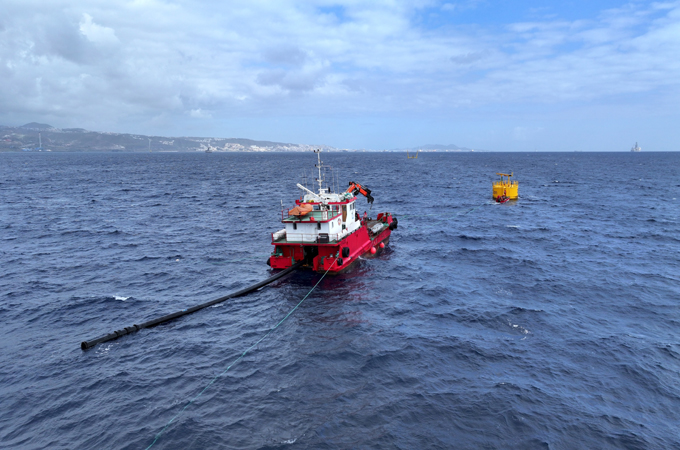
Global OTEC, a pioneer in Ocean Thermal Energy Conversion (OTEC), has completed the offshore installation of a floating platform prototype in the Canary Islands, marking a step toward commercialising ocean-based renewable energy.
Inspired by Jules
Verne’s Twenty Thousand Leagues Under the Sea, OTEC generates
electricity by harnessing the temperature difference between warm surface water
and cold deep ocean water, offering a continuous, 24/7 renewable power source.
While OTEC has been
demonstrated onshore for decades, offshore deployment is essential for
achieving the scale required for commercial viability.
The Canary Islands
installation addresses a long-standing industry challenge: the ability to
reliably deploy and operate systems in deep ocean conditions.
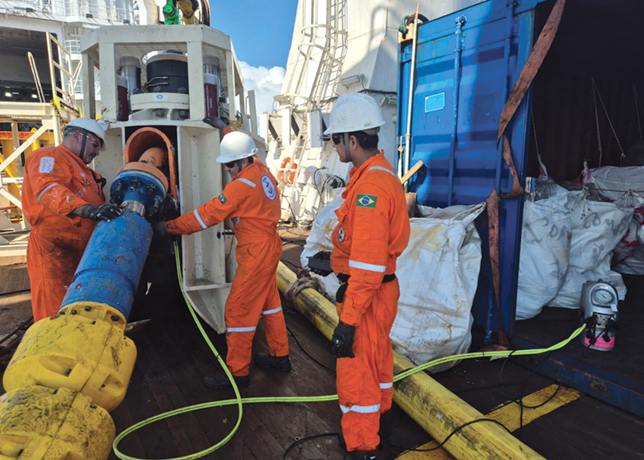
A key milestone was
the installation and connection of a 50-metre deep-water intake pipe, a
technically complex component that has previously caused failures in similar
projects, including past attempts in India.
The prototype is
located at the Oceanic Platform of the Canary Islands (PLOCAN), a pre-consented
offshore test site that enables real-world validation of performance and
environmental impact.
The project is part of
a €3.5 million ($4 million) European Union Horizon Europe programme led by
Global OTEC and a pan-European consortium, advancing the technology from
simulation and tank testing to full-scale ocean deployment.
A major innovation in
the project is the use of high-density polyethylene (HDPE) for the deep-water
intake pipe, supplied by partner AGRU, offering improved flexibility,
durability, and resistance to harsh marine conditions compared to traditional
materials.
This advancement also
has broader applications for offshore energy systems, including industrial
cooling and low-emission offshore operations.
“This is the moment
where OTEC moves away from controlled environments into the real world,” said
Dan Grech, Founder and CEO of Global OTEC. “Conventional onshore intake
systems, while great resources for aquaculture and testing equipment, are
low-capacity and expensive. Offshore, OTEC can scale in a modular approach that
transitions OTEC from a niche concept into a deployable offshore power system.
We now have a new class of standardised and replicable baseload power on a
learning curve akin to wind, solar, and batteries.”
The project has also
been selected by the DeepStar consortium, supported by major energy companies
such as ExxonMobil, BP, and Chevron, to evaluate OTEC for powering remote
offshore assets.
With offshore
validation underway, Global OTEC now plans to deploy its first OTEC Power
Module in Hawai’i, moving closer to establishing OTEC as a scalable clean
energy solution for island and coastal regions. -OGN/ TradeArabia News Service