
















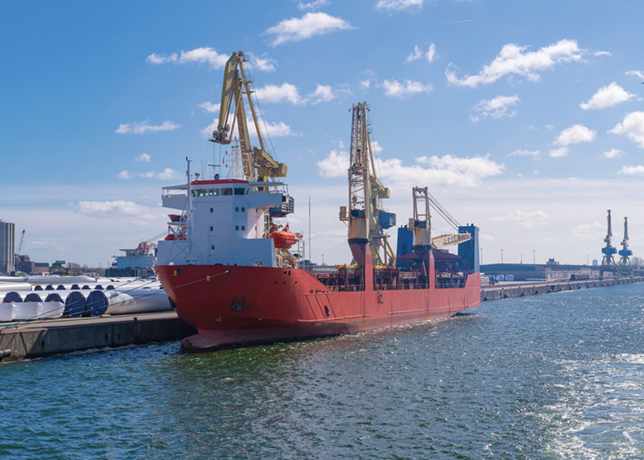







The company’s wholly owned shipping subsidiary, Vela International Marine Limited, took delivery in 2003 of three new modern, double-hulled tankers to further modernise its fleet.
Two of the new vessels were Very Large Crude Carriers, (VLCC'S) built by Hyundai in South Korea, and the third weas an Aframax crude/product carrier also builtin South Korea by Daewoo.
The three new tankers are equipped with the latest navigational systems and have robust safety systems designed to help ship's officers maintain maxiimumm control at all times. By having a large fleet at its disoposal, Saudi Aramco will further it ability to meet customers needs for reliable delivery of energy supplies under a wide variety of market and operating conditions.
Two additional double-hulled crude/product tankers were contracted with Daewoo during the year for delivery in 2004, plus Vela negotiated and signed an optiohn agreement for twomore medium-range tankers at Vela's sole discretion on or before May 31, 2005.
Vela was established in 1984 with four ships, and has since grown to include 21 VLCC and ULCCs, in addition to two refined product vessels.
Vela’s tanker fleet is in the process of being upgraded, with the addition of four new 300,000 deadweight tonne tankers and a new Aframax product carrier, replacing older tankers. Each new VLCC has a capacity to transport two million barrels of crude oil.
Vela transports crude oil to North America, Europe and Asia, and in a previous year delivered more than 1.9 million barrels per day (bpd) of oil, and 830,000 bpd of refined products and LPG to customers around the world.
The sheer size of the company’s crude-carrying fleet provides beneficial economies of scale which are passed on to clients in the form of competitive shipment rates.
Running a fleet of crude oil tankers of the size of Vela International also means keeping that fleet safe and well maintained, as an accident on a tanker could, for instance, cause a major oil spill and subsequent environmental damage.
The company has a proud history of commitment to accident-free voyages and quality maintenance. It has received ISO accreditation for its safe ship operations and environmental practices.
Its global operations comply with the highest international standards of the International Maritime Organisation (IMO).
The shipping industry is diverse and subject to many local and global regulations. For a company of Vela’s size, these regulations cover a huge range of daily activities. The company’s instruction manual includes more than 600 operational procedures, covering everything from emergency shipboard response to catering.
Vela’s Marine Operations Department takes a close interest in the safety of the fleet. The company reviews and refines its already-comprehensive emergency shipboard action plans, as well as its role in supporting all concerned authorities in the event of an oil spill.
These actions, combined with shore-based support functions and industry cooperatives, form two outstanding features of Vela’s International Safety Management (ISM) capabilities.
In complying with the ISM code, Vela has to demonstrate more than a dozen major areas of competence, all contained in a cohesive safety management system.
Periodic dry-docking is a requirement of all carriers expecting to maintain international government and industry certification. In the interest of accident-free operations, these requirements impose strict standards or codes with which the owners and operators must comply.
Vela was recently named best customer of last year at Arab Shipbuilding and Repair Yard (ASRY), a leading Gulf dry dock.
Vela supports the shipping industry-wide Condition Assessment Program (CAP) for its tankers, under which a ship’s quality is rated by dividing it into its three basic components: hull (structure and plate); machinery (main and auxiliary engines plus electrical equipment and service pumps) and cargo system (piping, valves, cargo pumps, and control equipment).
Each of these three main areas receive an overall CAP rating established by the three major classification societies: American Bureau of Shipping (ABS), Det Norske Veritas (DNV) and Lloyds Register (LR).
Storage surge
To ensure that petroleum products are available to Saudi consumers under a wide variety of conditions and scenarios, the Kingdom pushed forward its Saudi Strategic Storage Program (SSSP) during 2003 with completion of the program’s underground storage facility in Abha. Constructed by the Ministry of Defense and Aviation and operated and maintained by Saudi Aramco, the site was formally inaugurated in February by HRH Prince Sultan ibn ‘Abd al-’Aziz Al Sa’ud, Second Deputy Premier and Minister of Defense and Aviation.


