














SAUDI Basic Industries Corp (Sabic), the world’s largest chemicals firm by market value, is cutting spending to counter rising costs and a possible slowdown in US and European demand in 2008.
It says it expects “more challenges in light of an increase in the prices of raw materials and chances of declining demand as a result of a slowdown in the economies of the United States and Western Europe to some extent.”
The state-owned company has taken steps to cut costs to overcome these constraints.
Sabic also seeks to calm investors after losing almost 30 per cent of its value since it ended a run of record profits in the fourth quarter as US chemicals demand faltered.
The company’s fourth-quarter costs soared 115.7 per cent against a 77 per cent rise in sales. This surge slashed the firm’s net margin by more than a third.
Sabic chief executive Mohamed Al-Mady says higher input costs from a surge in oil prices also weighed on fourth-quarter profit which rose 12.3 per cent to 6.87 billion riyals ($1.83 billion), missing analysts’ forecasts which ranged from 8.38 billion riyals to 9.1 billion riyals.
Sabic also defends its $11.6-billion purchase of GE’s plastics unit last year, saying the acquisition would add value and boost its competitiveness in growth markets in the United States, Europe and Asia, boosting long-term growth.
“Sabic confirms its confidence in the quality of its investments in Sabic Innovative Plastics, according to its long-term strategic plan in which its future growth depends on expansion in specialised products,” it says.
Sabic Innovative Plastics Japan intends to expand its domestic business in areas related to automobiles and optics, with particular consideration to its products’ contributions to environmental protection.
The Japanese subsidiary of Sabic will emphasise its nonhalogenated flame-retardant materials, its flexible Noryl modified polyphenylene ether resins, and its Valox iQ and Xenoy iQ polybutylene terephthalate resins made from post-consumer plastics waste such as recycled PET bottles.
The Tokyo-based company plans to market its flexible Noryl resins and iQ resins to the automotive industry. It is targeting the application of the former in electrical-wire coating because of their high flame retardance despite their zero halogen content. The resins also allow increased thinwalling and lightweighting of products compared with polyvinyl chloride resin, which is currently the mainstream material.
Its iQ resins are being favourably reviewed in such applications as the shock-absorbing portion of car bumpers.
The company also is accelerating the practical application of its Lexan polycarbonate resin to automotive glazing.
In the optics field, Sabic Innovative Plastics Japan will promote the development of its heat-resistant materials for use in light-emitting diodes for automobile lights as well as application development for its Ultem polyetherimide resin.
It will explore markets in the sectors of electrical and electronic equipment for its Noryl resins, which are highly amenable to recycling, and its Cycoloy polycarbonate/acrylonitrile butadiene styrene, or PC/ABS, high-impact amorphous thermoplastic blends.
The company plans to allocate 10 per cent more management resources in 2008 than in 2007 to expand its Mooka factory, which produces compounds, and its Japan Technology Center located in the factory.
Looking ahead, it aims to eventually become the market leader for some of its functional-resin products. Takashi Hata, president of Sabic Innovative Plastics Japan, says, “We at the Japanese company have not yet been able to do ourselves justice in our performance in the domestic market to match Sabic’s global market share.”
General Electric of the US agreed to sell its GE Plastics division to Sabic in 2007, upon which the business was renamed Sabic Innovative Plastics.
China Petroleum and Chemical Corp (Sinopec), China’s major fuel and chemical supplier, and Sabic has agreed to a $1.7 billion joint venture to produce ethylene derivatives in China’s northern Tianjin municipality.
The 50-50 joint-venture company will invest in an ethylene derivative complex with an annual production capacity of 1 million tonnes, including 600,000 tonnes of polyethylene and 400,000 tonnes of ethylene glycol. The complex, to be completed by September 2009, will receive its ethylene feedstock from an ethylene cracker owned by Tianjin Petrochemical Co, a Sinopec subsidiary.
The deal came despite the Chinese government’s policy to encourage self-reliance in building ethylene production capacity, a key petrochemical block for making auto parts, packaging and plastics. Sabic’s extensive network in Saudi Arabia’s energy sector is expected to pave the way for Sinopec’s other projects in the Middle Eastern country, an anonymous industry insider said.
Beijing previously favoured global players such as BP, Shell, BASF and ExxonMobil for such collaborations in downstream oil sectors due to factors such as cash, technology and management. Since last year however, the Chinese government, now more abundant in cash and savvier in management, seems to be more interested in companies with other advantages, such as secure crude supplies and the ability to help the country’s oil majors tap the international resource market, according to industry experts.
China is expected to produce around 14.5 million tonnes of ethylene annually by 2010, with the remaining 42 per cent of its 25 million-tonne market demand to be sourced from the international market.
Both Sinopec and PetroChina have and will continue to pump money into expanding their ethylene production capabilities due to the sector’s promising outlook.
PetroChina currently has five large ethylene projects under construction in Dushanzi, Fushun, Sichuan, Daqing and Urumqi, which are all expected to be completed around 2009 or 2010. The oil giant, traditionally dominant in the upstream oil and gas exploration sector, aims to have an annual ethylene production capacity of 7 million tonnes by the end of the decade.
However, Sinopec is still projected to account for 60 per cent of China’s ethylene production capacity by then.
Saudi Basic Industries Corporation’s (Sabic) origins go back 32 years, to when the government embarked on a strategic push to use associated gas from its oil production as the key feedstock for the production of chemicals, poly-mers and fertilisers. With a $80 billion market cap, Sabic is now the largest public company in the Middle East, though the government still owns 70 per cent of its shares.
As one of the world’s top 10 petrochemicals manufacturers, Sabic produces a large and expanding range of products, and is among the world’s market leaders in the production of polyethylene, polypropylene, glycols, methanol and fertilisers. Overall production capacity has grown from 27 million tonnes in 2001 to 49.1 million tonnes in 2006. In the first nine months of 2007, Sabic reported a 13 per cent increase in output to 40.9 million tonnes.
From its Riyadh headquarters, Sabic controls 18 manufacturing affiliates inside the kingdom. Eight are joint ventures with foreign partners, while seven are joint-venture deals with local/regional partners. Three are wholly owned. Most of its affiliates are based in Jubail Industrial City and Dammam. Others are based in Yanbu.
The company has in the past 10 years undergone a major organisational restructure, shifting from a functional, site-based structure to a strategic business unit (SBU) structure. Sabic operates six interlinked SBUs: basic chemicals, intermediates, speciality products, polymers, fertilisers and metals.
The company operates a series of dedicated research and technology centres, and has a dedicated engineering and procurement function that will manage Sabic’s increasingly diverse contractor base.
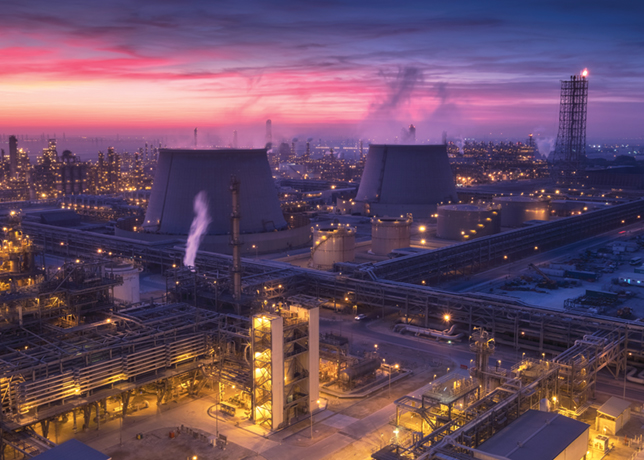
Sabic has two large production sites in Saudi Arabia, at Jubail and Yanbu, comprising 19 world-scale complexes. Some of these complexes are partnerships with international joint venture partners such as the US’ ExxonMobil Corporation, the UK/Dutch Shell Group and Japan’s Mitsubishi Chemicals. Increased production has come from an ethylene glycol plant at Jubail, a reinforced steel plant through the Saudi Iron & Steel Company (Hadeed) and urea and ammonia plants through Saudi Arabian Fertiliser Company (Safco).
In Europe, Sabic employs about 3,300 staff at three petrochemical manufacturing sites at Geleen in the Netherlands, Teesside in the UK and Gelsenkirchen in Germany. Sabic Europe produces 2.5 million tonnes a year (t/y) of polyolefins and 3.3 million t/y of basic chemicals. Since its mid-2007 acquisition of GE Plastics – to be known as Sabic Innovative Plastics – Sabic has also massively increased its US footprint.
Sabic’s profits are expected to grow further this year as three world-scale petrochemicals pro-jects – Yansab, Sharq and Kayan – are due to come on stream in 2008 and 2009, augmented by a series of smaller plants up to 2010.
Having established its credentials as the first genuine Saudi multinational, Sabic is not content to stop at a top-five placing. By 2015, the company wants to become the world’s largest petrochemicals producer.
The industrial giant is prepared to use its strong financial position to consolidate its recent growth spurt with a far wider footprint, both in terms of its product portfolio and its geographical positioning.
The move downstream is a necessity. With ethane in such short supply in the Gulf, polymer and base chemical production are likely to peak in 2010, leaving the strongest growth in the plastics sector, though it also means Sabic must market directly to the consumer. Sabic will have to adopt a whole new skills set, and fast, if it is to meet its ambitious targets.
Sabic does not have to grow through acquisitions to extend its reach further down the value chain. Some of its ventures, such as the $9 billion Saudi Kayan petrochemicals complex, will extend its product slate to take in poly-carbonates and phenols. It is also forging strategic relations with other Saudi corporates – for example, moving into the mining sector via a $3.5 billion joint venture with the Saudi Arabian Mining Company (Maaden) to produce phosphate fertilisers.
Sabic has met all the targets set out at its inception in the mid-1970s. In the past five years, it has emerged as one of the world’s top 10 petrochemicals producers, and significantly grown its foreign presence with intelligent acquisitions in high-growth markets. By the end of 2009, when two petrochemicals complexes – Yanbu National Petrochemical Company (Yansab) and Eastern Petrochemical Company (Sharq), of which it owns 50 per cent – come on stream, it will enter the top five.
Though numerous domestic private players are competing for feedstock, these are unlikely to dent Sabic’s regional dominance. Indeed, Sabic is widening the gap between itself and its nearest Gulf competitor. According to a recent MEED analysis, Sabic enjoys a total production capacity of nearly eight times its nearest rival, Qatar Fertiliser Company (Qafco).
Sabic will press ahead with plans to secure new markets and access new technology, but its plans may be undermined by international financial markets. Ratings agency Moody’s Investors Service weighed in with a potential ratings downgrade for Sabic Innovative Plastics in December 2007, out of concern that Sabic had used a highly leveraged funding structure, which put added pressure on the business.
These concerns may prove well-founded, given that Sabic has to deal with rising costs, For example, the Sabic-Maaden phosphate project costs have risen by 62 per cent to $5.6 billion. But it has sufficient financial reserves to support all its overseas businesses.
Still, there will be some concern at Sabic over the impact of the anticipated tailing off of petrochemicals prices in the second half of 2009, which may put further production increases in doubt.


