












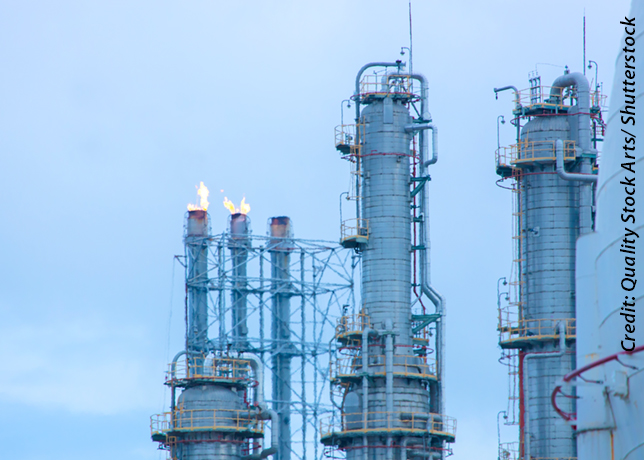











THE flares went out in Saudi Arabia, but no one missed them. Once burned, the gasses that fed the flares are being put to use.
In fact, the immense network for collecting, treating and distributing the gas was the keystone in Saudi Arabia’s on-going industrial development programme. Called the Master Gas System, this network is already providing fuel to generate power and desalinate water, and will soon be furnishing invaluable raw materials – feedstock – to nourish new industries.
The most ambitious energy project in history, the Master Gas System harnessed, for domestic and world markets, immense quantities of gas released from the ground with oil in Saudi Arabia’s oil fields. Designed to process up to 9,900,000 cubic metres (3.5 billion cubic feet) of gas a day, the system furnished fuel for items as diverse as cigarette lighters and cement plants and, by 1983, added the equivalent of some 750,000 barrels of crude oil a day to the world’s energy supply. Above all, it provided fuel and feedstock for plants under construction, or about to be constructed, at the new Saudi industrial cities of Yanbu’ and Jubail: mainly oil refineries, petrochemical and fertiliser plants, plus a steel plant and a rolling mill.
For a product that was once a problem it was a dramatic change. Dissolved in crude oil, the gases were brought to the surface with the oil, separated from it, and burned – since collection and processing were not economically justifiable; there simply was no market for such gas.
Aramco, which designed and built the Master Gas System – and now operates it on behalf of the Saudi government – used some gas on a small scale as far back as the early 1950s: primarily as fuel for Aramco plants, and, injected back into the ground, as a means of maintaining pressure in the Ghawar and Abqaiq oil fields. Some was also delivered to a number of local industries and power companies.
Later, in 1959, the company also began to develop a gas gathering system to recover what are called “natural gas liquids” (NGL) —a collective term used for some of the light hydrocarbon components produced with oil – and in 1961 began exporting liquefied petroleum gas (LPG). Aramco facilities, including gas processing and fractionation plants at Abqaiq and Ras Tanura, were expanded over the years until they were capable of producing and processing 360,000 barrels of natural gas liquids a day, making Saudi Arabia the largest NGL exporter in the world.
Although economic utilisation of gas had long been an objective of Saudi Arabia, a lot of gas still had to be flared until, in the mid-1970s, the rapid climb in world energy costs, coupled with the Saudi government’s decision to launch a massive industrialisation program, finally justified the huge investments necessary for gathering and processing gas on a large scale. Even so – when the Saudi government announced in 1975 its decision to build a greatly expanded and integrated gas system – sceptics predicted that the project would prove unprofitable because of depressed international gas prices.
The mammoth gas programme, however, paid off. Already, fuel gas gathered and processed by the system started driving seven major power generating stations and a steam power plant – producing almost all the electricity in the Eastern Province; two huge water desalination plants, a glass factory, and cement, fertiliser and lime plants. And, attracted by the prospect of ready supplies of relatively cheap fuel and feedstock, several major international firms entered into joint ventures with Saudi government agencies – Petromin and the Saudi Arabian Basic Industries Corp (Sabic) – in setting up industries at Yanbu’ and Jubail. These industries soon produced chemicals, refined petroleum products and manufactured goods for both export and domestic use, thereby reducing Saudi Arabia’s economic dependence on crude oil exports and industrial imports.
Sales of Saudi gas, moreover, have boosted world energy supplies substantially, with more production capacity still to come on stream. By 1983, the approximate total daily capacity of the integrated gas system was 56 million cubic metres (two billion cubic feet) of methane fuel gas; 10.6 million cubic metres (370 million cubic feet) of ethane; more than 315,000 barrels of natural gas liquids; and 3,700 tonnes of sulphur by-product. In general, the fuel gas and ethane will be used domestically as fuel and petrochemical feedstock and NGL and sulphur will be exported.
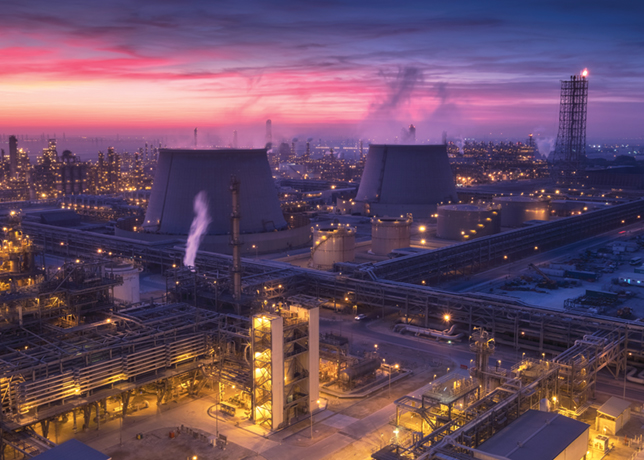
Collection of the gas begins in the kingdom’s eastern oil fields, where it is separated from crude oil at or near the well heads and piped to strategically located gas plants. At those plants, the gas is treated to remove sulphur compounds and carbon dioxide. The gas is then compressed and chilled to extract the heavier hydrocarbon components or NGL. The remaining gases, mainly methane, are compressed and distributed for use as plant fuel for industries and power generators in the Eastern Province. What’s left – ethane and NGL – is piped to east and west coast plants for fractionation into component parts by controlled vapourisation and condensation in a series of columns. Ethane, the lightest component, comes off first in gaseous form for use as fuel and feedstock for petrochemical complexes at Yanbu’ and Jubail. Propane and butane, which are refrigerated and condensed for export as liquefied petroleum gas, are extracted in the second and third columns, leaving natural gasoline as the remaining product. Additional columns in the series process this product to make finished natural gasoline, also for export.
The integrated gas system comprises 34 gas-oil separator plants (GOSPs) located on the Berri, Ghawar, Abqaiq and Har-maliyah oil fields; four gas processing centres at Berri, Shedgum, Uthmaniyah and Abqaiq in the Eastern Province; and three NGL fractionation plants and export terminals, at Juaymah and Ras Tanura on the Arabian Gulf and at Yanbu on the Red Sea. Linking these facilities are more than 2,400 kilometres of gas pipeline, including the longest and most advanced in the world, running east-west across the Arabian Peninsula from Shed-gum to Yanbu.
The total storage capacity at Juaymah, Ras Tanura and Yanbu for the propane, butane and natural gasoline product streams exceeds 16 million barrels. To keep them liquid, propane and butane are stored in special 29-metre-high (95 feet) refrigerated, dome-roofed tanks, while natural gasoline, which does not have to be chilled to remain liquid, is stored in 19.5-metre-high (64 feet) floating-roof tanks at Ras Tanura and Yanbu. The natural gas liquids are loaded for export at offshore terminals capable of handling vessels up to half a million tons. LPG is shipped to world markets in special refrigerated tankers, natural gasoline by conventional tanker.
To build the Master Gas System, many top-ranking international companies were contracted and tens of thousands of workers employed. Some 2,500 engineers and draftsmen alone were involved in the engineering phase of the project, which consumed nearly 200 million man-hours and some two million tons of imported equipment and materials.
Equipment and construction methods used were among the largest and most sophisticated in the world. Computers, for example, were used to work out precise settings for some 1,530 piles supporting a 10-kilometre-long (six-mile) pier carrying pipes to the offshore gas loading terminal at Juaymah. The Shedgum and ‘Uthmaniyah gas plants, each covering some 121 hectares (300 acres), utilise some of the largest gas processing equipment available today, and the fractionation modules at Yanbu’ are 261 metres long (856 feet) – just short of the length of three football fields.
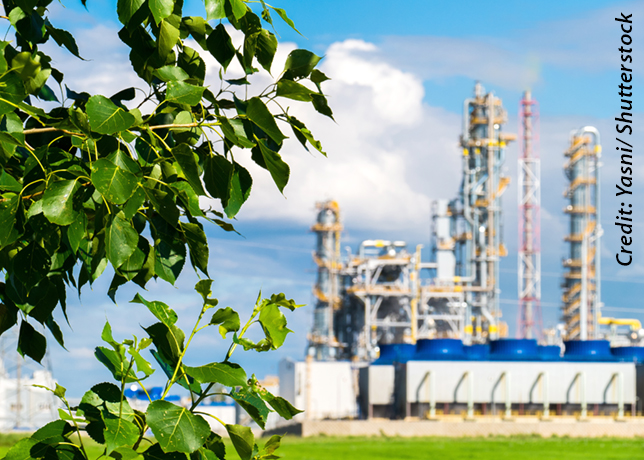
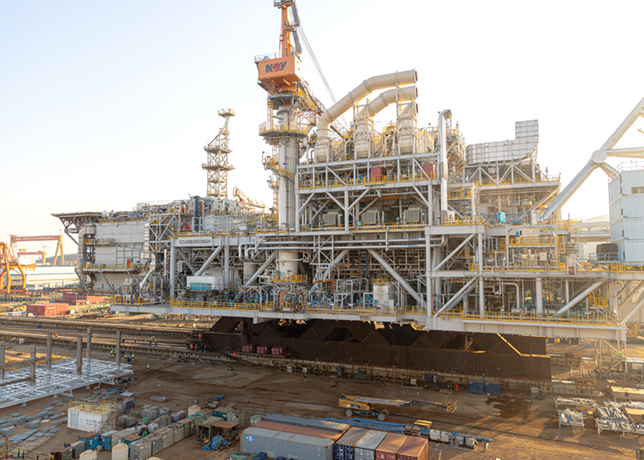
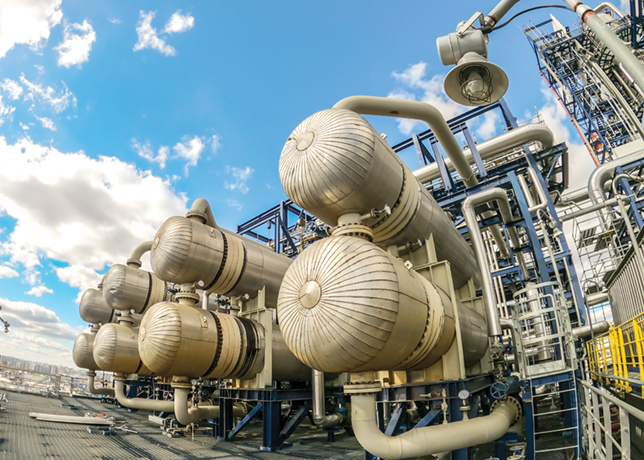
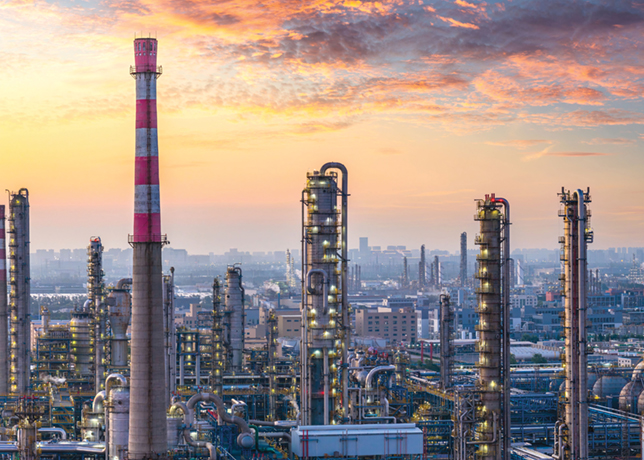
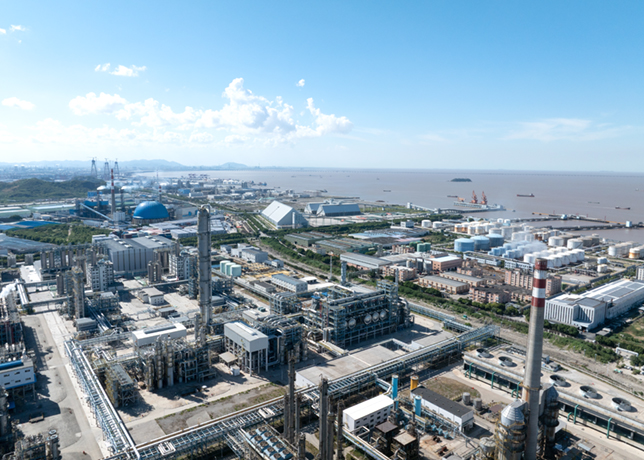
The visual result is quite stunning: masses of gleaming steel pipes, polished aluminum spheres and shiny metal tanks and towers rising like futuristic cities from the desert sands; and giant arms reaching out to huge tankers tethered in the turquoise waters of the Gulf.
But not all of the components of the gas system were new or man-made. In fact, one was the work of nature and millions of years old – a vast underground reservoir into which excess ethane can be injected for recovery and use later by domestic industries.
Marketing the products of the gas system is being handled by Petromin, which, already responsible for the domestic distribution of petroleum products and some overseas marketing of crude, is fast establishing itself as one of the biggest NGL marketers in the world. The main overseas customer at present for Saudi NGL is Japan.
To ensure complete reliability of gas supplies to Petromin’s customers, the Shedgum and Uthmaniyah processing plants each have four separate identical processing modules, and the Yanbu and Juaymah fractionation plants each have two independent fractionation trains, only one of which will be affected by maintenance shutdowns at a time, while the others continue production.
Currently, Saudi Aramco is pressing ahead with its plans to expand gas production, even as it calls a pause in its oilfield development.
Top on the list is the Karan project, which several in the industry have dubbed as Aramco’s single-largest non-associated gas development programme. Some $3 billion has been earmarked for investment to produce at least 1.5 billion cu ft/day from mid-2011.
Located offshore and north of the giant Safaniya field, Karan is potentially home to about 10trn cu ft (tcf) of gas. Development of the acreage was first taken up in third quarter 2006, when exploratory drilling indicated substantial reserves. This was followed by in-depth 3D seismic work and testing of wells. With field delineation and demarcation completed, Aramco did not look back since and mounted on the drawing board front-end and detailed engineering work of gas extraction and processing facilities.
At a mid-March job explanation meeting in London of contractors and vendors, officials from Aramco’s project management team unveiled details of the proposed facilities. Offshore, they include the installation of five production platforms, including a tie-in, a 92-km gas transmission pipeline and four 24-inch-diameter flowlines. Onshore, the planned major facilities are gas processing trains with capacity of 1.5 billion cu ft/d at the existing Khursaniyah gas plant (KGP), a sulphur recovery trains and related handling units.
The project is being fast-tracked with technical and commercial bids due to be submitted by June 24th for the engineering, procurement and construction (EPC) contract. In the next stage of project implementation, in July Aramco plans to receive funding approval from its board of directors. An award for the construction contracts is aimed in August, with the facilities planned to be built by July 2011.
As part of efforts to draw benefits from economies of scale, the Karan development is being synchronised with the 90m cu ft/d of gas and 67,000 bpd of condensate to be produced from the adjacent Manifa oil field. Under the original plan, Karan gas was to be processed at a new onshore plant to be built as part of the Manifa development. But, now output from both acreages will be brought to KGP.
The Karan development will dwarf any other gas projects Saudi Arabia may initiate in the coming few years, but to keep pace with the rising demand for natural gas Aramco has also embarked on a major scouting programme to add another 50 tcf of non-associated gas reserves by 2016. At present, the kingdom’s total natural gas reserves is 242 tcf, but nearly 60 per cent of it is in associated form and linked with crude oil output.
The new focus areas for exploration include the Nafud basin, northern and western Saudi Arabia, the Red Sea, the Persian Gulf and Rub al-Khali (Empty Quarter). Some 300 development and over 70 exploration and delineation wells are planned to be drilled by 2010, according to Aramco.
Of the new frontiers, the most advanced is the Empty Quarter where exploratory drilling work is ongoing. Until now, the South Rub al-Khali Company (Srak) has spudded two wells. The results have been discouraging, but to the north there seems to be a glimmer of hope. Early last year, Luksar – a joint venture of Lukoil Overseas and Aramco – reported findings in its second wild cat well in Block A. More recently at Block B, Sino-Saudi Gas also announced initial flows from its preliminary drilling activities. The Royal Dutch/Shell Group, which holds 40 per cent of Srak has also been undeterred by the withdrawal of France’s Total, and is pressing ahead with more exploratory well drilling.
Next in line is the Red Sea, where Ottawa-based Sanders Geophysics has launched an aero-magnetic survey. According to Aramco, initial seismic work has indicated that the west coast is particularly promising. The verdict will be awaited. But, in the meantime Aramco is expanding its gas-handling capacity at the onshore Ghazal field to receive 40m cu ft/d of gas by late 2008. Incremental volumes of non-associated gas will also come from fields discovered recently in the Eastern Province.
Significant volumes of associated gas – estimated to be at least 200m cu ft/d – will also flow from the Khurais field, the largest in the current expansion programme, with capacity to produce 1.2m bpd of crude oil by end-2009.
With demand for natural gas growing at 7-9 per cent each year, Aramco is well aware its master gas systems (MGS) set up in the 1970s will need sufficient back up.
By 2030, demand will soar to 14.5bn cu ft/d from current levels of 5.5bn cu ft/d. At present, the power and desalination sector accounts for nearly 55 per cent of the total gas consumption, with the remaining 45 per cent being used as feedstock for petrochemicals. However, pressure is mounting on Aramco to make available increased volumes of propane, butane and ethane.
The Karan development will considerably ease the looming gas shortage, but looking ahead, producing the increased volumes of gas needed to satisfy demand will be a daunting task.
Saudi Arabia has proven gas reserves of around 250 trillion cubic feet, according to British oil giant BP PLC, the world’s fourth largest after Russia, Iran and Qatar. But most of that is caught up in producing oil fields, and not available for use. New discoveries have fallen far short of expectations.
Meanwhile, the kingdom is seeing a huge increase in domestic demand for the fuel as a feedstock for everything from desalination plants to heavy industry and power generation. Companies including Dow Chemical Co, Chevron Corp and Japan’s Sumitomo have made significant chemicals investments based on the prospect of inexpensive natural gas.
Saudi Aramco, forecasts that domestic gas demand will nearly triple by 2030 and the company is on a drive to boost the kingdom’s reserves of nonassociated gas – gas from wells that don’t contain any crude oil – by 100 trillion cubic feet over the next 10 years.
One of the world’s largest deserts, the Rub al Khali is one of the most-inhospitable environments on Earth: temperatures can reach 55 degrees Celsius. Former US Secretary of Defense Caspar Weinberger once wrote that Rub al Khali “makes Death Valley look like a summer resort.” But it has long been seen as the key to Saudi Arabia’s gas-supply problems. The hope is that the region will add a significant fresh stream of natural gas by 2011.
Saudi Arabia has traditionally been off limits to foreigners for exploration, but five years ago the country invited foreign investors to help it develop gas deposits in the Empty Quarter. That decision marked an evolutionary leap for Aramco, which has barred the big international operators from any exploration work in the kingdom since the company was fully nationalised in 1980. Saudi officials are confident there will be big finds. “There is still reason for optimism,” said one. “We don’t know what the success will be but the geologists are still hopeful.”
One former senior Aramco official remains sceptical. “If there was a lot of gas there, we would have been exploring it ourselves,” says Sadad Al-Husseini, former head of exploration and production, who retired in 2004. He spent several years overseeing gas exploration in the Empty Quarter in the early 1970s. “It is just unfortunate that so much money has been spent to confirm what we knew already,” he said. All of the companies declined to divulge costs.
Husseini is among a growing contingent within Saudi Arabia that believes that the kingdom’s gas strategy is misguided. With signs mounting that the kingdom overestimated its available gas supplies, Husseini says, “the consequence is that we need to go back to the strategy we had before, which is to make better use of oil, to be more efficient, and to be more gradual in our industrialisation.”
Total was a partner in one of four international consortia created to drill in the Empty Quarter. The company it formed along with Aramco and Royal Dutch Shell PLC – the South Rub al Khali Co or Srak – was awarded by far the largest concession, an area the size of the US state of Kansas. But the results have been disappointing. “We see the ingredients of a hydrocarbon system,” says Malcolm Brinded, Shell’s head of exploration and production. “We just haven’t found them all together in the same place.”
With Total gone, Shell will now have to shoulder more of Srak’s exploration costs. But it says it will stay the course. Shell Chief Executive Jeroen van der Veer recalls an incident in the 1930s when the company was asked to take part in an international consortium exploring for oil in Saudi Arabia. A famous telex, still in Shell’s archives, declined the offer, saying there was no oil in the kingdom. “I don’t like to make the same mistake based on three wells in an area fives times as big as the Netherlands,” van der Veer says.
There has been some good news. Luksar, a joint venture of Aramco and Russian producer OAO Lukoil, reported discovering some hydrocarbons at one of its wells last year. Sino Saudi Gas, which brings together Aramco and Sinopec International Petroleum Exploration & Production Corp., also announced initial gas flow from one of its wells, though it is too early to say how much gas is there. EniRepsa, a consortium of Italy’s Eni SpA, Spain’s Repsol-YPF and Aramco, has found nothing substantial.
But analysts say it’s still early. “They’ve only scratched the surface in terms of the search for gas,” says Iain Brown, a Middle East expert at oil-and-gas consultancy Wood Mackenzie in Edinburgh, Scotland. “There’s a long way to go before the potential for gas has been fully evaluated.”
Analysts say the Rub al Khali might not even be the best place to be looking for gas in Saudi Arabia, and that the Saudi Aramco Reserve Area in the east – a province off limits to foreign companies – has by far the most promising acreage that covers an area of 200,000 sq km close to the size of Romania.


