









































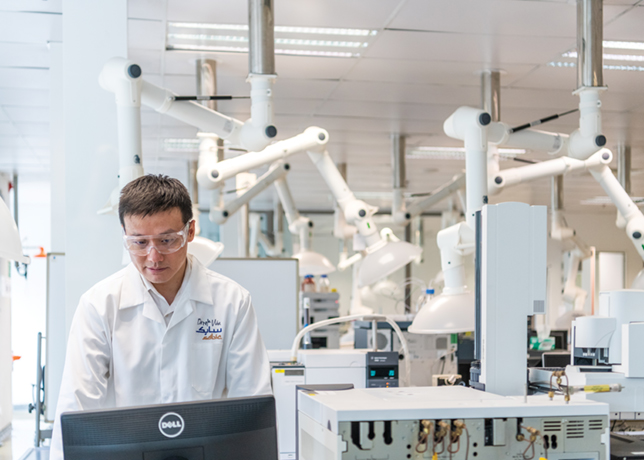




WORDS like bioengineering and nanotechnology a few years back would have brought to mind a science fiction book or film; however, now those are just a couple of the emerging technologies being employed at Saudi Aramco’s Research and Development Centre in Dhahran.
Throughout the complex, cutting-edge science and technology are being applied to many challenges the company faces, from crude-oil desulphurisation and bioremediation of contaminated soil to fuel blending for future engines and corrosion-resistant coatings.
The centre houses a mini-refinery, an internal- combustion-engine research facility and even a DNA lab, all to support company activities – both upstream and downstream, at present and in the future, Aramco says.
After ideas and new processes are tested in the labs, many are tested in the field, and if those tests are successful, the advances may be applied companywide.
In the centre’s Biotechnology Group, bacteria and microbes are explored to find ways to inhibit corrosion, enhance oil recovery, control spill damage and even reduce crude-oil sulphur content.
The focus of attention is a special one-cylinder internal combustion research engine at the R&D Centre’s Petroleum Fuel Combustion Lab. The engine can be set up in a variety of different ways to examine fuels and fuel additives so the company can prepare its products for new fuel formulations.
The group’s microbiologists analyse DNA molecules to characterise bacteria and determine their effects on crude oil. Using a multi-step process to extract and purify DNA, it can be copied and identified. Then, biotech processes can be devised to address a variety of challenges.
Bacteria that produce sulphides in reservoirs have been controlled in the past through use of biocides, but now they also can be inhibited through biocompetition by “good” bacteria.
At Hawtah Field, that research has been applied, and the biocides in use have been replaced with nitrates that allow benign bacteria to flourish in that subterranean environment. The “good” bacteria are encouraged and overpower the harmful, sulphur-producing strains.
The results have been impressive. Operating costs to treat the injected water at the field have plunged by about 40 percent, and water injectivity has improved by 15-20 percent. Hydrogen sulphide production by bacteria in the field has been virtually eliminated.
There are other bacteria that actually “eat” oil – not something you would want in an oil field but something that can be useful in cleaning up oil spills. That process is called bioremediation, and it can be used to treat contaminated soil without removing it for more traditional decontamination processes.
Bacteria that eat sulphur can be introduced in crude storage tanks in a process called biocatalytic desulphurisation that improves the quality of the oil and simplifies the refining process later on.
The centre also is studying microbes that could be used to “biocrack” crude oil, which would improve the crude quality and also could simplify later refining.
The R&D Centre’s analytical capabilities go far beyond microbial evaluation.
Chromotography, mass spectrometry, nuclear magnetic resonance spectroscopy, electron microscopy, X-ray fluoroscopy and plasma technology are used for detailed chemical analyses of materials, says Aramco.
These advanced analytical techniques are used to see the effects of the drilling activities on wells and to deeply analyse the catalysts used in Saudi Aramco’s refineries.
The centre has a project to characterise various grades of Arabian crude and analyse its components.
Crude oil consists of thousands of different compounds. A better understanding of these compounds is essential to much of R&D’s research. To date, it has categorised associated sulphur compounds and conducted the first detailed analysis of nitrogen compounds.
By gaining molecular insights into crude, the company can better use the kingdom’s energy stream and maximise the return on every barrel of product while cutting costs.
Chemical analysis has also led to improvements in hydrocracking now in use at Riyadh Refinery and is leading to the development of new, more efficient catalysts and more precise feedstock pre-treatment strategies.
Upstream, research has created better drilling fluids for gas reservoirs.
Nanotechnology deals with materials, the particles of which are approximately a billionth of a metre in size, and the centre’s Material Performance Group is looking at nanocoatings and how they can benefit Saudi Aramco.
Researchers say that the tiny particles form much stronger bonds than do larger particles of the same compounds, offering more effective corrosion protection and improvements in mechanical properties. Nanocoatings can be used to make rotating equipment, valves and heat-exchanger tubes more durable.
In the future, nano-technology may create fuel cells, gas separation membranes for desulphurisation processes and improved catalysts, Aramco adds.


