














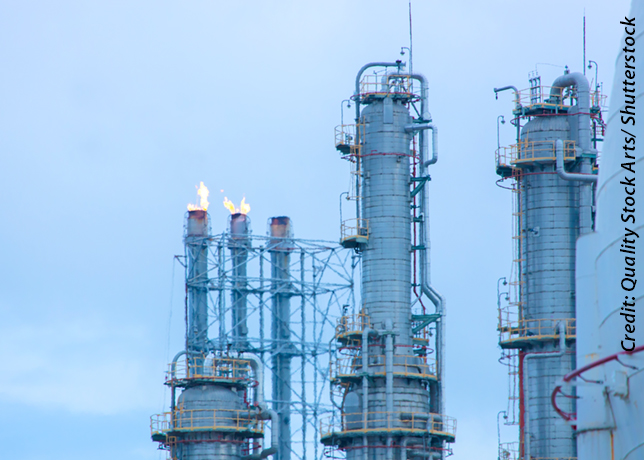
























AN ‘artificial lift’ installation is simply a method of increasing the flow of crude oil or water from a production well. Some wells contain sufficient pressure for oil to rise to the surface naturally. Most don’t, and even in those that are initially capable of providing unassisted flow the pressure will fall off over time, so requiring artificial lift.
There are a number of different artificial lift methods:
• Rod or beam pump;
• Electrical submersible pumps (ESP);
• Progressive cavity pumping (PCP);
• Hydraulic pumping; and
• Gas lift.
Other than installation and operating costs, there are a number of factors that determine the choice between these five basic artificial lift systems. Well productivity is important as well as reservoir pressure. There are also factors such as depth, well deviation and fluid viscosity that need to be considered.
The choice of artificial lift also varies according to region.
THE NEED FOR VFDS
Artificial lifting systems can be divided into two main parts:
* Downhole equipment, such as pumps, motors, downhole gauges etc;: and
* Surface equipment, such as the mechanical driving device or drive head, motor, pump off controller, VFD and data communication device
The VFD (variable frequency drive) performs a vital role in the artificial lift system by providing precise speed regulation of the motor. In Rod Pump, ESP and PCP applications the use of VFDs has been shown to optimize production by ensuring both maximum inflow from the well and optimal pumping speed – in some practical applications they have resulted in volume production increases of over 40 percent.
VFDs also reduce maintenance – resulting in less downtime and lost production – and reduce energy costs, with typical payback periods as low as 3 to 9 months.
INTEGRATED CONTROLLERS
VFDs installed in artificial lift applications are normally controlled by a separate pump-off controller that runs a dedicated software program for operating the different methods.
ABB has developed controllers that integrate the functions of a VFD and a pump-off controller in a single unit, eliminating the need for an additional external controller.
These controllers are designed specifically for the harsh environmental conditions encountered in the oil and gas industry, especially the high ambient temperatures in the Middle East. They are housed in robust enclosures and are suitable for use at temperatures up to +50°C.
The VFDs utilised in the controllers feature DTC (Direct Torque Control). This encoder-less technology is integrated with the control software so there is no need for external PLC or hardwired control logic.
The ABB controllers are available in versions tailored for each artificial lift application – Rod Pump, ESP and PCP – and they are fully compatible with most down-hole sensor equipment and are able to act as a data concentrator – collecting and feeding all data from well instrumentation to Scada systems – making them an ideal component for the creation of the new generation of smart fields.
COMBATING HARMONIC ISSUES
The growing number of VFD installations in oil fields has created concerns regarding their impact on the power quality of their electrical networks. In response, some operators are now specifying complex and expensive 18-pulse drives.
However, ABB offers a more elegant and cost-effective solution based on active front end low harmonic drives.
What are harmonics?
Harmonic distortion is a form of electrical pollution. According to the International Electrotechnical Commission (IEC), the level of harmonics is described by the total harmonic distortion (THD) and is expressed as a percentage of the total voltage or current.
Why are harmonics harmful?
Harmonics can cause overheating of cables, motors and capacitors while motors may also become noisy and suffer from vibration. Electronic displays and lighting may flicker, circuit breakers can trip, computers fail and meters give false readings.
How are harmonic currents created?
Harmonic currents and voltages are created by non-linear loads connected on the power distribution system. These include motor starters, computers and other electronic devices such as electronic lighting, welding supplies and uninterruptible power supplies and VFDs.
How can the effect of VFDs be reduced?
Harmonics can be reduced by modifications to the supply network and/or drive system and by using external filtering.
Three-phase PWM (pulse width modulation) drives normally feature a 6-pulse diode rectifier which is rugged, robust and cheap, but the input current contains high amounts of low order harmonics. The 12-pulse rectifier connects two 6-pulse rectifiers in parallel, giving a smoother current waveform. 18-pulse and 24-pulse rectifiers are formed similarly by connecting three or four 6-pulse rectifiers.
USING AN ACTIVE IGBT RECTIFIER
An active IGBT (insulated gate bipolar transistor) rectifier can control the power from the supply network. This allows the power factor to be maintained close to unity, as the rectifier is actively modulated to reduce harmonic overtones.
At first, the active IGBT rectifier can as a more expensive solution than the diode rectifier. However, in comparison with other equipment intended to address harmonic issues, such as external harmonic filters, 12-pulse, 18-pulse and 24-pulse drives that also require specialized pulse transformers and complex cabling, the active IGBT represents the most cost-effective option, as well as providing a more simple and compact system architecture.
The ABB IGBT rectifier also provides superior performance. Typically an 18-pulse VFD solution will reduce THD to around 10 per cent. However, an ABB low harmonic VFD with an active IGBT front end can deliver a THD of less than 5 per cent. Furthermore, the unity power factor helps improve network power quality.