



































SAUDI Arabia’s decision to call a halt to major new oilfield developments has added to concerns about long-term global oil supply, following indications that Russia’s plans to boost its crude output had hit the buffers.
The Saudi moratorium on net increases in capacity from 2009 onwards comes after a period of unprecedented investment in the kingdom’s upstream oil industry, and the oil minister’s argument that there is little sense in committing resources to developing capacity that may ultimately be unnecessary is not unreasonable.
However, the decision will add grist to the mill of peak oil theorists, who will no doubt argue that it reflects Saudi Arabia’s own anxieties about the sustainability of its oilfields.
The oil minister, Ali Al Naimi, says in an interview that once the current programme of lifting capacity to 12.5 million barrels per day (mbpd) is completed in 2009, there will be a pause before any major new projects are undertaken.
Saudi Arabia’s oil production strategy has for many years been based on maintaining about 2mbpd of spare capacity to be deployed in the event of sudden disruptions to global supplies. The kingdom is currently producing about 9mbpd. Naimi says that most projections of world oil demand growth now pointed to a slowdown, and he suggested that Saudi capacity of 12.5mbpd was likely to be sufficient up to 2020.
It had previously been assumed that Saudi Arabia would consider a second phase of expansion projects to bring capacity up to 15mbpd by the end of the next decade. World oil demand is currently about 86mbpd, and is projected by the International Energy Agency (IEA) to increase by just over 1 per cent per year on average up to 2030. In order to satisfy extra demand of this magnitude, production would need to rise by some 20mbpd across the world. Saudi Arabia, which accounts for one-fifth of global oil reserves, would be expected to make a major contribution to filling the gap.
However, the IEA’s current projections for long-term demand are significantly lower than its earlier forecasts, and there is a growing consensus in the oil industry that demand could well peak at around 100mbpd owing to supply constraints, high prices and the development of viable alternatives.
Naimi emphatically rejects the notion that the recent surge in oil prices means that Opec should supply more crude to the market now. As far as Opec is concerned there is plenty of oil available, and the price is being pushed up as a result of the headlong flight of global investors into commodity futures.
The Saudi expansion programme started in 2004, after it had become apparent that previous estimates of global oil demand were about 3mbpd short of what was actually being consumed.
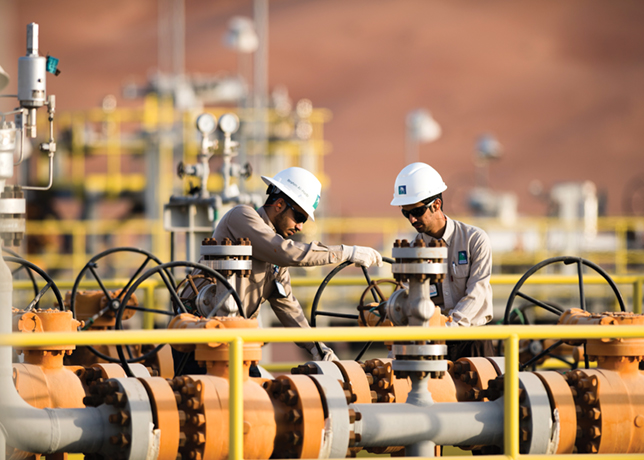
Saudi Aramco, the national oil company, was able to make swift progress with its new upstream projects because most of them are based on reviving operations in fields that had been initially discovered in the 1950s and 1960s, but which had either been mothballed or left dormant because there was sufficient output from other fields.
Earlier plans to move ahead with some of these projects were also affected by budgetary constraints during the 1990s when the oil market was volatile, with prices touching a low of $10/b in 1998.
The sharp rise in oil prices since 2003 has meant that Saudi Aramco faced no such constraints in financing its current crop of development projects, even though costs of materials and services have gone through the roof.
The first major project to come on stream will be the 500,000-bpd Khursaniyah field. Its start-up has been delayed by several months, but the speed of its execution still compares very favourably with similar-sized projects elsewhere in the world. Early next year a 250,000-bpd expansion of the Shaybah field in the Empty Quarter is scheduled to come on stream (it is not clear whether plans to add a further 250,000 bpd will now go into effect), and Khurais, with capacity of 1.2mbpd is scheduled to follow by the end of 2009. Work is also going ahead on the 900,000-bpd Manifa project, but Naimi indicates that this is considered as a replacement for output declines elsewhere, rather than a net addition to capacity.
Saudi Arabia’s ability to continue to play the role as the linchpin of the global industry has been challenged by a small band of dissenters. The most outspoken is Matthew Simmons, an investment banker, who has conducted exhaustive research of historical source material on the state of Saudi Arabia’s reservoirs and reached the conclusion that the kingdom’s five major fields – which account for some 90 per cent of total production – are nearing exhaustion and that production will soon start to decline drastically.
Simmons has put himself forward as the Cassandra of the global oil industry, but his analysis is hard to verify or conclusively to debunk given the reluctance of Saudi Aramco to open up its current data resources and the reticence of the company’s pre-nationalisation partners (Chevron, Texaco and ExxonMobil—whose shares were taken over in 1979) to make any comment based on their extensive knowledge of Saudi reservoirs. Simmons bases his analysis in his 2005 book, Twilight in the Desert, on the lack of major new oilfield discoveries in Saudi Arabia since the 1960s and on the increasing use of water injection to sustain production in the older fields, in particular Ghawar.
A more measured, and perhaps ultimately more credible, dissenting view has come from Sadad Al-Husseini, who retired from his position as senior executive for exploration and production at Saudi Aramco in 2005.
Husseini has rejected any suggestion that Saudi oil production has peaked, and he has described the current target of increasing capacity to 12.5mbpd as realistic. However, he has made clear in a number of media interviews and conference speeches that he foresees serious problems in sustaining production at significantly higher levels in the future.
If the revised demand projections on which Naimi is basing his strategy are correct, there should be little cause for concern as regards the sustainability of Saudi output.


