







































SAUDI Arabia’s Minister of Petroleum and Mineral Resources Ali Al-Naimi reaffirms that Saudi Arabia is committed to the availability of petroleum to global markets, especially for developing and emerging countries, pointing out that this pledge is backed by concrete plans and actions, and by the commitment of some $70 billion for capital projects.The deepest recession in 80 years complicates the energy scene, he says.
“This current environment is a sharp contrast indeed to the rapid and sustained economic growth witnessed between 2003 and 2007, when global GDP gains experienced their fastest four-year growth periods in 20 years. Nowhere was this prosperity trend more evident than in Asia, as its economic ascension and parallel growth in energy demand signalled an Eastern shift of the world energy market’s gravity centre. However, just as globalisation contributed to Asia’s rising fortunes, the economic unravelling that began with the sub prime mortgage disaster and subsequent banking and credit crises in the West in mid-2008 has observed no geographic boundaries.
“This global downturn is exerting a profound effect on the entire continent of Asia, from the Pacific Rim in the East to the Red Sea in the West. Asia’s impressive economic growth statistics, rooted in its purchasing power, robust trade and consumption, and generous percentage of world central bank reserves, have declined sharply in response to lack of investment capital and slowed global demand. This reversal is clear confirmation that the economic fortunes of our continent and its people are intertwined”, he says.
The drying up of liquidity to fund projects underpinning economic growth in emerging and developing economies has been a significant consequence of the recession. This impact on investment is of great concern, notably for energy-sector projects adversely affected by oil price volatility and lower demand for oil, when long-range commitments of adequate and timely investment flows are needed to ensure future supply.
Oil prices and energy security remain at the top of the international agenda as major, long-term challenges that must be urgently addressed by consumers and producers.
 |
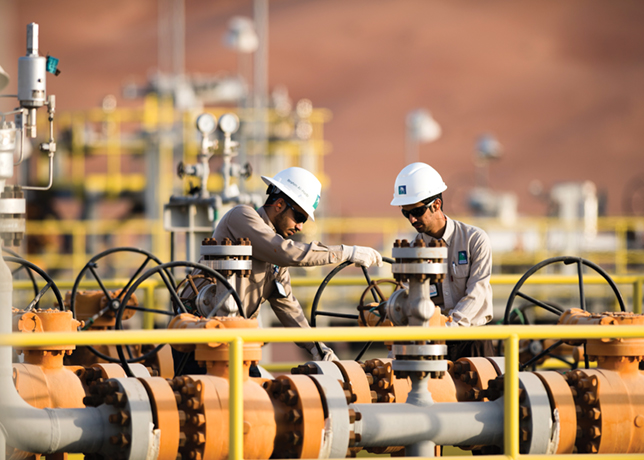
Aramco will continue to play its role |
Just in the past year, oil prices took the world by surprise with the great speed in which they rose, and in recent months, they again stunned with their spectacular fall. Just as no one anticipated oil prices would climb to their unprecedented height of $147 per barrel last summer, the precipitous price drop below the $40 mark has likewise been a shock.
“Both price extremes have been unjustified and unsustainable, and such continued volatility poses serious risk. I have often cautioned that if prices remain too low for too long, they can carry the seeds of future price spikes and volatility. The bitter yield of such seeds is the danger of impeded recovery, inadequate supplies for the world’s economic engines, and a vicious cycle of price instability,” he says.
Clearly it is in everyone’s best interests to explore avenues that can contribute to price stability and foster an investment climate that serves the interests of producers and consumers alike; does not limit the prospects of developing nations that need affordable energy for their economic and social goals; incentivises developed nations to conserve energy; and creates an environment conducive to the development of all viable energy sources.
“Our efforts should include open discussion of factors and issues that influence energy demand, and can possibly impinge on the willingness and ability of producers to plan long-range investments for finding and producing energy resources, and to commit research and development to energy technologies and processes, including innovations that enhance recovery of more challenging resources. I believe that we should champion science and technology to enable solutions that enhance energy efficiency and sustainability. I also believe we must renew our commitment to greater transparency by sharing information on policies, statistics and projections, and improving their accuracy, including our support of the Joint Oil Data Initiative development,” he says.
Such cooperation and coordination are essential to capacity-building among energy importers and exporters. Such multilateral cooperation must also overcome persistent challenges to energy security. One such energy-market challenge is artificial fear, with pessimism about oil supplies and production capacity, unfounded by scientific or economic basis, fostering a perception of scarcity; this very negativity contributed to the oil-price spike. Whether the doubt is rooted in misperceptions of supply adequacy, geographic origin or environmental footprint, such negativity is both unwarranted and harmful, he says.
Energy independence, whatever its motivation, is much easier said than done; the very interdependent nature of our global economy, as observed in this recession, means that no nation can hope for full energy self-sufficiency.
Such misperception must be addressed through the understanding that all viable resources will have a role in the future energy mix, but that fossil fuels inescapably and rightly have a part in that mix. Indeed, fossil fuels will continue to meet some 80 per cent of the world’s energy needs for the foreseeable future. Petroleum is a proven, reliable, affordable and safe energy source whose accessibility and sustainability continually increase, thanks to the industry’s emphasis on research and development, and its greater focus on energy efficiency and conservation. Oil will remain indispensable to global energy demand throughout the first half of this century, if not far beyond.
“For some observers, the energy pessimism is tied to a great optimism that alternative energies can handily circumvent oil’s leading role. While we expect alternative fuels to grow, their economic and social competitiveness will hinge on their passing financial, technical, social and other tests, and on the development of their infrastructures and markets. Until that time, they will supplement fossil fuels, not supplant them,” he says.
Given the importance of oil to the functioning of modern society, its role in economic growth and recovery, and future demand that is expected to double the call on fossil fuels, including oil, by 2050, it is vital that producers and consumers alike commit to strengthening global energy trade, investment and cooperation to enhance the flow from production to consumption.
The worldwide recession is slowing industrial growth rates around the world, and the oil industry is no exception; it is feeling the full effects of the financial crisis. However, Saudi Arabia remains committed to its massive expansion programme to raise our production capacity to 12.5 million barrels per day. This significant spare production capacity will mitigate any future shortages. The kingdom has also made an unprecedented commitment to expand its refining capacity, both at home and abroad, to help correct the imbalances between crude-oil quality and refining configurations.
The petroleum industry is a long-range business, with project horizons necessarily spanning decades into the future. Such investment reflects the kingdom’s commitment, despite current economic conditions, to implement its business strategy and infrastructure development plans to help ensure long-term market stability and availability of energy supplies.


