































GHAWAR remains the world’s largest oil field 70 years after its discovery. Its size and continuity were not initially apparent, but a series of early exploration wells, now called the Magnificent Five, put the pieces of the puzzle together.
Amid the important commercial oil discoveries of Dammam (1938), Abu Hadriyah (1940) and Abqaiq (1940), geologists were exploring surface features to get a better picture of the potential of the Eastern Province.
While mapping the surface outcrops, geologists Ernie Berg and Max Steineke excitedly identified a broad, low-relief dome (called an anticline). Subsequent exploration established that this En Nala anticline at Haradh continued northward all the way to Ain Dar and Shedgum and was filled with oil.
Ghawar helped catapult Saudi Arabia into its role as the world’s leading oil producer. The super-giant field is 280 kilometres in length and consists of five contiguous oil fields from north to south: Ain Dar, Shedgum, Uthmaniyah, Hawiyah and Haradh.
Ain Dar No 1: After World War II and with the resumption of drilling, the most obvious location to resume wildcat drilling was the Ain Dar structure because of its proximity to producing facilities at Abqaiq. Ain Dar No 1 was drilled in 1948 and flowed oil to the surface during testing. It was put on production in early 1951 and is still producing today with the original well casings.
This well has been producing for more than 58 years with the aid of best-in-class reservoir management practices. It has produced 152 million barrels of oil and is still producing 2,100 barrels per day (bpd).
Haradh No 1: In 1949, Aramco engineers initially wanted to drill a step-out well, Ain Dar No 2, about 12 km to the south of Ain Dar 1. Instead, a second wildcat was drilled 185 km to the south at Haradh. At that time, no one openly suggested that the En Nala anticline would prove to be one continuous field 280 km long and up to 30 km wide. That possibility became very real when the Haradh No 1 wildcat struck oil in 1949.
The Haradh well was nearly 200 km south of Ain Dar production facilities and, therefore, was not brought on stream until 15 years later. Haradh No 1 was put in production in 1964 but shut down during the mid-1980s because of low demand. In 1990, after acid stimulation, it resumed production.
Today, 44 years after its first production, Haradh No 1 has produced more than 24 million barrels of oil and continues to produce at a rate of 2,300 bpd.
Uthmaniyah No 1: Uthmaniyah No 1 was important in establishing that the En Nala anticline was oil-filled between Ain Dar and Haradh. This wildcat well was successfully drilled and tested in 1951. As with the other Ghawar wells, oil gravity was in the range of 33 degrees API (Arabian Light Crude).
Uthmaniyah No 1 was brought on stream in 1956 and has since produced more than 20 million barrels of oil. Located on the eastern flank of Uthmaniyah, close to the water, this well was the first of the discovery wells to employ water shutoff techniques to limit water production.
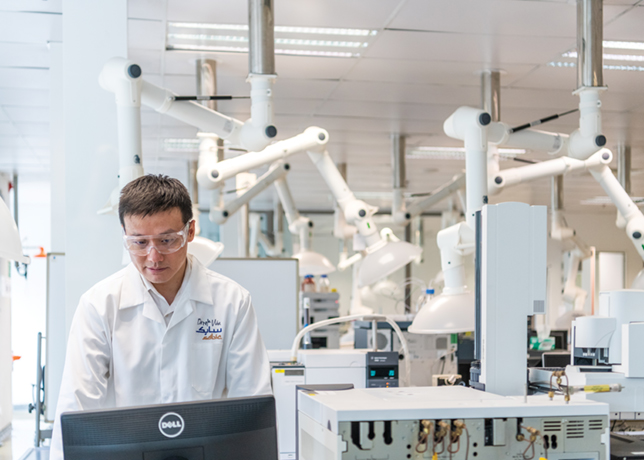
In 1995, a comprehensive 3D seismic campaign was conducted across the Ghawar field. The equipment used is a stark contrast to the early exploration team.
Shedgum No 1: The Shedgum No 1 discovery well was drilled in 1952 to delineate the En Nala anticline to the east of Ain Dar. The well struck oil in the Arab-D carbonate and was later brought on stream in 1954.
In 1968, the wellbore rock matrix was acidised to improve the flow of oil from the carbonate formation. In 1989, liners were run across the open hole to address future water encroachment.
Recently, the oil production rate was enhanced greatly for Shedgum No 1 by recompleting the well with a horizontal sidetrack complemented with inflow control device (ICD) technology. Not only was the oil rate increased to more than 3,700 bpd, but the water cut has also been lowered significantly.
Shedgum No 1 has produced more than 98 million barrels of oil over the past 55 years, and the application of new technologies will keep it producing for many years to come.
Hawiyah No 1: The final discovery well of the magnificent five was Hawiyah No.1, which confirmed that Ghawar held oil between ‘Uthmaniyah and Haradh. Drilling was completed in 1953, and the well was put on stream in 1966, when the Hawiyah Field was developed. The well received an acid stimulation treatment in 1977. With Saudi Aramco’s superior reservoir management practices, Hawiyah No 1 has produced 51 million barrels of oil, and continues to produce today at 4,600 bpd.
Since the discovery of the Ghawar field in 1948, Saudi Aramco has implemented best-in-class reservoir management practices and leading technologies that have evolved over the years. As a result, the Magnificent Five have demonstrated extraordinary performance with extended lifecycles and outstanding oil recovery.
One of the first reservoir management initiatives was gas reinjection in Ain Dar. In 1958, King Saud ibn Abdulaziz inaugurated the gas injection facilities in Ain Dar. The primary purpose of the program was to reinject produced gas to sustain reservoir pressure. Gas injection began in 1959 and continued for 20 years.
Water injection began in Ghawar in 1964 to provide additional pressure support — to maintain reservoir capacity to push oil to the surface. That technology, known as secondary recovery, provided a stepwise improvement in pressure support and began the displacement of oil from the outer edges of the Ghawar field toward the central regions to sustain oil production, as demonstrated by the phenomenal performance of the discovery wells.
In 1995, a comprehensive 3-D seismic campaign was conducted across the Ghawar field. The seismic profiles provided vital information on reservoir structure and distribution of fractures, guiding development and recompletions across Ghawar. That information, for example, was used to guide the placement of the horizontal well trajectory for Shedgum No 1.
 |
|
Ghawar is the largest known oil field, |
The Ghawar discovery wells, Ain Dar No 1, Shedgum No 1, Haradh No 1 and Hawiyah No 1 are still producing today with the original well casings. That speaks to the quality of workmanship and materials that went into the original wells.
Altogether, the Magnificent Five have produced nearly 350 million barrels of oil. There’s no telling how much more they will produce — as the end of their story is not yet in sight.
Ghawar is the largest known oil field, not only in Aramco’s concession area, but in the world. If there is one thing that is more impressive than Ghawar’s size, however, it is its productivity. Along about the time this issue reaches its readers the field will be producing on the order of five million barrels of oil a day. Large as this figure is, however, the experts say it is modest when stacked up against Ghawar’s potential.
The northernmost portion of Ghawar field lies about 60 miles west of the Arabian Gulf port city of Dammam, which is a 20-minute drive north of Aramco’s headquarters community of Dhahran. From its northern extremity Ghawar extends southward some 150 miles as essentially one long continuous anticline, about 25 miles across at its widest point. Geologically, the field is categorised as a fairly simple structure with a complete closure, a typical Middle East reservoir of porous limestone and dolomite. The oil comes almost entirely from a producing zone known as Arab D, about 7,000 feet, on the average, below the surface.
Long before Ain Dar Well 1, the field’s discovery well, was spudded in in 1948, geologists had a pretty good idea of Ghawar’s potential. Along the whole piece of territory they could see, by means of detailed survey mapping, what they called “surface expression” of dips to the east and west.
Later, as small, portable “structure drilling” rigs probed the earth, it was confirmed that these dips followed a somewhat parallel course below the surface on either side. It took little ingenuity on their part for geologists to reason that if two opposite sides slope outward from each other there must be a rise in between them, and this rise might be an anticline containing oil.
These structure indications were so clearcut that it was possible to bypass on Ghawar the use of technically complex seismic means of oil exploration. Structure drilling told the geologists all they needed to know before they recommended going for broke with wildcats and then production drilling. Development/ delineation drilling is still the means in progress of exploring and fully defining the oil-bearing anticline that has long given Ghawar its preeminence.
Before it became clear that Ghawar was actually one big field, wildcat wells were drilled over a period of nearly nine years in widely separated areas along the recognised Ghawar structural trend. Wildcatting began with Ain Dar in the north, then moved to Haradh at the extreme southern end. Success at these two broadly removed locations led to “fill-in” wildcats at Uthmaniyah, Shedgum and Hawiyah. Ultimately, on February 21, 1957, Arab D oil was also discovered at Fazran, the most northerly protuberance of Ghawar. There are today some 300 producing wells altogether in these areas of the field.
The oil being produced carries up gas dissolved in it, which must be separated out in stages in big vessels called traps before the oil can be pumped any distance for processing or export. There are, so far, 25 of these gas-oil separator plants (GOSPs) distributed over Ghawar field, with more in various stages of construction. The jumbo of all these plants, functioning up in the northern section of the field, is Shedgum GOSP No 1, whose three pairs of traps operating in parallel together have a daily rated throughput capacity of 750,000 barrels of oil, piped in from wells producing in a surrounding area nearly 60 square miles.
After the two initial stages of pressure reduction, first down to 175 pounds per square inch and then to 50 psi, have been carried out in GOSPs at Ghawar, the oil with some gas still in it arrives by pipeline at Abqaiq, where stabilisers in the industrial area remove the corrosive and poisonous hydrogen sulphide initially present in all of Aramco’s inland crude, making that oil “sweet” and fit for transporting further through pipelines and aboard tankers.
 |
|
Monitoring the Shedgum oil field, |
Everyone concerned with production at Aramco is acutely aware that oil is a highly valuable natural resource which must be brought out of the ground with techniques that make it as certain as is economically possible that first-rate oil field practices are maintained.
Saudi Arabian oil happens to rise through wells to the surface under its own innate pressure, but after a field has been produced for a long time that fortuitous force tends to diminish. A great deal of Aramco’s best engineering talent concentrates exclusively on ways to maintain pressure in its fields by induced means.
In Ghawar this is accomplished by means of water, augmented in the Ain Dar area by gas. There exists in underground aquifers within the structure, but above the Arab D producing reservoir, water with such a high mineral content that it is completely unfit for human or animal consumption, or for agriculture.
Some of this water flows downward by gravity through injection wells connecting the aquifer directly with the reservoir. Additional nonpotable water is pumped to the surface from specially drilled water supply wells and then pumped down with considerable force into the producing reservoir. A properly designed system with optimum strategic placement of the injection wells will maintain the reservoir pressure somewhere near its original force. At the same time, the water introduced under pressure into the reservoir will “sweep” the oil in the direction of the production wells.
Everything connected with a pressure-maintenance program in a field the size of Ghawar must obviously be on a massive scale to be at all effective. For example, the field has a total of 94 injection wells and 32 water supply wells, and more are being drilled.
The pipelines which carry the great volumes of water for injection purposes must not only be huge in diameter but must have walls able to withstand extremely high pressures. No pumps previously existed in the marketplace large enough to handle all the water used in the injection programme at Ghawar, so Aramco had to go out and have such pumps specially designed and built. The results were 20,000-horsepower giants able to handle a half-million barrels of water a day at approximately 2,000-pounds-per-square-inch pressure.
The planning, construction and operation of oil-production and pressure-maintenance facilities in such fields as Ghawar represents a deliberate, coordinated effort to produce crude oil in Saudi Arabia at optimum conditions. It is common knowledge in informed circles that the volume of crude produced daily by Aramco’s fields, including Ghawar, is very substantial. While the company’s storage tank capacity is large, and growing, it would take very little time to overflow its tanks with current production.


