


















































Downtime in any industry is costly, but in the oil and gas sector, that expense can be magnified by market conditions.
According to Siemens in their ‘True Cost of Downtime’ report, as oil prices rise, so too does the hourly cost of downtime.
In moments of volatility, oil and gas companies must focus on maximising efficiency and productivity during outages.
Turnarounds for planned upgrades and maintenance or outages due to operational upset can last from a few days to several weeks or months.
Both result in downtime, where a facility is not producing product while paying their workforce and additional contractors to complete the maintenance.
When shutdowns and turnarounds face schedule disruptions, they can cost organisations millions more than anticipated.
Having tools that make your shutdowns and turnarounds efficient and effective, while keeping people safe, is one of the key strategies to adhering to schedule and staying on budget.
THE STATE OF WORKPLACE SAFETY
Connected safety solutions provider Blackline Safety conducted a third-party survey of 200 safety and operations leaders from around the world for a report about the state of workplace safety.
The findings revealed the patterns those leaders notice, where they’re choosing to invest, and how this relates to shutdowns and turnarounds.
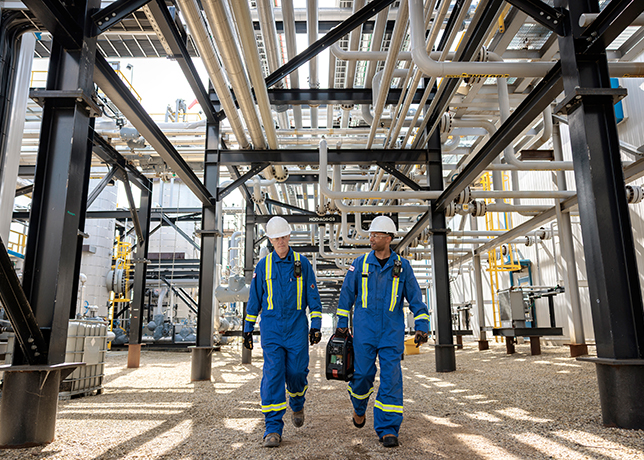
Technology plays an important role in worker safety during outages
OIL & GAS AMONG THE MOST FORWARD-LOOKING SECTORS
Within oil and gas organisations specifically, the survey found growing evidence that traditional safety metrics are no longer the sole focus.
• Only 59 per cent of oil and gas respondents actively track incident reports and near misses (versus 73 per cent overall).
• 49 per cent monitor recordable injuries and lost-time incidents (versus 65 per cent overall).
• 54 per cent assess root-cause analysis outcomes (versus 64 per cent overall).
Instead, there is a notable shift towards forward-looking approaches.
Nearly 48 per cent of oil and gas leaders report spending time on predictive analytics, significantly higher than the 33.5 per cent cross-industry average.
This reflects a broader move to anticipate and mitigate risk before incidents escalate, and a growing recognition that real-time visibility into worker safety can improve both safety outcomes and operational performance.
BUDGETS
Over the next two years, 95 per cent of safety budgets are expected to increase or remain at their current levels.
This is likely in part because 97 per cent of safety and operations leaders believe workplace safety is fundamental to reliable productivity.
One of the top budget priorities in the next two years is investing in new technology, with 30 per cent of safety and operations leaders planning to do so.
As demonstrated, technology plays a foundational role in worker safety, especially during periods of intense activity such as when operations are paused for maintenance.
EFFECT OF INCIDENTS ON PRODUCTIVITY
During turnarounds, additional lost time due to incidents can also extend already costly operations.
When there are workplace safety incidents, 53 per cent of them result in injuries that lead to lost time; another cost to your people, reputation, and bottom line.
Some 35 per cent of safety and operations leaders reported experiencing incidents that led to alarms and evacuations, resulting in even more schedule disruptions.
COMPLIANCE MADE EASY
Compliance is another major challenge during plant turnarounds.
While three-quarters of organisations reported having substantial visibility into contractor safety behaviours, only 68 per cent of contractors meet compliance expectations, compared to 84 per cent of regular staff.
Transforming the data gathered through contractor monitoring paves the way to holding contractors accountable for compliance and safety performance, but access to information is crucial.
Once again, the right technology can help companies achieve compliance goals while enhancing workforce safety and protecting their bottom line at the same time.
During shutdowns and turnarounds, connected safety technologies can provide critical insight into worker location, exposure to hazardous environments and emerging risks, enabling faster intervention when every minute matters.
Blackline Safety is a technology leader driving innovation in the industrial workforce through the Internet of Things (IoT).
With connected safety devices and predictive analytics, Blackline enables companies to shift towards increased safety and improved operational performance.
The company provides wearable devices, personal and area gas monitoring, cloud-connected software and data analytics to meet demanding safety challenges and enhance overall productivity for organisations.
With customers in more than 75 countries, Blackline provides a lifeline to tens of thousands of people, having reported over 336 billion data-points and initiated over eight million emergency alerts.