


































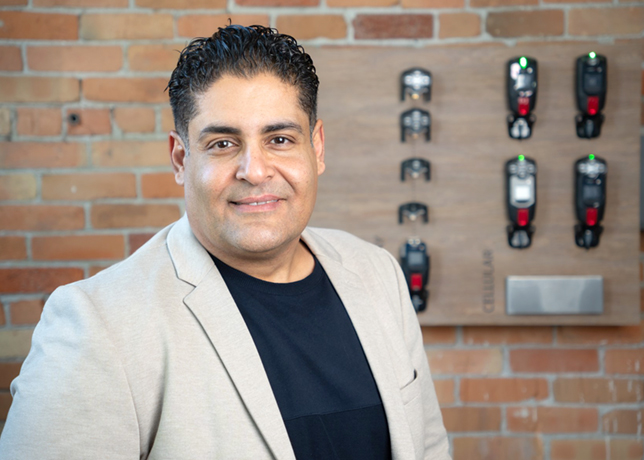
By Abdulaziz Khattak
Blackline Safety is reporting strong growth in fire and hazardous materials (hazmat) use as energy operators shift from traditional reactive models toward live operational awareness.
Fire responders now need instant visibility into evolving hazards to coordinate faster, more confident interventions.
Predictive analytics are increasingly reshaping fire-ground command, while real-time gas readings and plume modelling enable teams to assess community risk and plan evacuations earlier, helping them “get ahead of incidents rather than simply reflecting on reporting after the fact,” Samy Karam Gerguis, Blackline Safety’s Regional Sales Director for the Middle East, Turkey, and Africa, tells OGN energy magazine.
These same capabilities are extending into major-event security.
For fire departments, usability is becoming as critical as technical performance. Drop-and-go connectivity allows rapid deployment in high-pressure environments, and while cost and change management remain barriers, Gerguis argues the core value is clear: saving lives is “the best ROI there is”.
Below are excerpts from the interview:
Blackline Safety has seen a 42 per cent increase in fire and hazmat (hazardous materials) customers over the past year. What broader structural changes in industrial risk management and emergency response are driving this acceleration in connected safety adoption?
Industrial risk management is shifting from reactive safety models to real-time operational awareness.
When you’re managing increasingly complex environments and hazards, you need live visibility into what’s happening on the ground to make informed decisions and coordinate a faster response if anything goes wrong.
That’s driving adoption of connected safety technologies like Blackline’s personal and area monitors that combine gas and gamma radiation detection with live cloud connectivity to give you that live, detailed view of conditions as they evolve.
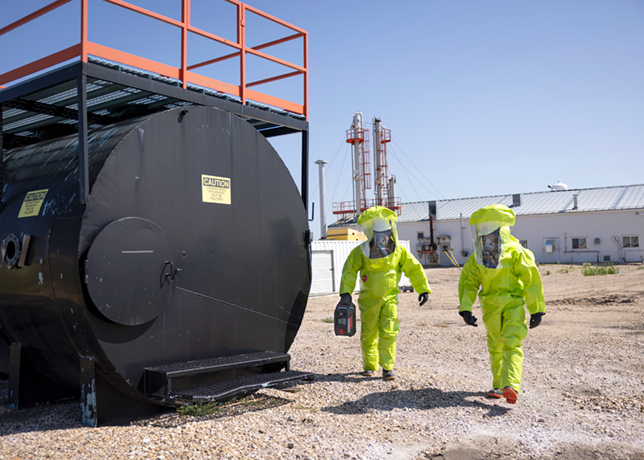
Fire responders need instant visibility into evolving hazards to coordinate faster, more confident interventions
Plume modelling and live gas readings enabled faster decision-making during a Canadian refinery incident. How do you see predictive analytics changing the traditional command structure of industrial emergency response over the next five years?
Companies are already embracing predictive analytics. It’s not something for the future, it’s happening right now.
In the case of that refinery incident, access to live gas readings and plume modelling meant the fire department was able to determine if the nearby neighbourhoods were at risk, and which areas might need evacuation.
Predictive information offers the time needed to communicate risk to the community, so fire and hazmat teams are using that real-time data to help them get ahead of incidents rather than simply reflecting on reporting after the fact.
Blackline’s deployment at the Milan-Cortina Winter Olympics suggests connected safety technologies are moving beyond industrial environments into public-security applications. How significant is this convergence between industrial safety and national-event security markets?
Both industrial safety and public-event security now depend on the same core capability: real-time situational awareness.
The tools used to protect compliance-driven industrial workplaces can be equally effective for large-scale event security.
Public safety requires full-scale visibility and discreet technology that doesn’t interrupt the experience, which is why devices like our EXO 8 portable area monitor have been invaluable at these events.
The Winter Olympics is obviously the peak of event security, and it was a great example of going beyond putting controls in place to taking advantage of real-time technology.
The G8 combines wearable gas detection with real-time communications capabilities in a single device. To what extent is the industry moving towards multifunctional connected-worker platforms rather than standalone safety equipment?
For Blackline, the ability to communicate in real time doesn’t feel like a separate application from monitoring hazards because if you can’t communicate when incidents or exposures happen, you only have part of a solution.
We also know that too many devices are a barrier to adoption, so the more multifunctional and connected tools and platforms are the more likely workers are to use them.
Organisations are moving away from isolated safety tools toward multifunctional, connected platforms because they reduce operational blind spots and function both in high hazard and operational scenarios.
True safety cultures evolve when all the pieces work together.
Fire departments emphasise deployment speed and operational simplicity. In high-risk energy and industrial environments, how important is usability becoming compared with purely technical performance specifications?
We hear this from our customers over and over: Our drop-and-go functionality is key because they need to be able to move fast.
In high pressure environments, they need to be able to quickly set up a rugged device that can withstand anything it might encounter and know it’s going to work, and stay connected.
Fire chiefs have told us that enhancing the safety of their personnel is key to their success and usability is an important part of that.
Cloud-connected monitoring is a way to reduce uncertainty during hazardous incidents. What are the main barriers preventing wider adoption of fully connected safety ecosystems across the energy and industrial sectors?
Any organisation that’s had a fatality or near-miss immediately sees the value in getting real-time information during an incident so they can act faster.
Saving lives is the best ROI there is, and Blackline devices have saved a lot of lives.
Any barriers to wider adoption are the same as they are for any technology — change management, cost — so it becomes about being able to prove that the technology will give you the certainty you need, when you need it.
With growing geopolitical instability and increasing concern over critical infrastructure resilience, do you expect demand for integrated gas and radiation monitoring solutions to rise significantly in the coming years?
Many markets are facing new and growing threats, and the more information teams have access to, and the greater visibility they can have into exposure and worker safety status, the more effective decisions they can make with their workers and the public in mind.
And it spans from gas and gamma detection, to air monitoring using plume modelling, to accessible, remote, real-time data made available to experts who could be providing guidance while being connected from across the world.
Blackline increasingly frames safety technology as a contributor to operational efficiency and productivity rather than solely regulatory compliance. How is this changing the way energy companies evaluate return on investment for safety-related capital expenditure?
Safety beyond compliance is our number one concern, but we know that efficiency and productivity go hand in hand with safety.
In a recent study we commissioned of global safety and operations leaders we found 97 per cent agree that workplace safety is fundamental to reliable productivity.
Where companies might be shifting how they evaluate ROI when making capital safety investments is the fact that multifunctional tools can live both in Safety and Operations budgets.
Any investment that reduces incidents that lead to lost time is a clear line to ROI. Maybe that’s why technology is one of the top five investment areas for safety leaders over the next two years.
How do companies with teams across the globe deal with different compliance requirements using the same technology?
The need to protect workers is universal, but of course the way organisations approach safety varies based on region, industry, and even culture.
As we continue expanding globally, we know it’s not just about exporting a product, but about understanding what matters to customers in each market.
The versatility of the Blackline ecosystem enables global clients to adapt depending on their compliance needs, and we’ve invested heavily in regional teams and partners to ensure customers receive local expertise and support.
As industrial facilities become more digitised and interconnected, how concerned should the energy sector be about cybersecurity risks within cloud-connected safety and monitoring platforms, and how can companies mitigate those vulnerabilities effectively?
The best way to mitigate cybersecurity vulnerabilities when it comes to connected safety platforms is to partner with companies that take your data as seriously as they take their own.
Blackline encrypts data at every stage between field devices and cellular carriers, undergoes annual SOC 2 Type II audits to ensure customer protection, and our Cloud is a fully independent software platform with each layer individually firewalled.
Tech companies must go the extra mile to protect customer information these days; without client trust, no one feels safe.