











































Across the Middle East, the transformation of infrastructure operating models between 2020 and 2050 is unfolding at scale, driven by expanding industrial capacity, urban population growth and severe climate pressures.
Electricity demand across the Middle East and North Africa has tripled since 2000 and is projected to rise by another 50 per cent by 2035 under current policy settings, with roughly 40 per cent of that growth generated by cooling and water desalination requirements alone.
Rather than choosing between economic growth and decarbonisation, regional leadership is pursuing both objectives concurrently, navigating severe operational heat, water stress and complex security environments.
This dual mandate demands unprecedented capital alignment, structural resilience and coordinated execution across energy, industrial and built environment sectors.
Drawing on a survey of 400 executives across the UAE, Saudi Arabia, Egypt, Qatar and Oman, complemented by expert interviews, the inaugural Siemens Infrastructure Transition Monitor report highlights a region defined by high ambition and distinct momentum.
Exactly 66 per cent of Middle East executives assert that the global energy transition must accelerate significantly, compared to 57 per cent globally.
Furthermore, 65 per cent of regional respondents report close collaboration between business and government on energy policy, exceeding the 59 per cent recorded outside the region.
Despite this momentum, regional executives maintain a measured assessment of current maturity, with an average of 40 per cent describing progress across 14 infrastructure transition goals as mature or advanced, compared with 50 per cent globally.
Rather than indicating institutional delay, this score demonstrates that high regional ambitions continually elevate performance benchmarks across electricity network expansion, national energy independence, large-scale energy storage deployment, systematic transmission expansion and core heavy industry decarbonisation and operational efficiency.
DEPLOYMENT OF AI & DIGITAL INFRASTRUCTURE ASSETS
To support strategic scaling, capital investment intentions across the region are heavily weighted toward digital technology adoption and operational decarbonisation.
Operational decarbonisation ranks as the primary priority for regional organisations over the next three years, contrasting with its seventh-place ranking globally.
Improving facility energy efficiency ranks second, while on-site renewable energy production or storage ranks third.
Furthermore, 70 per cent of regional entities maintain explicit targets for Scopes 1 and 2 direct and indirect emissions from controlled sources, whereas global target adoption stands at 58 per cent, while Scope 3 emissions targets cover 14 per cent of regional organisations.
Consequently, 62 per cent of regional enterprises are increasing investments in digital technologies, 61 per cent are accelerating decarbonisation efforts and 60 per cent are expanding investments in renewable energy, energy efficiency and facility electrification.
Some 68 per cent have identified digitalisation as critical.
Advanced data analytics and artificial intelligence (AI) applications form the core driver for these technological investments.
Across regional industries, 62 per cent of executives expect AI to transform operational models within three years, while 61 per cent use artificial intelligence to enhance critical infrastructure resilience.
When evaluating technologies expected to drive decarbonisation, AI solutions lead all categories: AI data analysis ranks highest at 38 per cent, followed by predictive analytics at 33 per cent and autonomous systems at 30 per cent.
Additional impactful solutions include digital twins and advanced simulation at 29 per cent, cloud computing at 29 per cent, virtual and augmented reality at 27 per cent, smart edge devices at 27 per cent, remote sensing and geospatial tools at 25 per cent, digital business platforms at 22 per cent and intelligent automation at 19 per cent.
Furthermore, 68 per cent of regional executives describe digitalisation as a critical transition enabler overall.
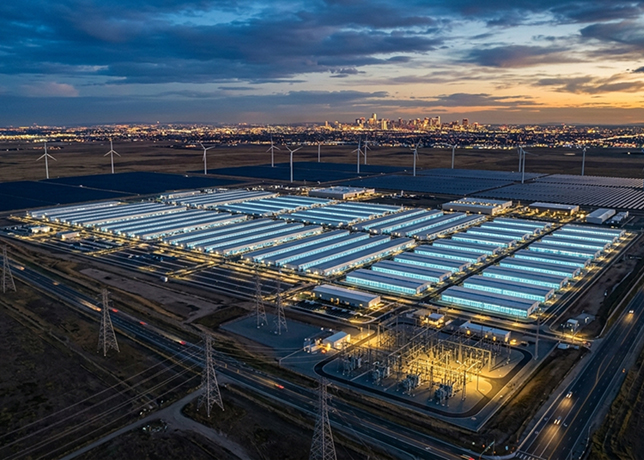
Data centres represent the leading edge of this digital shift, operating approximately five years ahead of standard commercial buildings on the innovation curve.
Facility design is evolving toward integrated artificial intelligence factories where microchip-to-grid optimisation defines operational competitiveness.
Machine learning (ML) models now assimilate historical operational and maintenance records from building and energy management systems, replacing fragmented human consensus with automated recommendation engines.
This algorithmic approach yields substantial improvements in decision speed, auditability and operational efficiency, where advancing efficiency from 94 per cent to 97 per cent generates substantial performance gains across continuous multi-facility operations.
Similar digital frameworks are expanding across commercial real estate, enabling developers to integrate energy, cooling and customer traffic data to anticipate maintenance requirements, prevent operational outages and optimise energy usage.
Data integration remains essential for these advanced analytical engines, although legacy infrastructure and sub-processes built over time across spreadsheets and manual platforms create adoption friction.
Consequently, 69 per cent of regional organisations state that smarter technologies are required for rapid data integration, while an identical 69 per cent plan increased investments in data integration technologies.
Concurrently, interest in autonomous systems is expanding, with 56 per cent of regional entities prepared to implement autonomous building technology and 57 per cent planning significant investments in autonomous capabilities over the coming year.
However, critical infrastructure deployments maintain human-in-the-loop oversight for high-level operational decisions, balancing automated efficiency with essential cybersecurity, regulatory compliance, risk oversight and continuous system auditability across regional industrial and commercial built assets.
GRID MODERNISATION, INTERCONNECTION & DEMAND-SIDE INTEGRATION
As electrification expands across transport, cooling and industrial operations, electricity networks have become the central constraint governing regional growth.
Power grid limitations are identified by regional respondents as the factor most likely to slow the clean energy transition, with 62 per cent stating that electrification is held back by inadequate grid infrastructure.
Electricity networks can no longer operate as static supply channels; they require real-time visibility, digital control and dynamic demand management.
Smart grid software and grid-edge digital technologies are recognised by 64 per cent of executives as crucial transition enablers, reflecting a movement toward managing power, gas, transport and hydrogen as a unified, coordinated system to support rising demand across expanding industrial corridors and urban centres regionally.
Major utilities are directing substantial capital toward converting traditional networks into intelligent digital platforms.
In Dubai, the local electricity and water authority is deploying an AED7 billion ($1.9 billion) smart grid programme through 2035 to modernise grid infrastructure.
Its distribution network smart centre ingests and analyses over 15 million data units daily, using AI and ML to provide diagnostic services, anticipate network issues and support automated operational decisions.
These digital grid capabilities allow utility operators to transition from reactive maintenance to predictive asset management, improving overall network reliability and ensuring grid stability as variable renewable energy sources and heavy industrial loads connect to distribution.
Parallel to grid upgrades, the relationship between utilities and major power consumers is becoming more collaborative.
Exactly 70 per cent of regional executives agree that increased data sharing between producers and consumers would significantly improve energy system efficiency, while 70 per cent plan to use organisational assets to profit from demand-side flexibility mechanisms.
Large consumers, including hyperscale data centres, ports and industrial clusters, are actively taking direct stakes in energy delivery value chains and behind-the-meter storage assets.
Rather than waiting passively for utility power allocation, major power users are sharing demand forecasts, phasing capacity requirements and participating in demand-response schemes to secure immediate energy access and support system stability.
Cross-border grid connections are expanding to enhance regional energy security and enable cross-border power trading.
The Gulf Cooperation Council Interconnection Authority has linked the 400-kV electricity networks of Bahrain, Kuwait, Oman, Qatar, Saudi Arabia and the UAE since 2009 across seven substations, using a back-to-back HVDC converter station to connect the 50 Hz regional grid with Saudi Arabia’s 60 Hz system.
Building upon this inter-state model, a 3-GW electricity interconnector between Saudi Arabia and Egypt entered final testing in early 2026, spanning 1,350 km including Red Sea submarine cables.
This link establishes a major power corridor connecting the Middle East, North Africa and Europe, complemented by Egypt’s existing electricity exports.
STRATEGIC MODULARITY, OPERATIONAL SECURITY & FUTURE RESILIENCE
Beyond decarbonisation, infrastructure design is driven by extreme resilience imperatives. Regional operators manage severe heat, water scarcity, population growth and geopolitical security risks.
In response, asset architecture is shifting away from centralised facilities toward modular, decentralised and geographically dispersed assets.
Strategic dispersion enhances physical security while easing localised grid congestion and reducing single-point operational vulnerabilities.
Integrating structural redundancy alongside microgrids ensures that critical industrial operations, water treatment facilities and urban developments maintain continuous functionality during wider power system disruptions, ensuring operational continuity across complex environmental conditions and evolving regional security environments operating parameters.
Agile digital infrastructure provides the foundation required to maintain business continuity during operational disruptions.
Pre-existing digital integration, unified data platforms and remote systems allow real estate developers and infrastructure managers to execute real-time adjustments, maintaining uninterrupted community services and operational output throughout external shocks.
This agility demonstrates that digital transformation functions as a direct driver of institutional stability and risk management, rather than merely carbon tracking.
Regional competitiveness will depend on deploying connected digital intelligence, executing public-private coordination and building resilience directly into physical and digital infrastructure architectures systemwide.